
Written by: Rona Castañeda
Professionally reviewed and edited by: Chantal Santacaterina
Bachelor of Science (Psychology & Human Bioscience) (Honours), Victoria University
Clinically reviewed on: 16 June 2026
LinkedIn: Profile
Senior Consultant Psychologist, Clinical Content Reviewer
Chantal Santacaterina is a Senior Consultant Psychologist and clinical reviewer for Therapy Near Me. She reviews selected educational and service content for clinical accuracy, consumer readability, and alignment with contemporary psychological practice.
What Is a Mental Health Crisis?
A mental health crisis is any situation where a person’s emotional or psychological distress becomes severe enough that they may be at risk of harm or unable to cope safely.
According to Healthdirect, crises may include suicidal thoughts, self-harm, extreme anxiety or panic, severe emotional distress, or sudden deterioration in mental wellbeing requiring urgent support. (Healthdirect Australia)
Common warning signs may include:
- suicidal thoughts or talking about wanting to die
- recent self-harm or suicide attempt
- feeling unable to stay safe if alone
- severe agitation, panic or emotional overwhelm
- sudden withdrawal or feelings of hopelessness
- drastic changes in behaviour or mood
Suicide Call Back Service notes that warning signs can appear in behaviour, mood or communication, and they should always be taken seriously. (Suicide Call Back Service)
When to Call Emergency Services (000)
In Australia, Triple Zero (000) should be called if a situation is immediately life-threatening or someone is at imminent risk.
Examples include:
- a suicide attempt or self-harm requiring medical attention
- someone has taken an overdose
- the person is unconscious or severely intoxicated
- violent behaviour or inability to ensure safety
- the person has a clear suicide plan and may act immediately
Healthdirect and Beyond Blue both emphasise that emergency services should be contacted when someone is in immediate danger. (Healthdirect Australia) (Beyond Blue)
If you are unsure whether the situation is serious enough, it is safer to seek emergency help than delay.
National Mental Health Crisis Support Services
If a situation is urgent but not an immediate emergency, several free Australian crisis support services are available 24 hours a day.
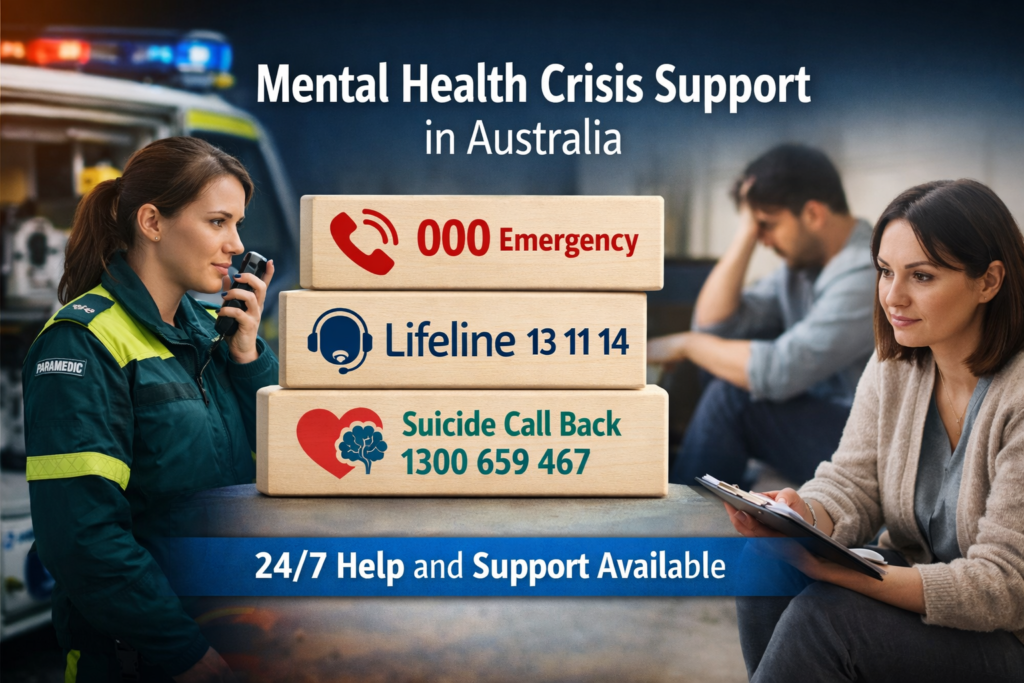
Lifeline – 13 11 14
Lifeline provides 24-hour crisis counselling by trained volunteers and professionals.
Support is available via:
- phone counselling
- text support
- online chat
Lifeline supports people experiencing distress, suicidal thoughts, or emotional crisis. (Healthdirect Australia)
Suicide Call Back Service – 1300 659 467
Suicide Call Back Service provides free nationwide counselling to:
- people thinking about suicide
- people worried about someone else
- people bereaved by suicide
- individuals experiencing severe emotional distress
The service operates 24/7 and offers phone and online counselling. (Suicide Call Back Service)
Beyond Blue Support Service – 1300 22 4636
Beyond Blue provides support for people experiencing anxiety, depression, or emotional distress.
Services include:
- telephone counselling
- online chat
- moderated online forums
Beyond Blue advises contacting 000 for emergencies and using their support line when urgent emotional support is needed. (Beyond Blue)
What to Do If You Are in Crisis
If you are experiencing severe distress or suicidal thoughts, the following steps can help increase immediate safety.
1. Assess Immediate Safety
If you feel unable to stay safe or believe you may act on suicidal thoughts, call 000 or go to the nearest emergency department. (Healthdirect Australia)
2. Contact a Crisis Support Service
If it is not an immediate emergency, call a crisis service such as Lifeline or Suicide Call Back Service to speak with a trained counsellor.
These services are confidential and available 24 hours a day. (Healthdirect Australia)
3. Reduce Isolation
If possible, tell a trusted person that you are struggling and ask them to stay with you or remain on the phone.
Connection can reduce the intensity of crisis thinking and provide support until professional help is accessed.
4. Increase Immediate Safety
If suicidal thoughts are present, practical safety steps may include:
- moving away from anything that could be used for self-harm
- avoiding alcohol or drugs
- staying in a safe environment
- keeping crisis numbers nearby
- continuing to talk to someone supportive
Safety-planning approaches promoted by Beyond Blue emphasise identifying warning signs, coping strategies, and emergency contacts in advance. (Beyond Blue)
What to Do If You Are Worried About Someone Else
If you believe someone may be experiencing a mental health crisis:
- Take the situation seriously — do not ignore warning signs.
- Stay with the person if possible, especially if risk appears immediate.
- Encourage them to seek help, such as calling Lifeline or their GP.
- Call 000 if you believe the person may harm themselves or cannot be kept safe.
Suicide Call Back Service specifically supports people who are concerned about a friend, family member, or colleague. (Suicide Call Back Service)
Crisis Support vs Ongoing Mental Health Care
Crisis helplines provide immediate emotional support and safety assistance, but they are not a replacement for ongoing mental health care.
Healthdirect explains that Australia’s mental health system includes GPs, psychologists, psychiatrists, community mental health services and hospital-based care. (Healthdirect Australia)
After a crisis, follow-up support may include:
- visiting a GP
- seeing a psychologist or counsellor
- reviewing medication with a doctor
- creating a safety plan
- involving family or support networks
Early follow-up support can reduce the risk of future crises.
When to Seek Help Even If It Is Not an Emergency
You do not need to wait until a crisis becomes life-threatening before asking for help.
Healthdirect recommends seeking support if mental health difficulties are significantly affecting daily life, work, relationships, sleep, or ability to cope. (Healthdirect Australia)
Examples include:
- worsening depression or anxiety
- increasing suicidal thoughts
- persistent hopelessness
- severe stress or emotional exhaustion
- substance use to cope with distress
Early intervention often leads to better outcomes than waiting until symptoms escalate.
Preparing a Crisis Safety Plan
A safety plan is a short, practical guide created during a calm period that outlines what to do during future crises.
According to Beyond Blue, effective safety plans often include:
- personal warning signs
- coping strategies that help reduce distress
- people who can provide support
- crisis support numbers
- steps to reduce access to means of harm
- emergency actions if safety becomes uncertain
Digital tools such as the Beyond Now safety planning app are designed to help people create and access these plans quickly during distress. (Beyond Blue)
If You Need Help Right Now
If you are experiencing a crisis or feel unsafe:
Emergency:
Call 000
Crisis counselling:
Lifeline — 13 11 14
Suicide support:
Suicide Call Back Service — 1300 659 467
Mental health support:
Beyond Blue — 1300 22 4636
These services are available across Australia and operate 24 hours a day.
References
Beyond Blue 2026, Urgent help, Beyond Blue, viewed 11 March 2026,
https://www.beyondblue.org.au/get-support/urgent-help
Beyond Blue 2026, Suicide safety planning, Beyond Blue, viewed 11 March 2026,
https://www.beyondblue.org.au/mental-health/suicide-prevention/suicide-safety-planning
Healthdirect Australia 2026, Mental health crisis support , Healthdirect, viewed 11 March 2026,
https://www.healthdirect.gov.au/mental-health-crisis-support
Healthdirect Australia 2026, Mental health helplines, Healthdirect, viewed 11 March 2026,
https://www.healthdirect.gov.au/mental-health-helplines
Healthdirect Australia 2026, Mental health: where to get help, Healthdirect, viewed 11 March 2026,
https://www.healthdirect.gov.au/mental-health-where-to-get-help
Healthdirect Australia 2026, Australian mental health services, Healthdirect, viewed 11 March 2026,
https://www.healthdirect.gov.au/australian-mental-health-services
Suicide Call Back Service 2026, About Suicide Call Back Service, Suicide Call Back Service, viewed 11 March 2026,
https://www.suicidecallbackservice.org.au/
Suicide Call Back Service 2026, Learn about suicide warning signs, Suicide Call Back Service, viewed 11 March 2026,
https://www.suicidecallbackservice.org.au/worried-about-someone/learn-about-suicide-warning-signs/