
Introduction
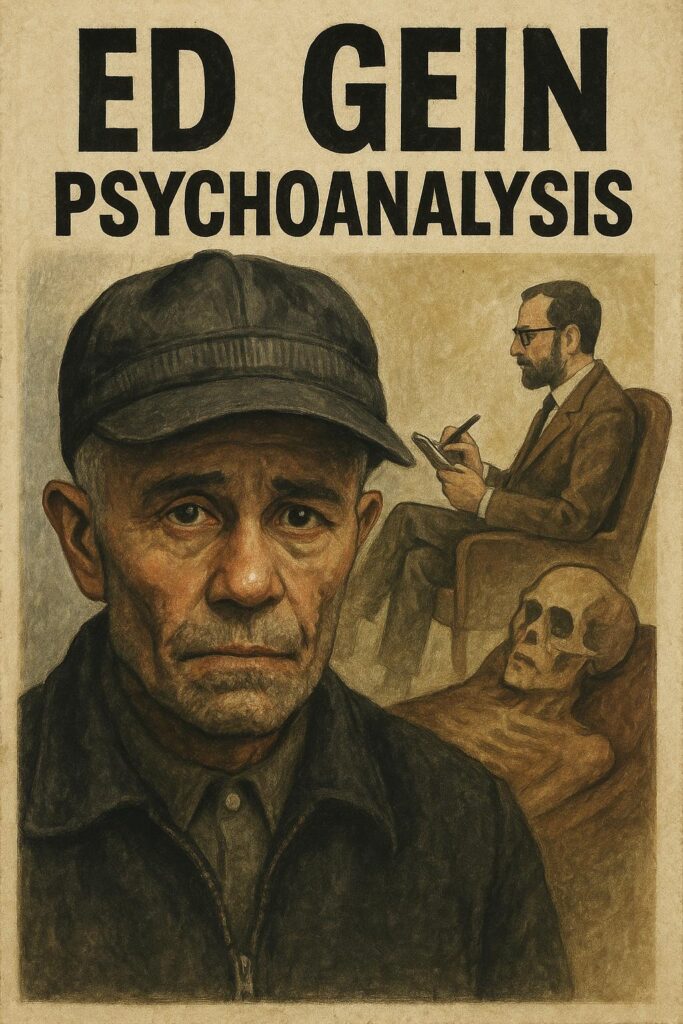
The name Ed Gein occupies a singular place in criminology and popular culture. His crimes in rural Wisconsin (1950s) influenced fictional characters in Psycho, The Texas Chain Saw Massacre, and The Silence of the Lambs. Yet public fascination often outpaces scholarship, amplifying myths and obscuring clinical questions. What can psychoanalytic and forensic psychology frameworks responsibly say about Gein’s inner world? Where must we refrain from certainty?
This extended review synthesises credible case material with contemporary theory. We examine developmental history, attachment disruptions, bereavement and isolation, possible psychotic processes, and paraphilic/compulsive features, while highlighting the limits of retrospective analysis (Schechter, 1989; Ressler, Burgess & Douglas, 1988; American Psychiatric Association, 2013).
1) Case overview and evidentiary boundaries
- Context: Gein lived a socially isolated life in Plainfield, Wisconsin, on a decrepit farm after the deaths of his abusive alcoholic father and, later, his domineering and moralistic mother.
- Discovery: In 1957, police searches uncovered human remains sourced from grave‑robbing and at least two murders.
- Legal outcome: He was judged legally insane and confined to a state hospital following competency and insanity proceedings.
Limits of inference: Detailed psychiatric files are not fully public; much of what we “know” derives from press accounts and later true‑crime reporting. Accordingly, we treat any psychodynamic formulation as hypothesis, not diagnosis (Schechter, 1989; Hickey, 2016).
2) Developmental risk factors: an attachment‑trauma lens
Maternal dynamics and introjection
Accounts describe Gein’s mother as rigid, shaming, and controlling, framing sexuality as corrupt. Psychoanalytic writers might view this as a template for pathological introjection—internalising a punitive, moralistic superego that is simultaneously idealised and feared (Freud, 1923/1961; Kernberg, 1984). Following her death, Gein exhibited complicated grief marked by shrine‑like preservation of rooms, suggesting ambivalent attachment—intense dependency with rage at separations.
Isolation, social skill deficits, and regression
Rural isolation, bullying, and limited peer bonding can foster developmental arrest. In object‑relations terms, loss of the primary object (mother) without adequate substitutes may precipitate regressive defenses—magical thinking, denial, and omnipotent control over the object (Kernberg, 1984). Contemporary trauma frameworks similarly link chronic adversity with dysregulated affect and disturbed self/other representations (van der Kolk, 2014).
3) Bereavement and the search to undo loss
From a psychodynamic perspective, Gein’s post‑bereavement behaviour can be read as an attempt at “undoing” separation. Grave exhumations and crafting from remains—while also explicable via psychosis or paraphilia—fit a symbolic effort to recreate or merge with the lost object (mother), collapsing boundaries between self and other. Melanie Klein’s concept of manic reparation—a frantic, omnipotent attempt to repair the damaged object—offers one hypothesis for ritualistic behaviours after maternal loss (Klein, 1940/1975).
Caveat: These interpretations are theoretical and cannot substitute for clinical assessment.
4) Psychopathology: what frameworks fit—and what doesn’t
4.1 Psychotic features
Contemporaneous reports and later summaries indicate delusional thinking and impaired reality testing. In DSM‑5 terms, possibilities include schizophrenia spectrum or delusional disorder; however, late‑onset psychosis triggered by bereavement and isolation also fits some patterns (American Psychiatric Association, 2013). Clinically, his insanity ruling signals that evaluators judged major mental disorder impairing mens rea.
4.2 Paraphilic and compulsive elements
Some behaviours implicate paraphilic disorders (e.g., necrophilic interests) and obsessive‑compulsive traits (ritualised collecting/arranging), though direct evidence is fragmentary. Modern forensic texts caution against collapsing disparate behaviours into a single label; mixed presentations are common (Ressler, Burgess & Douglas, 1988; Kafka, 2010).
4.3 Psychopathy?
Contrary to media portrayals, fragments of testimony suggest blunted affect and social oddity rather than the glib charm and instrumental aggression typical of high psychopathy scorers (Hare, 2003). A plausible reading is low extraversion, high social withdrawal, plus severe thought disorder—distinct from the prototypical psychopathic profile.
5) Cultural scripts, gender, and the “skin” motif
Pop‑culture retellings often overstate the “skin suit” narrative. Symbolically, psychodynamic writers have likened such motifs to efforts at identity repair: donning a new “skin” to achieve maternal fusion or ward off annihilation anxiety. From a cognitive‑behavioral angle, repeated practices can become negatively reinforced rituals, temporarily reducing unbearable affect and therefore persisting despite consequences. Both views underscore function over sensationalism.
6) Forensic formulation: a multi‑axial hypothesis (non‑diagnostic)
Predisposing: Adverse childhood experiences; authoritarian, shaming caregiving; social isolation; limited peer attachment.
Precipitating: Maternal death; bereavement; progressive withdrawal; onset/worsening of psychotic ideation.
Perpetuating: Reinforcement from rituals; avoidance of social scrutiny; rural isolation; limited treatment engagement.
Protective (minimal): Occasional community contact; eventual law‑enforcement intervention leading to psychiatric containment.
This formulation resembles modern biopsychosocial models rather than a single‑cause explanation (Meloy, 1997; Hickey, 2016).
7) Media myths vs. archival realities
- Myth inflation: Later films/books amalgamated multiple offenders into a composite “serial killer” image, retrofitting Gein into tropes he only partly matches.
- Archival constraint: Primary psychiatric evaluations remain partially inaccessible; reliance on secondary sources risks drift.
- Takeaway: Responsible analysis distinguishes documented fact from cultural layering (Jenkins, 1994; Schechter, 1989).
8) Treatment and management (historical context)
Mid‑20th‑century U.S. state hospitals offered custodial care, rudimentary psychopharmacology (post‑1950s antipsychotics), and basic psychotherapy. For a patient with severe psychosis plus violent behaviour, the standard then was long‑term inpatient management with emphasis on safety. Contemporary practice would add structured risk assessment, trauma‑informed care, and multidisciplinary treatment—but these were limited at the time (APA, 2013; Meloy, 1997).
9) What psychoanalysis adds—and where it stops
Psychoanalysis can illuminate symbol formation, mourning, and defensive operations (splitting, denial, omnipotence). Yet it cannot—without direct clinical access—determine diagnoses or moral culpability. The most defensible conclusion is multiplicity: intersecting grief, psychosis, isolation, and possible paraphilic rituals within a unique biographical context.
FAQs
Was Ed Gein a psychopath?
Psychopathy requires a pattern of remorseless interpersonal exploitation and charm not clearly evidenced in Gein. Available material points more to psychosis and social withdrawal than classic psychopathy (Hare, 2003; Hickey, 2016).
Why is Gein linked to so many horror films?
His case provided vivid imagery that storytellers adapted and embellished, blending traits from multiple offenders into marketable archetypes (Jenkins, 1994).
Can psychoanalysis explain Gein’s behaviour?
It offers hypotheses (grief, identity repair, introjection) but cannot replace clinical diagnosis or case‑file evidence.
What role did his mother play psychologically?
Accounts suggest intense dependency and moralistic shaming. After her death, behaviours may reflect attempts to undo loss and regain contact with the “idealised/punitive” object (Kernberg, 1984; Klein, 1940/1975).
References
- American Psychiatric Association (2013) Diagnostic and statistical manual of mental disorders (DSM‑5). 5th edn. Washington, DC: APA.
- Freud, S. (1961) The Ego and the Id. Standard Edition, Vol. 19 (orig. 1923). London: Hogarth.
- Hare, R.D. (2003) Manual for the Hare Psychopathy Checklist–Revised (PCL‑R). 2nd edn. Toronto: Multi‑Health Systems.
- Hickey, E.W. (2016) Serial Murderers and Their Victims. 7th edn. Boston: Cengage.
- Jenkins, P. (1994) Using Murder: The Social Construction of Serial Homicide. New York: Aldine de Gruyter.
- Kafka, M.P. (2010) ‘Paraphilia‑related disorders: Controversies in the DSM‑5 era’, Annual Review of Clinical Psychology, 6, pp. 391–405.
- Kernberg, O.F. (1984) Severe Personality Disorders: Psychotherapeutic Strategies. New Haven: Yale University Press.
- Klein, M. (1975) ‘Mourning and its relation to manic‑depressive states’ (orig. 1940), in The Writings of Melanie Klein, Vol. 1. London: Hogarth.
- Meloy, J.R. (1997) The Psychopathic Mind: Origins, Dynamics, and Treatment. Northvale, NJ: Jason Aronson.
- Ressler, R.K., Burgess, A.W. & Douglas, J.E. (1988) Sexual Homicide: Patterns and Motives. Lexington, MA: Lexington Books.
- Schechter, H. (1989) Deviant: The Shocking True Story of Ed Gein, the Original Psycho. New York: Pocket Books.
- van der Kolk, B.A. (2014) The Body Keeps the Score. New York: Viking.