
Introduction
A Behaviour Support Plan (BSP) is an evidence-based framework designed to reduce challenging behaviours and improve quality of life for individuals across a variety of contexts, including disability support, education, and mental health care. BSPs are especially important in supporting people with developmental disabilities, autism, and complex behavioural needs (Carr et al., 2002). They are widely used within the National Disability Insurance Scheme (NDIS) in Australia and internationally as part of positive behaviour support approaches.
This article explores the purpose of behaviour support plans, their psychological foundations, implementation strategies, and mental health outcomes.
1. What is a Behaviour Support Plan?
A behaviour support plan is a written document that outlines strategies for:
- Understanding the function of challenging behaviours.
- Teaching alternative, positive behaviours.
- Modifying the environment to reduce triggers.
- Ensuring consistency of support across caregivers, educators, and clinicians.
BSPs are typically developed collaboratively by psychologists, behaviour practitioners, families, and support staff.
2. Psychological foundations
BSPs are grounded in applied behaviour analysis (ABA) and principles of operant conditioning (Skinner, 1953). Key concepts include:
- Functional Behaviour Assessment (FBA): Identifying the antecedents, behaviours, and consequences that maintain problem behaviour (O’Neill et al., 1997).
- Positive reinforcement: Encouraging desirable behaviours by rewarding them.
- Skill building: Teaching communication and coping strategies to replace maladaptive behaviours.
- Environmental modifications: Adjusting settings to minimise stressors and triggers.
3. Core components of a Behaviour Support Plan
Effective BSPs generally include:
- Functional behaviour assessment results.
- Proactive strategies to prevent triggers.
- Reactive strategies for safely responding to behaviours.
- Teaching plans for skill development.
- Crisis management protocols where necessary.
- Data collection methods for monitoring progress.
4. Implementation and consistency
Implementation requires training and collaboration among all stakeholders. Consistency is essential: inconsistent application of strategies can reinforce problem behaviours rather than reduce them (Horner et al., 2000). BSPs should be living documents, regularly reviewed and updated.
5. Benefits for mental health and wellbeing
BSPs improve not only behaviour but also mental health outcomes:
- Reduce anxiety by creating predictable routines.
- Improve communication and social interaction.
- Enhance self-regulation and coping skills.
- Reduce the need for restrictive practices, supporting autonomy and dignity (Gore et al., 2013).
By addressing the causes rather than just the symptoms of behaviour, BSPs contribute to long-term wellbeing.
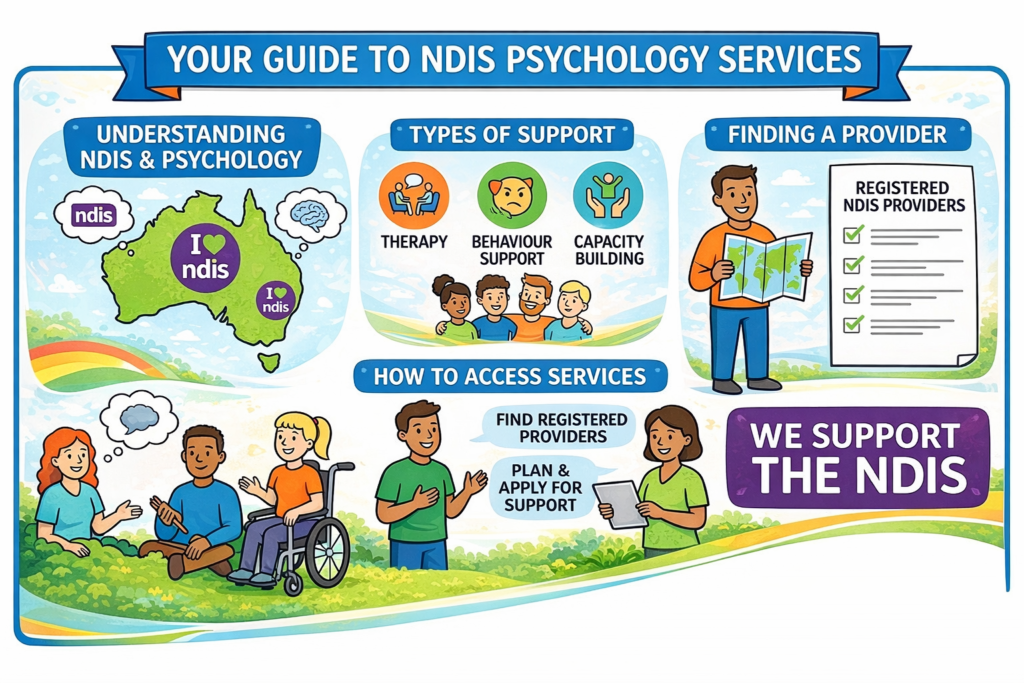
6. Behaviour support within the NDIS context
In Australia, the NDIS Commission regulates behaviour support to ensure plans comply with best practice. Registered behaviour support practitioners must develop BSPs that align with human rights and minimise restrictive practices (NDIS Commission, 2021). This ensures that BSPs focus on positive, proactive support.
7. Challenges in practice
- Resource limitations: Time and funding can restrict proper assessment and implementation.
- Staff training needs: Effective use requires training for carers, teachers, and support workers.
- Cultural considerations: BSPs must be tailored to individuals’ cultural and family contexts.
FAQs
Q: What is the purpose of a behaviour support plan?
To reduce challenging behaviours by identifying their causes and teaching positive alternatives.
Q: Who develops a behaviour support plan?
Usually psychologists or behaviour practitioners, in collaboration with families and support teams.
Q: How do BSPs help mental health?
They reduce anxiety, improve coping skills, and foster independence.
Q: Are behaviour support plans required under the NDIS?
Yes, for participants with behaviours of concern, BSPs are required to guide safe and ethical support.
References
- Carr, E.G., Horner, R.H., Turnbull, A.P., Marquis, J.G., McLaughlin, D.M. et al. (2002) Positive Behavior Support: Evolution of an Applied Science. Washington, DC: American Association on Mental Retardation.
- Gore, N.J., McGill, P., Toogood, S., Allen, D., Hughes, J.C. et al. (2013) ‘Definition and scope for positive behavioural support’, International Journal of Positive Behavioural Support, 3(2), pp. 14–23.
- Horner, R.H., Carr, E.G., Strain, P.S., Todd, A.W. & Reed, H.K. (2000) ‘Problem behavior interventions for young children with autism: A research synthesis’, Journal of Autism and Developmental Disorders, 30(6), pp. 451–467.
- NDIS Commission (2021) Behaviour Support. Available at: https://www.ndiscommission.gov.au/
- O’Neill, R.E., Horner, R.H., Albin, R.W., Sprague, J.R., Storey, K. & Newton, J.S. (1997) Functional Assessment and Program Development for Problem Behavior. Pacific Grove, CA: Brooks/Cole.
- Skinner, B.F. (1953) Science and Human Behavior. New York: Free Press.