
Written by: Therapy Near Me Editorial Team
Clinically reviewed by: qualified members of the Therapy Near Me clinical team
Last updated: 21/01/2026
This article is intended as general information only and does not replace personalised medical or mental health advice. Learn more about our Editorial Policy.
Attention Deficit Hyperactivity Disorder (ADHD) and Autism Spectrum Disorder (ASD) are two neurodevelopmental conditions that share some similarities but also have distinct characteristics. Both conditions can significantly impact an individual’s social, academic, and occupational functioning. This article explores the key differences, overlaps, and strategies for managing ADHD and ASD, drawing on scientific research and clinical insights.
1. What is ADHD?
ADHD is a neurodevelopmental disorder characterised by persistent patterns of inattention, hyperactivity, and impulsivity that interfere with functioning or development (American Psychiatric Association, 2013). It is typically diagnosed in childhood but can persist into adulthood.
Core Symptoms of ADHD:
- Difficulty sustaining attention.
- Impulsivity and acting without thinking.
- Hyperactivity, such as excessive movement or inability to stay seated.
ADHD affects approximately 5–7% of children worldwide (Polanczyk et al., 2014), with symptoms often continuing into adulthood.
2. What is ASD?
ASD is a developmental condition characterised by challenges in social communication and interaction, as well as restricted and repetitive behaviours or interests (American Psychiatric Association, 2013). ASD exists on a spectrum, meaning the severity and type of symptoms can vary widely among individuals.
Core Symptoms of ASD:
- Difficulty with social communication and understanding social cues.
- Restricted, repetitive patterns of behaviour or interests.
- Sensory sensitivities, such as hypersensitivity to sounds or textures.
ASD affects about 1 in 100 individuals globally, with diagnosis rates increasing as awareness and diagnostic tools improve (World Health Organization, 2022).
3. Differences Between ADHD and ASD
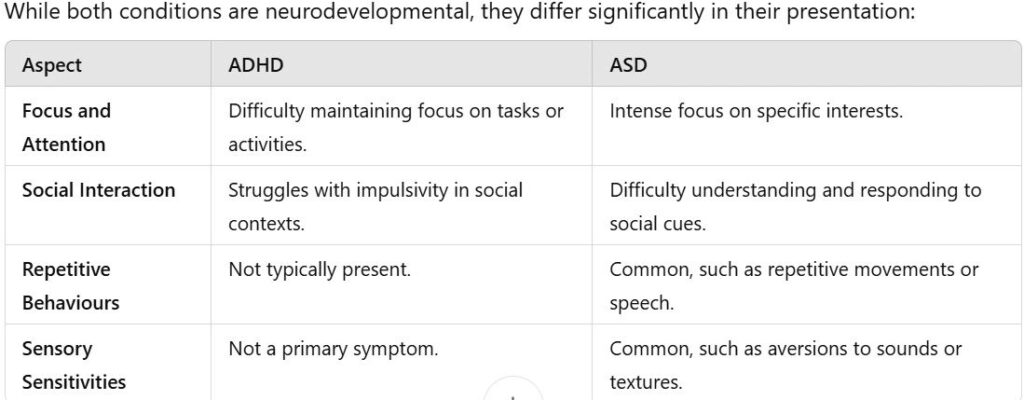
As shown the Table above, ADHD is often characterised by difficulty maintaining attention and impulsivity in social settings, while ASD features include challenges in social understanding and repetitive behaviours. Recognising these differences is critical for accurate diagnosis and tailored intervention.
ADHD and ASD are both neurodevelopmental disorders that differ significantly in their presentation. Individuals with ADHD often struggle with maintaining focus on tasks or activities, a challenge tied to deficits in attention regulation (American Psychiatric Association, 2013). Conversely, those with ASD typically display intense focus on specific interests, often referred to as “restricted interests” (Hyman, Levy & Myers, 2020). Social challenges also differ: ADHD is characterised by impulsivity, which can hinder appropriate social interactions, while ASD involves difficulties in understanding and responding to social cues, often resulting in more profound social communication deficits (Lord, Elsabbagh, Baird & Veenstra-Vanderweele, 2018). Repetitive behaviours, such as stereotyped movements or speech, are a hallmark of ASD but are not commonly observed in ADHD (Hyman, Levy & Myers, 2020). Additionally, sensory sensitivities, such as strong aversions to certain sounds or textures, are prevalent in ASD but are not considered a core feature of ADHD (Robertson & Baron-Cohen, 2017). These distinctions highlight the importance of comprehensive assessments to ensure accurate diagnosis and effective interventions for each condition.
4. Overlaps Between ADHD and ASD
There are several overlapping traits between ADHD and ASD, making differential diagnosis challenging:
- Executive Functioning Deficits: Both conditions can involve difficulties with planning, organisation, and emotional regulation.
- Social Challenges: Individuals with ADHD may struggle with social norms due to impulsivity, while those with ASD may face challenges understanding social cues.
- Comorbidities: Anxiety and sleep disturbances are common in both conditions.
Research suggests that 20–50% of individuals with ASD also meet the criteria for ADHD, highlighting the complexity of distinguishing between the two conditions (Leitner, 2014).
5. Diagnosing ADHD and ASD
A thorough assessment by qualified professionals is essential for accurate diagnosis. This process often includes:
- Detailed developmental history.
- Standardised diagnostic tools such as the DSM-5 criteria.
- Observations across multiple settings, such as home and school.
Misdiagnosis can occur due to overlapping symptoms, which is why a comprehensive evaluation is critical.
6. Managing ADHD and ASD
Management strategies should be tailored to the individual’s specific needs and may include:
For ADHD:
- Medication: Stimulants like methylphenidate are commonly prescribed to improve attention and reduce impulsivity (Faraone et al., 2021).
- Behavioural Therapy: Focuses on developing organisational skills and managing impulsivity.
- Parent and Teacher Training: Helps create supportive environments.
For ASD:
- Behavioural Interventions: Applied Behaviour Analysis (ABA) and social skills training can improve communication and reduce repetitive behaviours (Dawson et al., 2010).
- Sensory Integration Therapy: Helps individuals manage sensory sensitivities.
- Speech and Occupational Therapy: Supports communication and daily living skills.
7. Supporting Individuals with ADHD and ASD
- Early Intervention: Both conditions benefit from early diagnosis and intervention.
- Individualised Support: Tailoring strategies to the individual’s strengths and challenges ensures better outcomes.
- Inclusive Environments: Creating supportive settings in schools and workplaces fosters development and reduces stigma.
Conclusion
While ADHD and ASD share some overlapping traits, they are distinct conditions that require specific diagnostic and management approaches. Understanding these differences and similarities is essential for providing effective support. With early intervention, tailored strategies, and ongoing research, individuals with ADHD or ASD can lead fulfilling lives.
References
- American Psychiatric Association. (2013). Diagnostic and Statistical Manual of Mental Disorders (5th ed.). Arlington, VA: American Psychiatric Publishing.
- Dawson, G., et al. (2010). Early behavioral intervention is associated with normalized brain activity in young children with autism. Journal of the American Academy of Child & Adolescent Psychiatry, 49(11), pp. 1150-1161.
- Hyman, S. L., Levy, S. E., & Myers, S. M. (2020). Identification, evaluation, and management of children with autism spectrum disorder. Pediatrics, 145(1), e20193447. doi:10.1542/peds.2019-3447
- Faraone, S. V., et al. (2021). The world federation of ADHD international consensus statement: 208 evidence-based conclusions about the disorder. Neuroscience & Biobehavioral Reviews, 128, pp. 789-818.
- Leitner, Y. (2014). The co-occurrence of autism and attention deficit hyperactivity disorder in children – what do we know? Frontiers in Human Neuroscience, 8, p. 268.
- Lord, C., Elsabbagh, M., Baird, G., & Veenstra-Vanderweele, J. (2018). Autism spectrum disorder. The Lancet, 392(10146), 508-520. doi:10.1016/S0140-6736(18)31129-2
- Robertson, C. E., & Baron-Cohen, S. (2017). Sensory perception in autism. Nature Reviews Neuroscience, 18(11), 671-684. doi:10.1038/nrn.2017.112
- Polanczyk, G., et al. (2014). The worldwide prevalence of ADHD: A systematic review and meta-regression analysis. American Journal of Psychiatry, 171(6), pp. 606-614.
- World Health Organization. (2022). Autism spectrum disorders. Retrieved from https://www.who.int/news-room/fact-sheets/detail/autism-spectrum-disorders
How to get in touch
If you or your NDIS participant need immediate mental healthcare assistance, feel free to get in contact with us on 1800 NEAR ME – admin@therapynearme.com.au.