
Written by: Rona Castañeda
Clinically reviewed by: Qualified members of the Therapy Near Me clinical team
Last updated: 11 June 2026
This clinical information has been written by Rona Castañeda to support accuracy, clarity, and alignment with contemporary psychological practice. Content is reviewed in accordance with our Editorial Policy and is intended as general information only. It does not replace individual assessment, diagnosis, or treatment.
Content type: Health education (Australia)
Introduction
Ecotherapy, also known as nature immersion therapy, is a holistic mental health practice that integrates exposure to natural environments with psychotherapeutic techniques. Emerging from the principles of biophilia (Wilson, 1984), which suggests humans have an innate need to connect with nature, ecotherapy has gained evidence-based support for improving mental health outcomes including stress reduction, anxiety relief, and enhanced mood (Bratman et al., 2019).
This article reviews the psychological mechanisms, health benefits, and practical approaches to ecotherapy, offering a comprehensive, resource grounded in scientific research.
1. What is Ecotherapy?
Ecotherapy encompasses structured activities that intentionally connect people with nature to promote wellbeing. Core practices include:
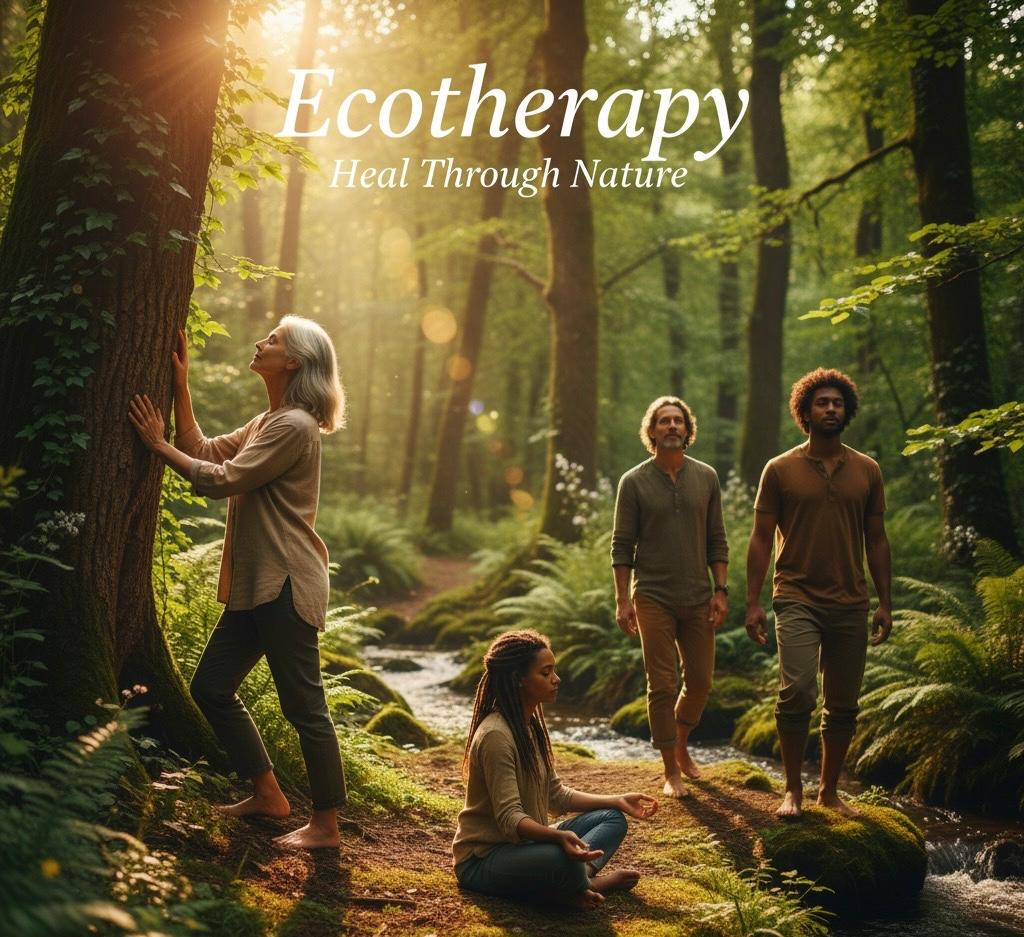
- Forest bathing (Shinrin-yoku): Mindful walking in natural forests.
- Horticultural therapy: Gardening and plant care for therapeutic purposes.
- Animal-assisted therapy: Healing interactions with animals in outdoor settings.
- Adventure therapy and wilderness programs: Structured group activities in nature to build resilience and social skills.
These approaches can be used in clinical mental health settings, community programs, or as personal wellness practices.
2. Psychological and physiological mechanisms
a) Stress reduction and mood regulation
Contact with nature reduces cortisol levels and activates the parasympathetic nervous system, producing relaxation and improved mood (Park et al., 2010).
b) Attention restoration
The Attention Restoration Theory posits that natural settings replenish cognitive resources depleted by urban environments, improving focus and creativity (Kaplan & Kaplan, 1989).
c) Connectedness and meaning
Nature immersion fosters feelings of awe and interconnectedness, which are linked to greater life satisfaction and purpose (Howell et al., 2011).
3. Evidence-based mental health benefits
Stress and anxiety
Clinical trials show significant decreases in anxiety and stress after forest bathing sessions and nature walks (Kotera et al., 2021).
Depression
Systematic reviews indicate ecotherapy can reduce symptoms of mild to moderate depression, with some effects comparable to standard psychological interventions (Bragg & Atkins, 2016).
Cognitive and emotional benefits
Nature exposure has been linked to better working memory, attention, and emotional regulation, supporting recovery from mental fatigue (Bratman et al., 2019).
Social wellbeing
Group-based nature programs enhance social connection and community belonging, protective factors for mental health (Corazon et al., 2019).
4. Ecotherapy in clinical and community practice
Ecotherapy can be integrated into:
- Formal psychotherapy: Therapists may conduct sessions outdoors to harness the calming effects of nature.
- Hospital and rehabilitation programs: Incorporating gardens and outdoor spaces to aid recovery.
- Preventive mental health: Community gardening and nature walks to promote resilience and early intervention.
In Australia, ecotherapy aligns well with NDIS plans and community mental health initiatives that prioritise holistic, non-pharmacological approaches.
5. How to practise ecotherapy
- Daily nature walks: Spend at least 20–30 minutes in green spaces.
- Gardening or urban greening: Engage in planting and caring for plants at home or in community gardens.
- Mindful outdoor meditation: Combine mindfulness with natural surroundings for enhanced relaxation.
- Join guided forest bathing or eco-retreats: Participate in structured sessions led by trained facilitators.
6. Safety, accessibility, and cultural considerations
Ecotherapy is generally safe, but considerations include:
- Sun protection and hydration during outdoor sessions.
- Accessibility for people with mobility challenges, which can be addressed by designing inclusive nature trails.
- Respect for Indigenous cultural practices and land management traditions.
FAQs
Q: What is ecotherapy?
A therapeutic approach that uses nature immersion to support mental health and wellbeing.
Q: How does ecotherapy improve mental health?
By lowering stress hormones, improving mood, and restoring attention and emotional balance.
Q: Is ecotherapy evidence-based?
Yes. Studies show benefits for depression, anxiety, and cognitive function.
Q: How can I start nature immersion therapy?
Begin with regular walks in green spaces, gardening, or guided forest bathing sessions.
References
- Bragg, R. & Atkins, G. (2016) A Review of Nature-Based Interventions for Mental Health Care. Natural England Commissioned Reports, Number 204.
- Bratman, G.N., Anderson, C.B., Berman, M.G. et al. (2019) ‘Nature and mental health: An ecosystem service perspective’, Science Advances, 5(7), eaax0903.
- Corazon, S.S., Sidenius, U., Poulsen, D.V., Gramkow, M.C. & Stigsdotter, U.K. (2019) ‘Psychological stress and restoration in nature-based therapy: A prospective cohort study’, International Journal of Environmental Research and Public Health, 16(10), pp. 1705–1717.
- Howell, A.J., Passmore, H.A. & Buro, K. (2011) ‘Meaning in nature: Nature connectedness as a pathway to meaningfulness’, Ecopsychology, 3(2), pp. 59–67.
- Kaplan, R. & Kaplan, S. (1989) The Experience of Nature: A Psychological Perspective. Cambridge: Cambridge University Press.
- Kotera, Y., Richardson, M., Sheffield, D. & Nishihara, K. (2021) ‘Nature-based guided imagery as a mental health intervention: A systematic review’, Frontiers in Psychology, 12, pp. 1–12.
- Park, B.J., Tsunetsugu, Y., Kasetani, T. et al. (2010) ‘The physiological effects of Shinrin-yoku (taking in the forest atmosphere or forest bathing): Evidence from field experiments in 24 forests across Japan’, Environmental Health and Preventive Medicine, 15(1), pp. 18–26.
- Wilson, E.O. (1984) Biophilia. Cambridge, MA: Harvard University Press.