
Written by: Rona Castañeda
Clinically reviewed by: Qualified members of the Therapy Near Me clinical team
Last updated: 06/11/2026
This clinical information has been written by Rona Castañeda to support accuracy, clarity, and alignment with contemporary psychological practice. Content is reviewed in accordance with our Editorial Policy and is intended as general information only. It does not replace individual assessment, diagnosis, or treatment.
Content type: Health education (Australia)
Introduction
The Trager® Approach is a gentle, mind–body method that combines psychophysical integration (table work) with Mentastics®—guided, effortless self‑movement. Developed by physician Milton Trager, MD (1908–1997), the method aims to soften chronic holding patterns, improve ease of movement, and cultivate a felt sense of lightness and freedom. Although the empirical literature is still emerging, Trager is situated within evidence‑based domains of touch therapy, movement education, and mindfulness of the body, each of which has growing scientific support for pain reduction, autonomic regulation, and functional mobility (Field, 2014; Mehling et al., 2011; Kamper et al., 2015).
This extended guide explains what Trager is, how it may work, what conditions it may help, how a session unfolds, and where the evidence stands—so clients and clinicians can make informed decisions.
1) What exactly is the Trager® Approach?
Trager combines two complementary elements:
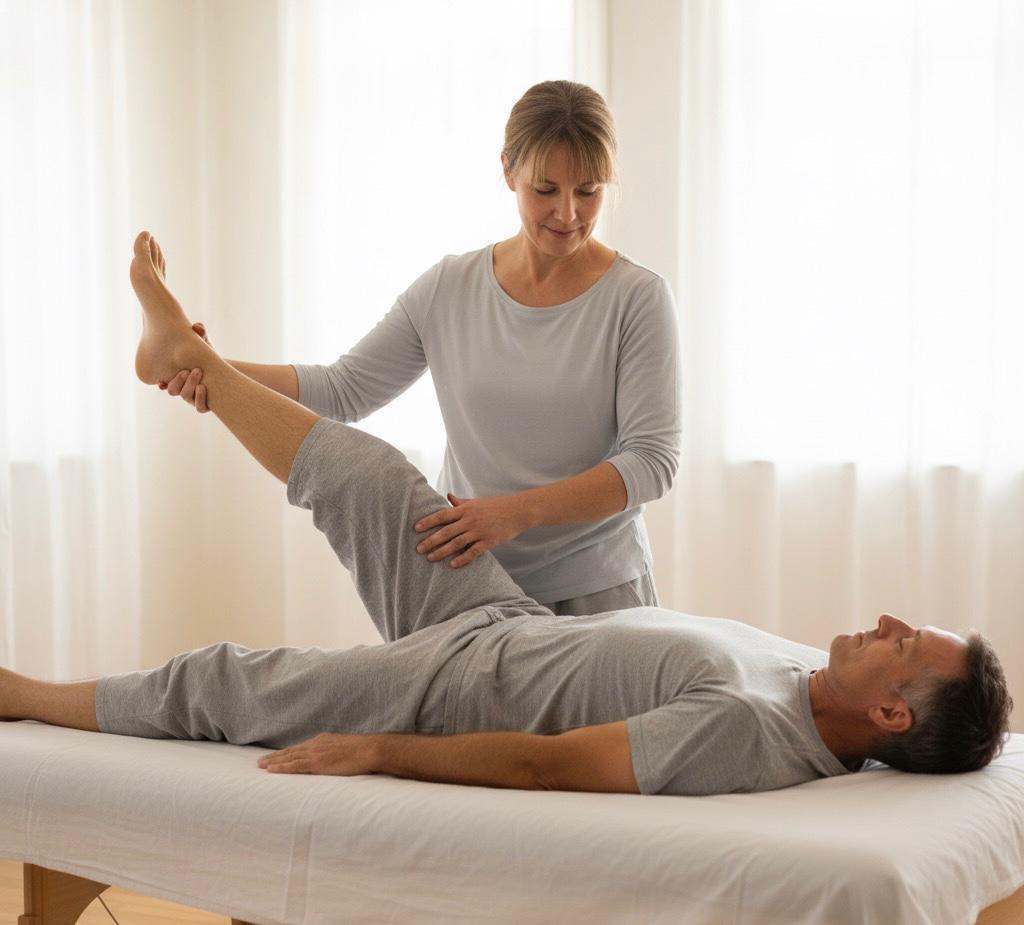
- Psychophysical Integration (table work): The practitioner applies gentle, rhythmic, wave‑like mobilisations and soft tissue contacts while the client lies clothed on a padded table. The touch is non‑forceful and communicative, inviting the nervous system to experience “softer, lighter, easier” movement options rather than imposing stretches or thrusts (Trager, 1992; Mairi, 2006).
- Mentastics® (mental gymnastics): Short, playful self‑directed movements that clients practise during and after sessions to reinforce ease, awareness, and efficient coordination in daily life (Trager, 1992).
The hallmark is a curiosity‑based, non‑corrective tone—asking internally, “What could be softer? What would feel easier?”—which orients attention toward pleasant interoceptive cues and reduces protective muscle guarding.
2) Proposed mechanisms: how might Trager work?
While Trager‑specific trials are limited, its core ingredients map onto mechanisms supported across manual and movement sciences:
- Down‑regulating threat and muscle tone via gentle touch
Pleasant, slow touch can reduce sympathetic arousal, modulate cortisol, and increase parasympathetic (vagal) activity, correlating with decreased pain and anxiety (Field, 2014; McGlone et al., 2014). Rhythmic mobilisations may alter reflex excitability and decrease co‑contraction. - Interoceptive and proprioceptive recalibration
Bringing attention to comfortable sensations enhances body awareness and reduces catastrophising; improved interoception is associated with better emotion regulation and pain outcomes (Mehling et al., 2011). - Motor learning and predictive processing
Exposure to effortless movement variants provides the nervous system with safe prediction errors—new options contradicting the expectation of stiffness—supporting neuromuscular re‑education (Moseley & Butler, 2015). - Mechanotherapy
Gentle loading and soft‑tissue shear may modulate connective tissue stiffness and nociceptive input without provoking protective guarding (Schleip, 2003; Langevin et al., 2013).
3) What does the evidence say?
Direct Trager studies: Published Trager‑specific research is modest (small samples, case series). Reports include feasibility and pilot data suggesting improvements in range of motion, pain, and relaxation in neuromuscular conditions; however, higher‑quality randomised trials are scarce. Consequently, clinicians should frame Trager as promising but under‑researched.
Adjacent evidence bases:
- Massage/soft‑tissue therapies show small‑to‑moderate benefits for chronic musculoskeletal pain and anxiety compared with usual care (Field, 2014; Furlan et al., 2015).
- Movement‑based mind–body therapies (e.g., Feldenkrais, Alexander Technique, Tai Chi, yoga) improve pain, balance and quality of life in various populations, offering indirect support for Trager’s movement education component (Cramer et al., 2018; Little et al., 2008).
- Body awareness interventions are linked with reduced pain interference and better self‑regulation (Mehling et al., 2011).
Bottom line: Trager aligns with mechanisms and outcomes supported elsewhere, but more rigorous RCTs are needed to quantify specific effects and identify best‑responders.
4) Potential indications (with clinical reasoning)
- Persistent musculoskeletal pain (neck, low back, shoulder): down‑regulation, graded exposure to effortless movement, and decreased guarding may reduce pain and improve function (Kamper et al., 2015).
- Stress, anxiety, sleep disturbance: parasympathetic engagement and interoceptive soothing can support relaxation and sleep quality (Field, 2014).
- Neurological conditions (e.g., Parkinson’s disease, post‑stroke stiffness): gentle rhythmic mobilisations and cueing may enhance ease and fluidity; best used as adjunct to neurorehabilitation (Earhart, 2009).
- Movement efficiency for performers/athletes: Mentastics reinforces economical coordination and recovery.
Trager is complementary, not a replacement for medical care. Clients with red flags (unexplained weight loss, progressive neurological signs, fever, trauma) require medical evaluation.
5) What happens in a Trager session?
- Brief interview & goal setting (pain, stress, mobility, performance).
- Table work: gentle oscillations, traction, and passive movements with constant feedback (“How does this feel?”).
- Mentastics coaching: standing or seated micro‑moves—pendulums, light sways—clients can use at work or home.
- Integration & home practice: 1–2 minute Mentastics “micro‑breaks” every few hours to consolidate the new movement options.
Sessions typically last 60–90 minutes. Most people feel lighter, taller, calmer immediately; durable change depends on home practice and graded activity.
6) Safety, contraindications, and scope
Trager uses non‑forceful contact, making it suitable for many populations. Still, practitioners screen for and adapt to:
- Acute tissue injury, unhealed fractures, DVT, unstable medical conditions (refer/modify).
- Hypermobility disorders: minimise end‑range oscillations; emphasise active Mentastics and strength.
- Trauma‑sensitive care: consented touch, clear options to pause/stop, collaborative pacing (Emerson & Hopper, 2011).
Seek qualified practitioners listed by Trager International or recognised associations.
7) How Trager compares with other methods
| Method | Primary focus | Touch intensity | Self‑practice | Evidence base |
|---|---|---|---|---|
| Trager® | Ease, lightness, neuromotor options (Mentastics) | Very gentle | High (Mentastics) | Emerging; supported by adjacent fields |
| Massage therapy | Tissue modulation, relaxation | Gentle–firm | Low–moderate | Moderate evidence for pain/anxiety |
| Feldenkrais | Somatic learning via novel movement | Gentle | High | Growing evidence for function/pain |
| Alexander Technique | Postural coordination & inhibition | Light | High | RCTs for chronic back pain (Little et al., 2008) |
8) Practical tips clients can try now (Mentastics‑inspired)
- Pendulum arms (60–90 seconds): Stand tall, imagine arms are silk scarves; allow them to sway effortlessly—no muscle “doing.” Notice breath softening.
- Cloud steps (1–2 minutes): Walk slowly as if on soft moss, letting ankles and knees be springy. Sense effortless rebound.
- Shoulder whisper (3 breaths): Invite the question, “What would be lighter?” as the shoulders melt away from ears. Stop if discomfort arises.
These micro‑practices are not prescriptive exercises; they are experiments in ease that can punctuate your day and support nervous‑system calm.
FAQs
Is the Trager Approach evidence‑based?
There are few Trager‑specific trials; however, its core ingredients—gentle touch, movement education, and body awareness—are supported by broader research in pain science and mind–body therapies (Field, 2014; Kamper et al., 2015; Mehling et al., 2011).
What does a session feel like?
Most people describe sensations of lightness, spaciousness, and calm. There should be no pain; pressure is minimal and rhythmic.
How many sessions will I need?
Some feel immediate relief; lasting change typically requires several sessions plus brief daily Mentastics and graded activity.
Is it safe for older adults?
Yes—when adapted to health status and mobility. Always inform your practitioner about medical conditions and medications.
References
- Cramer, H., Lauche, R., Haller, H. & Dobos, G. (2018) ‘A systematic review and meta‑analysis of yoga for chronic low back pain’, Clinical Journal of Pain, 34(1), pp. 1–13.
- Earhart, G.M. (2009) ‘Dance as therapy for individuals with Parkinson disease’, European Journal of Physical and Rehabilitation Medicine, 45(2), pp. 231–238.
- Emerson, D. & Hopper, E. (2011) Overcoming Trauma through Yoga: Reclaiming Your Body. Berkeley, CA: North Atlantic Books.
- Field, T. (2014) ‘Massage therapy research review’, Complementary Therapies in Clinical Practice, 20(4), pp. 224–229.
- Furlan, A.D., Giraldo, M., Baskwill, A., Irvin, E. & Imamura, M. (2015) ‘Massage for low‑back pain’, Cochrane Database of Systematic Reviews, (9), CD001929.
- Kamper, S.J. et al. (2015) ‘Multidisciplinary biopsychosocial rehabilitation for chronic low back pain’, Cochrane Database of Systematic Reviews, (9), CD000963.
- Langevin, H.M. et al. (2013) ‘Biomechanics and connective tissue plasticity: A review’, Journal of Bodywork and Movement Therapies, 17(2), pp. 214–222.
- Little, P. et al. (2008) ‘Randomised controlled trial of Alexander Technique lessons, exercise, and massage for chronic and recurrent back pain’, BMJ, 337, a884.
- Mairi, A. (2006) Trager® for Self‑Healing: A Practical Guide for Everyday Health. Rochester, VT: Healing Arts Press.
- McGlone, F., Wessberg, J. & Olausson, H. (2014) ‘Discriminative and affective touch: Sensing and feeling’, Neuron, 82(4), pp. 737–755.
- Mehling, W.E. et al. (2011) ‘Body awareness: A phenomenological inquiry into the common ground of mind–body therapies’, Philosophy, Ethics, and Humanities in Medicine, 6, 6.
- Moseley, G.L. & Butler, D.S. (2015) Explain Pain Supercharged. Adelaide: NOI Group.
- Schleip, R. (2003) ‘Fascial plasticity – a new neurobiological explanation’, Journal of Bodywork and Movement Therapies, 7(1), pp. 11–19.
- Trager, M. (1992) Mentastics: Movement for Mind and Body. Kentfield, CA: Trager Institute Press.