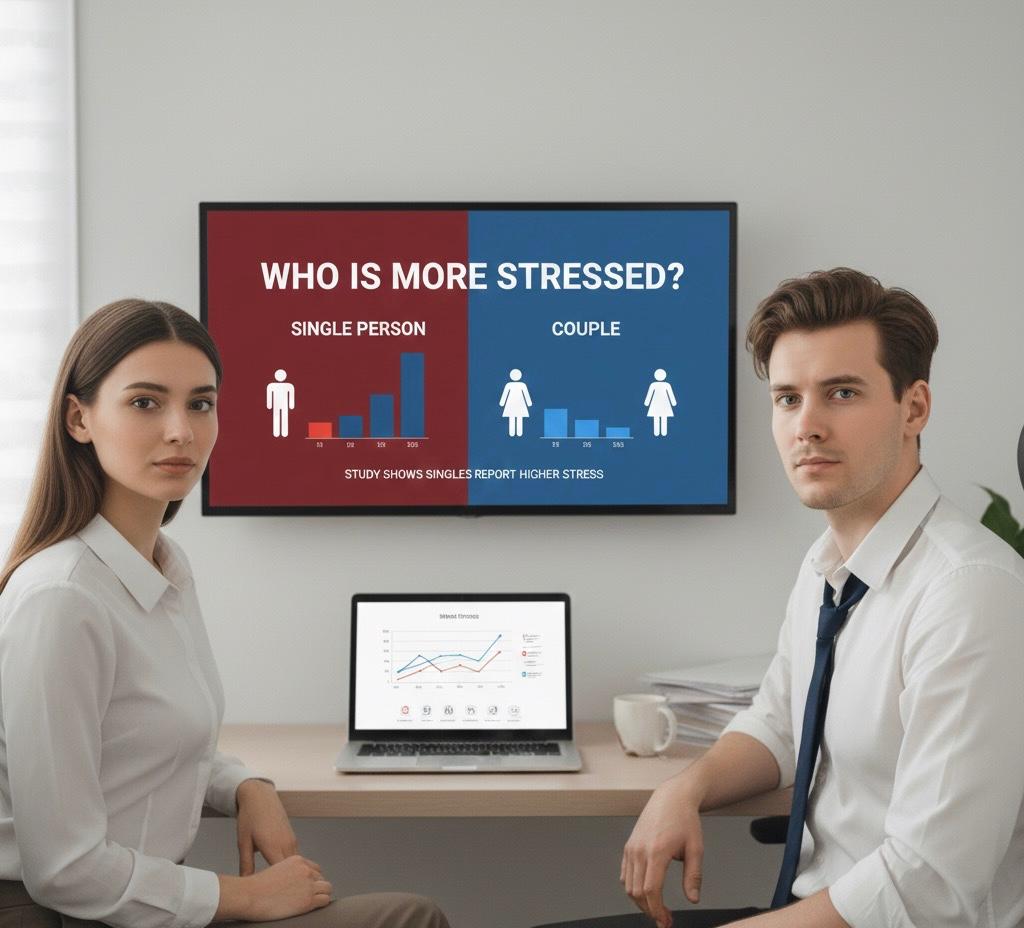
Who’s more stressed — single people or those in relationships?
Written by: Rona Castañeda
Clinically reviewed by: Qualified members of the Therapy Near Me clinical team
Last updated: 06/10/2026
This clinical information has been written by Rona Castañeda to support accuracy, clarity, and alignment with contemporary psychological practice. Content is reviewed in accordance with our Editorial Policy and is intended as general information only. It does not replace individual assessment, diagnosis, or treatment.
A psychologist’s guide to what the data (and biology) actually say.
Short answer
It depends far more on relationship quality than on relationship status. On average, partnered people report slightly lower stress and show some markers of better stress physiology—but only when the relationship is supportive. Poor‑quality, conflictual, or violent relationships are associated with higher stress than being single (Robles et al., 2014; Kiecolt‑Glaser and Newton, 2001; Umberson and Thomeer, 2013).
What do we mean by “stress”?
Psychologists distinguish between:
- Perceived stress: how overloaded and out of control you feel (typically measured with the Perceived Stress Scale).
- Physiological stress: how your body reacts—think cortisol, blood pressure, inflammation, and the day‑long “slope” of stress hormones (Adam and Kumari, 2009).
- Allostatic load: the wear‑and‑tear on multiple systems over time (McEwen and Seeman, 1999).
Relationship status and quality can shape all three.
What large studies say about singles vs. partnered people
- Slight average advantage for the partnered—conditional on quality. Reviews and meta‑analyses show married/partnered adults tend to report lower distress and better health than the never‑married group, but the effect hinges on marital quality; strained couples often look worse than singles on mental‑health outcomes (Williams and Umberson, 2004; Robles et al., 2014; Sbarra, 2015; Liu and Waite, 2014).
- Selection effects matter. Healthier, wealthier, and more socially connected people are statistically more likely to partner and stay partnered; good studies adjust for this, but it never disappears entirely (Sbarra, 2015; Umberson and Thomeer, 2013).
- Singles are not a monolith. Never‑married by choice, single‑again after divorce/bereavement, and single parents show different profiles; loneliness, not singleness, is the consistent risk factor for distress (Cacioppo and Hawkley, 2010; DePaulo and Morris, 2005).
Quality beats status: what happens inside relationships
- Support buffers stress. Partners who provide warm, practical support reduce biological stress responses during lab stressors (e.g., Trier Social Stress Test) (Heinrichs et al., 2003). Even hand‑holding from a trusted partner lowers threat‑related brain activation (Coan, Schaefer and Davidson, 2006).
- Conflict elevates stress. Hostile marital interactions raise cortisol and inflammatory markers, impair wound healing, and disturb sleep (Kiecolt‑Glaser and Newton, 2001; Kiecolt‑Glaser et al., 2005). Couples with lower satisfaction show flatter daily cortisol slopes—a riskier biological profile (Saxbe, Repetti and Nishina, 2008).
- Abuse is toxic. Intimate partner violence (IPV) is consistently associated with high distress, PTSD symptoms, and adverse health; risk is elevated regardless of legal marital status (Campbell, 2002).
Takeaway: A good relationship helps you cope; a bad one burdens your system. Being single poses less risk than staying in a chronically hostile or unsafe partnership.
Special cases and moderators
- Age and stage. Young adults experience intense peer and career transitions; supportive dating/early partnerships can buffer stress, but unstable or controlling relationships amplify it (Umberson and Thomeer, 2013).
- Parenting. Parenting raises day‑to‑day stress loads; partnered parents often benefit from shared labour, while single parents face high demands with less backup (Nomaguchi and Milkie, 2020).
- Attachment style. Anxious attachment predicts heightened rejection sensitivity and stress in relationships; avoidant attachment predicts less perceived support (Mikulincer and Shaver, 2007).
- Minority stress (LGBTQ+). External stigma adds background strain; supportive relationships can buffer minority stress, while concealment and discrimination increase distress (Meyer, 2003).
- Work and money. Economic stressors (job insecurity, debt) spill into both single and partnered lives; financial strain is a top predictor of couple conflict (Conger et al., 2010).
What this means for your choices
If you’re single:
- Invest in friendships and community; social connection, not romantic status per se, is the stress‑buffer (Cohen and Wills, 1985; Thoits, 2011).
- Build predictable routines (sleep, movement, daylight), which stabilise physiology as effectively as many relationship‑based buffers.
- If loneliness bites, take small approach steps (join groups, structured volunteering) rather than only seeking a partner.
If you’re partnered:
- Practise supportive communication: validation, problem‑solving, and soft‑start‑ups instead of criticism/defensiveness.
- Protect sleep and repair after conflicts; small ruptures are normal—unrepaired ruptures raise stress.
- If there is coercion or violence, prioritise safety and specialist support; leaving is a health intervention.
A simple decision tool
Ask three questions about your current situation:
- Do I feel safe and respected? If no, seek support and make a plan.
- Do I have at least two reliable sources of support? Partner, friend, family, community. If not, build breadth.
- Are my daily basics steady? Sleep, movement, daylight, decent food. Tending these reduces reactivity across statuses.
Myths to retire
- “Any relationship is better than none.” False. Poor‑quality partnerships can produce higher stress than being single (Robles et al., 2014; Kiecolt‑Glaser and Newton, 2001).
- “Singles are inevitably lonely.” False. Loneliness is about gap between desired and actual connection; many singles report high social fulfillment (DePaulo and Morris, 2005; Cacioppo and Hawkley, 2010).
- “Marriage automatically fixes stress.” False. Gains depend on supportive behaviour, shared problem‑solving, and fair division of labour (Umberson and Thomeer, 2013; Conger et al., 2010).
Bottom line
Who is “more stressed”—a single person or someone in a relationship? The best single‑sentence answer is: the person with poorer quality relationships and weaker daily recovery. You can tilt the odds in your favour by building supportive ties (romantic or not) and caring for the basics that settle the nervous system.
References
Adam, E.K. and Kumari, M. (2009) ‘Assessing salivary cortisol in large‑scale, epidemiological research’, Psychoneuroendocrinology, 34(10), pp. 1423–1436.
Cacioppo, J.T. and Hawkley, L.C. (2010) ‘Perceived social isolation and cognition’, Trends in Cognitive Sciences, 13(10), pp. 447–454.
Campbell, J.C. (2002) ‘Health consequences of intimate partner violence’, The Lancet, 359(9314), pp. 1331–1336.
Coan, J.A., Schaefer, H.S. and Davidson, R.J. (2006) ‘Lending a hand: social regulation of the neural response to threat’, Psychological Science, 17(12), pp. 1032–1039.
Cohen, S. and Wills, T.A. (1985) ‘Stress, social support, and the buffering hypothesis’, Psychological Bulletin, 98(2), pp. 310–357.
Conger, R.D., Conger, K.J. and Martin, M.J. (2010) ‘Socioeconomic status, family processes, and individual development’, Journal of Marriage and Family, 72(3), pp. 685–704.
DePaulo, B. and Morris, W.L. (2005) ‘Singles in society and in science’, Psychological Inquiry, 16(2), pp. 57–83.
Heinrichs, M., Baumgartner, T., Kirschbaum, C. and Ehlert, U. (2003) ‘Social support and oxytocin interact to suppress cortisol and subjective responses to psychosocial stress’, Biological Psychiatry, 54(12), pp. 1389–1398.
Kiecolt‑Glaser, J.K. and Newton, T.L. (2001) ‘Marriage and health: his and hers’, Psychological Bulletin, 127(4), pp. 472–503.
Kiecolt‑Glaser, J.K., Loving, T.J., Stowell, J.R., Malarkey, W.B., Lemeshow, S., Dickinson, S.L. and Glaser, R. (2005) ‘Hostile marital interactions, proinflammatory cytokine production, and wound healing’, Archives of General Psychiatry, 62(12), pp. 1377–1384.
Liu, H. and Waite, L.J. (2014) ‘Bad marriage, broken heart? Age and gender differences in the link between marital quality and cardiovascular risks among older adults’, Journal of Health and Social Behavior, 55(4), pp. 403–423.
McEwen, B.S. and Seeman, T. (1999) ‘Protective and damaging effects of mediators of stress’, New England Journal of Medicine, 338(3), pp. 171–179.
Meyer, I.H. (2003) ‘Prejudice, social stress, and mental health in lesbian, gay, and bisexual populations: conceptual issues and research evidence’, Psychological Bulletin, 129(5), pp. 674–697.
Mikulincer, M. and Shaver, P.R. (2007) Attachment in adulthood: Structure, dynamics, and change. New York: Guilford.
Nomaguchi, K. and Milkie, M.A. (2020) ‘Parenthood and well‑being: A decade in review’, Journal of Marriage and Family, 82(1), pp. 198–223.
Robles, T.F., Slatcher, R.B., Trombello, J.M. and McGinn, M.M. (2014) ‘Marital quality and health: a meta‑analytic review’, Psychological Bulletin, 140(1), pp. 140–187.
Saxbe, D.E., Repetti, R.L. and Nishina, A. (2008) ‘Marital satisfaction, recovery from work, and diurnal cortisol among men and women’, Health Psychology, 27(1), pp. 15–25.
Sbarra, D.A. (2015) ‘Divorce and health: Current trends and future directions’, Psychosomatic Medicine, 77(3), pp. 227–236.
Thoits, P.A. (2011) ‘Mechanisms linking social ties and support to physical and mental health’, Journal of Health and Social Behavior, 52(2), pp. 145–161.
Umberson, D. and Thomeer, M.B. (2013) ‘Family status and mental health: Recent advances and future directions’, Handbook of the Sociology of Mental Health, pp. 405–431.
Williams, K. and Umberson, D. (2004) ‘Marital status, marital transitions, and health: A gendered life course perspective’, Journal of Health and Social Behavior, 45(1), pp. 81–98.
How to cite this article
Therapy Near Me (2025) ‘Who’s more stressed — single people or those in relationships?’ Available at: https://TherapyNearMe.com.au (Accessed 9 December 2025).
General information only. If you are in immediate danger, call 000. For 24/7 support: Lifeline 13 11 14; Suicide Call Back Service 1300 659 467.