
NDIS Psychology in Australia: What It Covers, Which Budget It Comes From, and How to Avoid Payment Problems (2026)
Written by: Rona Castañeda
Clinically reviewed by: Qualified members of the Therapy Near Me clinical team
Last updated: 06/10/2026
This clinical information has been written by Rona Castañeda to support accuracy, clarity, and alignment with contemporary psychological practice. Content is reviewed in accordance with our Editorial Policy and is intended as general information only. It does not replace individual assessment, diagnosis, or treatment.
Content type: Educational guide (Australia, NDIS)
NDIS funding can make psychology more accessible—but it can also become confusing fast: Which budget pays? Do you need a registered provider? What does a plan manager need on an invoice? What’s the difference between “therapy” and “behaviour support”?
This guide is written to answer the questions participants and families actually run into, using primary sources (NDIS and NDIS Commission guidance) and practical steps to reduce avoidable delays.
Important (YMYL): This is general information, not medical or legal advice. If you’re in immediate danger call 000. For crisis support call Lifeline 13 11 14 (Healthdirect Australia 2025).
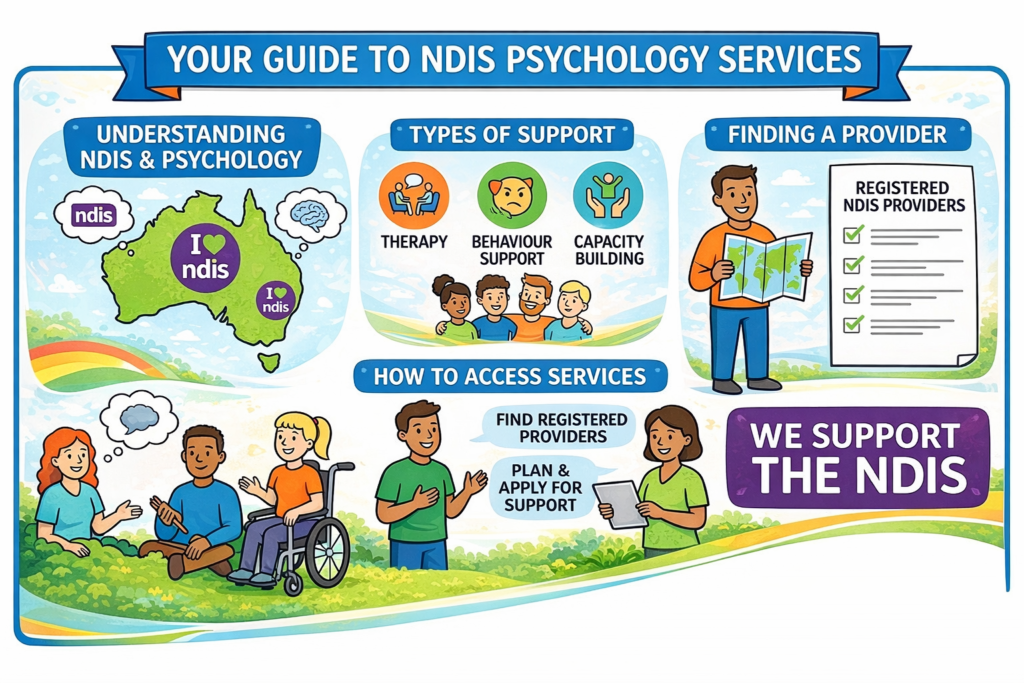
1) What is “NDIS psychology” and what can it be used for?
NDIS-funded psychology is typically used where it is reasonable and necessary to build capacity, improve functioning, and work toward NDIS goals (rather than treating a condition in a general health sense). In practice this can include:
- building emotional regulation and coping skills
- building social participation skills and confidence
- supporting independence, routines, and daily functioning
- supporting families and carers with strategies
- creating practical recommendations that link to NDIS goals
Most commonly, psychology sits under capacity building supports—particularly Improved Daily Living (see next section). This alignment is widely reflected in provider and participant guidance, but the key is always your plan goals and funded categories (NDIS 2026).
2) Which NDIS budget usually pays for psychology?
Many plans fund psychology from Capacity Building – Improved Daily Living, because it is designed for skill development and allied health capacity building (NDIS 2026).
That said, the NDIS is not “one-size-fits-all.” Funding categories can vary based on your plan structure and goals. The safe way to confirm is:
- check the budget categories in your plan, and
- confirm the intended claim category with your provider/plan manager before commencing services.
Why this matters: the NDIS has pricing rules and price limits that apply to NDIA-managed and plan-managed supports, and these are updated periodically (NDIS 2026).
3) Do you need a registered NDIS provider for psychology?
It depends on how your plan is managed:
NDIA-managed (Agency-managed)
You generally need to use registered providers for supports funded through NDIA-managed budgets, because those payments are made under the NDIA system rules and pricing arrangements (NDIS 2026).
Plan-managed
Plan-managed participants can usually access a broader range of providers, but invoices still need to comply with NDIS invoice requirements and pricing rules where relevant (NDIS 2026).
Self-managed
Self-management provides the most flexibility in choosing providers, but participants still have responsibilities (record keeping, spending aligned with plan goals). The NDIA has also tightened evidence expectations (e.g., keeping invoices/receipts) and clarified claim evidence requirements (NDIS 2024; NDIS 2026).
4) Service agreements: why they matter (and what should be in them)
A service agreement is essentially your contract with a provider. The NDIS explains that when you use your NDIS budget for supports, you’re entering into a contract and a service agreement helps clarify what both sides have agreed to (NDIS 2026).
A strong service agreement reduces disputes and payment friction. It should clearly cover:
- supports to be delivered (what, where, how often)
- fees and travel charges (if applicable)
- cancellation policy (and how notice is counted)
- reporting or assessment deliverables (if any)
- invoicing timeframes and who invoices go to (participant vs plan manager)
- privacy/consent and how information is shared with support teams (with permission)
5) Invoicing: the fastest way to avoid plan-manager “bounce backs”
The NDIA publishes explicit invoicing and record-keeping requirements. Key points include:
- one invoice per participant (though multiple supports can be listed)
- invoices need required tax invoice details; and
- where relevant, plan managers must include the ABN of the third-party provider (NDIS 2026).
If you’ve ever had an invoice rejected, it’s usually because one of these basics is missing, or the invoice doesn’t clearly tie to the correct support category / pricing rule.
Practical checklist before you send an invoice to a plan manager
- participant full name + NDIS number (if required by plan manager)
- provider legal entity name + ABN
- date(s) of service + clear description
- duration/units and rate
- total amount and GST status where applicable
- payment terms and bank details
- any travel/telehealth notes, if relevant and allowable under pricing rules (NDIS 2026).
6) Psychology vs Behaviour Support: don’t mix them up
“Behaviour support” under the NDIS is a specific regulated area—particularly when it involves restrictive practices. The NDIS Quality and Safeguards Commission sets expectations and rules for behaviour support and restrictive practices and emphasises rights-based, evidence-informed positive behaviour support (NDIS Commission 2026).
If you need formal behaviour support plans, ensure the provider and practitioner are operating within the appropriate framework and obligations (NDIS Commission 2026).
This distinction matters for:
- clinical responsibility and governance
- reporting requirements
- whether specific “behaviour support plan” work is being delivered by a suitable practitioner within a registered specialist behaviour support provider context (NDIS Commission 2026).
7) How to choose a psychology provider that is genuinely safe and credible
Participants should look for concrete quality signals, not marketing promises.
Green flags
- clear explanation of how therapy connects to NDIS goals
- transparent fees and cancellation terms in writing (service agreement)
- clear privacy process and consent boundaries
- professional documentation standards (session notes, outcomes tracking)
- willingness to collaborate with your support network with your consent (NDIS 2026).
Red flags
- vague pricing, “package” pressure, or unclear deliverables
- refusal to provide a service agreement
- unclear invoicing processes and repeated plan manager rejection
- no explanation of how the support aligns with your plan goals (NDIS 2026).
8) Quick action plan: get started cleanly in 48 hours
- Check plan management type (NDIA-managed / plan-managed / self-managed) (NDIS 2026).
- Confirm budget category for psychology (often Improved Daily Living) (NDIS 2026).
- Sign a service agreement before the first session (NDIS 2026).
- Confirm invoice format your plan manager expects, and ensure it meets NDIA invoice rules (NDIS 2026).
- Set measurable goals for the first 4 sessions (e.g., routine adherence, community participation steps, emotional regulation skills) and review progress.
Authorship, review, and editorial standards
Author: TherapyNearMe.com.au Editorial Team
Editorial standards: This article is created and maintained under our quality, sourcing, and clinical governance process. Read our Editorial Policy: https://therapynearme.com.au/editorial-policy/
References
Healthdirect Australia 2025, Mental health helplines, Healthdirect, viewed 5 March 2026.
National Disability Insurance Scheme (NDIS) 2024, Information about self-management evidence requirements, NDIS, viewed 5 March 2026.
National Disability Insurance Scheme (NDIS) 2026, Invoicing and record keeping, NDIS, viewed 5 March 2026.
National Disability Insurance Scheme (NDIS) 2026, Making a service agreement, NDIS, viewed 5 March 2026.
National Disability Insurance Scheme (NDIS) 2026, Plan management, NDIS, viewed 5 March 2026.
National Disability Insurance Scheme (NDIS) 2026, Pricing arrangements, NDIS, viewed 5 March 2026.
National Disability Insurance Scheme (NDIS) 2026, Self-management, NDIS, viewed 5 March 2026.
NDIS Quality and Safeguards Commission 2026, Behaviour support and restrictive practices, NDIS Commission, viewed 5 March 2026.
NDIS Quality and Safeguards Commission 2026, Rules for behaviour support and restrictive practices, NDIS Commission, viewed 5 March 2026.