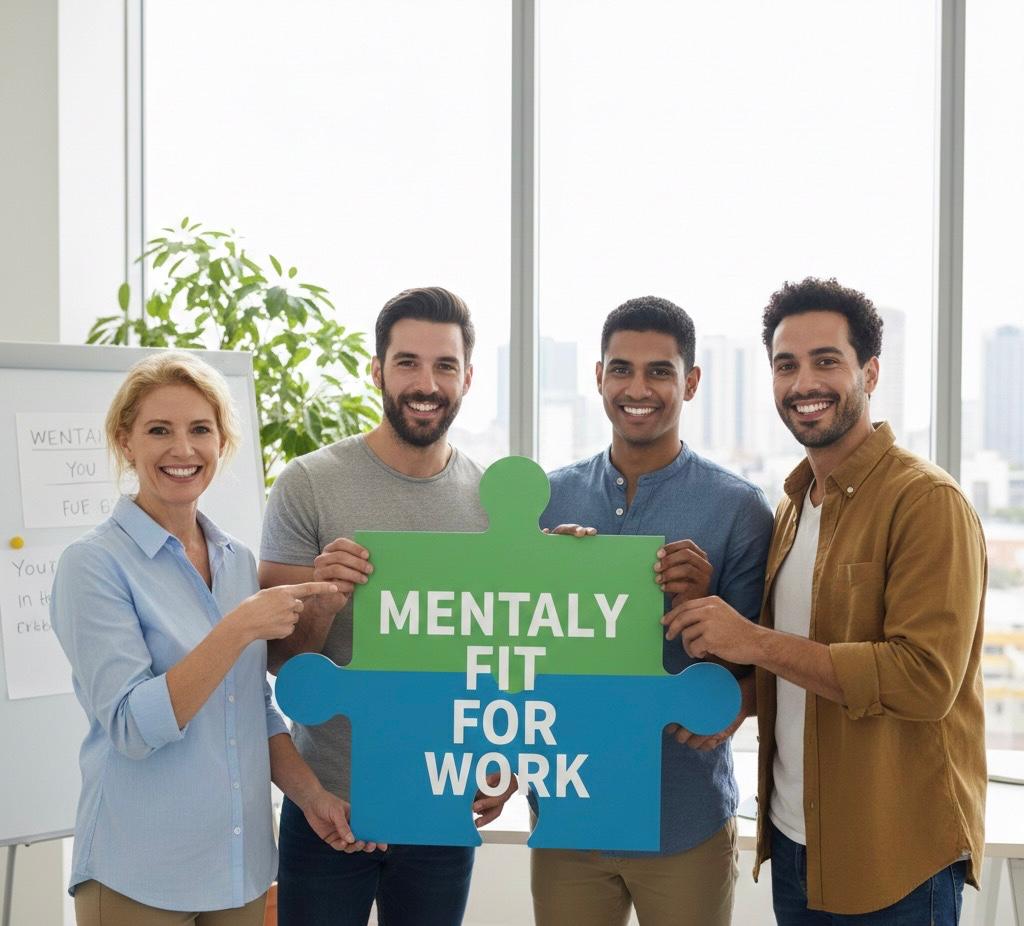
Am I mentally fit for work?: an evidence‑based guide
By TherapyNearMe.com.au. General information only; not a substitute for personalised medical, psychological, legal or HR advice. If you are in crisis, call 000. For 24/7 support: Lifeline 13 11 14; Beyond Blue 1300 224 636.
Why “mental fitness for work” matters
Being “mentally fit for work” means you can meet the essential requirements of your role—safely and sustainably—given your current health, supports, and working conditions. Fitness is not an all‑or‑nothing label; it varies with job demands (cognitive, emotional, interpersonal), resources (support, autonomy, recovery time), and temporary adjustments (Karasek, 1979; Bakker and Demerouti, 2007; WHO, 2022). Well‑designed work can protect mental health; poorly designed work can harm it (Harvey et al., 2017; LaMontagne et al., 2014).
What affects mental fitness at work?
Work design factors
- Demands: workload, time pressure, emotional labour, role conflict (Karasek, 1979; WHO, 2022).
- Resources: control, skill use, supervisor/peer support, clarity, fairness (Bakker and Demerouti, 2007).
- Psychosocial hazards: bullying, violence, traumatic exposure, moral injury, low reward, poor change management (Safe Work Australia, 2022; WHO, 2022).
- Environment: light, noise, heat, and shift patterns influence sleep and stress physiology (AIHW, 2024).
Personal and clinical factors
- Common conditions: anxiety, depressive disorders, PTSD, OCD, substance use—each influences attention, memory, motivation, sleep and social processing (NICE, 2011; 2018; APA, 2022).
- Life events: grief, caregiving, financial strain (Umberson et al., 2010).
- Health behaviours: sleep, activity, alcohol, and caffeine patterns (Roehrs and Roth, 2001).
Mental fitness is the fit between person and job. Change either side—and the fit changes.
How to tell if work is helping or harming
Use both subjective and objective signals over a few weeks:
- Mood and anxiety: rising baseline sadness, irritability, or worry most days (PHQ‑9; GAD‑7) (Kroenke et al., 2001; Spitzer et al., 2006).
- Sleep: trouble falling/staying asleep, early waking, or oversleeping tied to work cycles (Roehrs and Roth, 2001).
- Cognition: difficulty focusing, memory slips, indecision impacting safety or quality.
- Function: missed deadlines, errors, avoidance, social withdrawal (Sheehan, 1983; Lerner et al., 2001).
- Physiology: headaches, GI upset, chest tightness triggered by work contexts.
- Recovery: do days off actually restore you—or does dread return quickly? (Bakker and Demerouti, 2007).
If symptoms persist ≥2 weeks, escalate to a GP or psychologist. Early support shortens time to recovery (NICE, 2011; 2018).
Self‑check: a quick “work fit” screen (not a diagnosis)
Tick any that applied on 10+ days in the last 14 days:
- I could not switch off from work outside hours.
- Sleep was cut short or fragmented because of work thoughts/shifts.
- I avoided key tasks or people due to anxiety/low mood.
- I made more mistakes than usual or felt unsafe.
- I felt persistently undervalued or treated unfairly.
- I used alcohol, energy drinks or sedatives to cope.
- I had physical stress symptoms most workdays.
If 3+ are checked, consider speaking with your GP/psychologist and your manager/HR about temporary adjustments.
Reasonable adjustments that work
Evidence‑based adjustments protect function while recovery proceeds (Joyce et al., 2016; WHO, 2022; ISO, 2021):
- Workload and pacing: staged hours, phased tasks, smaller caseloads, reduced after‑hours contact.
- Focus: uninterrupted blocks, fewer concurrent projects, written briefs, quiet space/noise controls.
- Time: flexible start/finish, protected breaks, predictable rosters, swap nights to days if possible.
- Interpersonal: a single point of contact; structured 1:1s; clear feedback norms; bullying zero‑tolerance (Safe Work Australia, 2022).
- Location: hybrid options or temporary work‑from‑home with regular check‑ins.
- Support: EAP, peer support, graded exposure back to complex tasks, training refreshers.
Adjustments should be documented, time‑bound, and reviewed against functional goals.
Return‑to‑work (RTW) after a mental‑health episode
A good RTW plan reduces relapse and presenteeism (Nieuwenhuijsen et al., 2014; Arends et al., 2012):
- Shared goal: what “fit for work” looks like (functions, not feelings).
- Graded schedule: e.g., 3 days × 4 hours → 4 days × 6 hours → full duties.
- Task ramp: start with low‑stakes tasks; reintroduce complex work with graded exposure (NICE, 2011).
- Supervisor check‑ins: brief, weekly; focus on barriers/solutions.
- Measure and adjust: track PHQ‑9/GAD‑7 and a work function scale (WLQ/SDS) (Lerner et al., 2001; Sheehan, 1983).
- Boundary hygiene: pause non‑essential after‑hours communication during ramp‑up.
- Trigger plan: early‑warning signs and what to do.
For managers: building mentally healthy work
- Design work, don’t just offer yoga. Fix high‑risk job designs (excessive demands/low control; poor support; injustice) (Karasek, 1979; LaMontagne et al., 2014; WHO, 2022).
- Psychosocial risk management: identify, assess, control, and review psychosocial hazards like any safety risk (Safe Work Australia, 2022; ISO, 2021).
- Role clarity and civility: clear goals; predictable feedback; zero tolerance for bullying/harassment (NICE, 2015; Safe Work Australia, 2022).
- Train leaders in supportive conversations and RTW planning; leadership style influences burnout and sickness absence (Kivimäki et al., 2003).
- Measure what matters: short pulse checks on demands/resources; track adjustments and outcomes (Joyce et al., 2016).
For workers: change the parts you control
- Sleep first: consolidate schedule; limit alcohol/caffeine near bedtime (Roehrs and Roth, 2001).
- Focus sprints: 60–90 minute deep‑work blocks; batch email; reduce toggling.
- Boundaries: define a “low‑noise” communication window; use delayed send.
- Micro‑recovery: daylight walks; brief movement; 10‑minute resets.
- Name and negotiate: put your needs in behavioural terms—e.g., “one weekly 1:1 and written priorities by Monday.”
When work is the harm
If bullying, discrimination, or unsafe exposure is present, document incidents and escalate through policy channels. In Australia, organisations must manage psychosocial risks like any other safety risk (Safe Work Australia, 2022). External advice may be sought from GP/psychologist, unions, or relevant regulators.
Common myths
- “Stress means I’m weak.” False. Stress is often about mismatch between demands and resources (Bakker and Demerouti, 2007).
- “Time off fixes everything.” Not alone. Without addressing work design and skills, problems return (LaMontagne et al., 2014).
- “We can’t change the job.” Many powerful adjustments cost little (WHO, 2022; ISO, 2021).
Evidence snapshot: what interventions help?
- Work‑focused CBT and problem‑solving therapy improve symptoms and work outcomes (Nieuwenhuijsen et al., 2014; Arends et al., 2012).
- Organisational changes (reduced demands, increased control/support) reduce distress and sickness absence (LaMontagne et al., 2014; Harvey et al., 2017).
- Supervisor training improves RTW and team climate (Kivimäki et al., 2003; Joyce et al., 2016).
Templates you can adapt
Worker email to request adjustments
“I’m committed to performing my role well. To support this, I’m requesting temporary adjustments for eight weeks: (1) one weekly priorities email by Monday; (2) two 90‑minute focus blocks/day with no meetings; (3) a graded caseload. Let’s review in four weeks.”
Manager RTW checklist
Shared role demands • Graded hours/duties • Weekly check‑in • Written priorities • Measures (PHQ‑9/GAD‑7 + SDS/WLQ) • Trigger plan • Review date
References
AIHW (Australian Institute of Health and Welfare) (2024) ‘Built environment and health’, in Australia’s Health. Canberra: AIHW.
APA (American Psychiatric Association) (2022) Diagnostic and Statistical Manual of Mental Disorders (DSM‑5‑TR). 5th edn, text revision. Washington, DC: APA.
Arends, I., Bruinvels, D.J., Rebergen, D.S., Nieuwenhuijsen, K., Madan, I., Neumeyer‑Gromen, A., Bültmann, U. and van der Klink, J.J.L. (2012) ‘Interventions to facilitate return to work in adults with adjustment disorders’, Cochrane Database of Systematic Reviews, 12, CD006389.
Bakker, A.B. and Demerouti, E. (2007) ‘The Job Demands–Resources model: state of the art’, Journal of Managerial Psychology, 22(3), pp. 309–328.
Harvey, S.B., Joyce, S., Modini, M., Christensen, H., Bryant, R., Mykletun, A. and Mitchell, P.B. (2017) ‘Can work make you mentally ill? A systematic meta‑review of work‑related risk factors for common mental health problems’, Occupational and Environmental Medicine, 74(4), pp. 301–310.
ISO (International Organization for Standardization) (2021) ISO 45003: Occupational health and safety management — Psychological health and safety at work — Guidelines for managing psychosocial risks. Geneva: ISO.
Joyce, S., Modini, M., Christensen, H., Mykletun, A., Bryant, R., Mitchell, P.B. and Harvey, S.B. (2016) ‘Workplace interventions for common mental disorders: a systematic meta‑review’, Psychological Medicine, 46(4), pp. 683–697.
Karasek, R.A. (1979) ‘Job demands, job decision latitude, and mental strain: Implications for job redesign’, Administrative Science Quarterly, 24(2), pp. 285–308.
Kivimäki, M., Elovainio, M. and Vahtera, J. (2003) ‘Workplace bullying and sickness absence in hospital staff’, Occupational and Environmental Medicine, 60(10), pp. 777–783.
Kroenke, K., Spitzer, R.L. and Williams, J.B.W. (2001) ‘The PHQ‑9: validity of a brief depression severity measure’, Journal of General Internal Medicine, 16(9), pp. 606–613.
LaMontagne, A.D., Keegel, T., Louie, A.M., Ostry, A. and Landsbergis, P.A. (2014) ‘A systematic review of the job‑stress intervention evaluation literature, 1990–2005’, International Journal of Occupational and Environmental Health, 13(3), pp. 268–280.
Lerner, D., Amick, B.C., Rogers, W.H., Malspeis, S., Bungay, K. and Cynn, D. (2001) ‘The Work Limitations Questionnaire’, Medical Care, 39(1), pp. 72–85.
NICE (National Institute for Health and Care Excellence) (2011) Generalised anxiety disorder and panic disorder in adults: management (CG113). London: NICE.
NICE (2015) Workplace policy and management practices to improve health and wellbeing (NG13). London: NICE.
NICE (2018) Depression in adults: treatment and management (NG222). London: NICE.
Nieuwenhuijsen, K., Bültmann, U., Neumeyer‑Gromen, A., Verhoeven, A.C., Verbeek, J.H.A.M. and van der Wilt, G.J. (2014) ‘Interventions to improve return to work in depressed people’, Cochrane Database of Systematic Reviews, 12, CD006237.
Roehrs, T. and Roth, T. (2001) ‘Sleep, sleepiness, and alcohol use’, Alcohol Research & Health, 25(2), pp. 101–109.
Safe Work Australia (2022) Model Code of Practice: Managing psychosocial hazards at work. Canberra: Safe Work Australia.
Sheehan, D.V. (1983) ‘The Sheehan Disability Scale (SDS)’, in The Anxiety Disease. New York: Scribner’s, pp. 151–157.
Umberson, D., Liu, H. and Reczek, C. (2010) ‘Stress and mental health: A life‑course perspective on social support and social strains’, Annual Review of Sociology, 36, pp. 261–286.
WHO (World Health Organization) (2022) Guidelines on mental health at work. Geneva: WHO.
How to cite this article
Therapy Near Me (2025) ‘Am I mentally fit for work?: an evidence‑based guide’. Available at: https://TherapyNearMe.com.au (Accessed 9 December 2025).