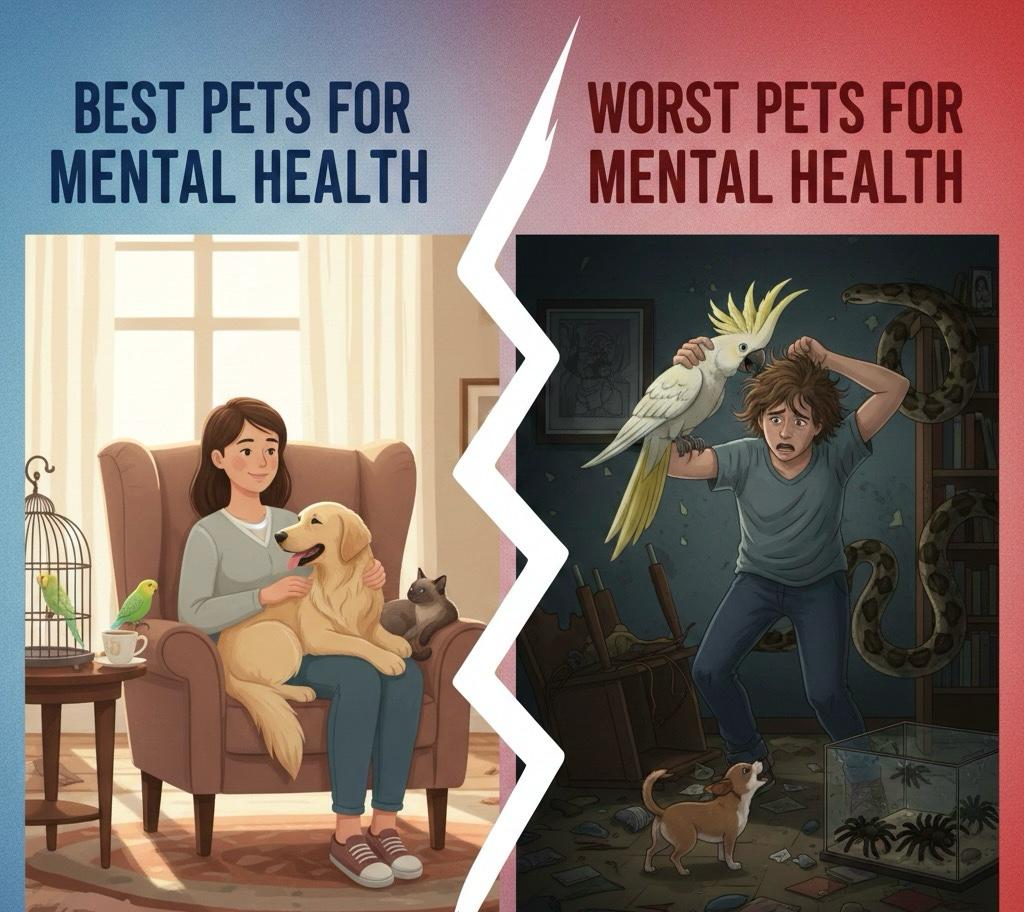
Best (and worst) pets for mental health an evidence‑based guide
By TherapyNearMe.com.au — reader‑first, research‑led article. General information only; not a substitute for personal medical or veterinary advice.
Why pets matter for mental health
Companion animals can provide social support, routine, and opportunities for activity and connection, all of which influence mood and stress physiology (McConnell et al., 2011; Brooks et al., 2018). At the same time, the evidence is heterogeneous: benefits vary by species, the person’s goals and circumstances, and the quality of human–animal interaction (HAI) (Gee and Mueller, 2019; Purewal et al., 2017). Poor fit or unmet animal‑welfare needs can backfire, increasing stress for both animal and human.
The question isn’t “Do pets improve mental health?” but rather “Which pet, for whom, under what conditions?”
What the research says (in brief)
- Associations are generally small‑to‑moderate and depend on context. Some studies show lower loneliness and higher well‑being among pet owners, but effects shrink when controlling for selection (McConnell et al., 2011; Brooks et al., 2018).
- Mechanisms include touch and affiliation, increased physical activity (especially dog walking), social facilitation (conversation starters), and structured daily routines (Serpell, 1991; Westgarth et al., 2019).
- Animal‑assisted interventions (AAI) show short‑term reductions in anxiety and distress across clinical settings; evidence for long‑term outcomes is mixed and quality varies (Barker and Wolen, 2008; O’Haire, 2013; Jones et al., 2019).
- Risks include allergies, zoonoses, injuries, grief after loss, financial stress, and sleep disruption (Day, 2011; CDC, 2017; Brooks et al., 2018).
Best‑fit pets by common goals
The right animal depends on lifestyle, health, housing, budget, sensory preferences, and time. Below are options aligned to typical goals with key caveats.
1) “I want more structure, movement and social contact” → Dogs (well‑matched temperament)
- Why they help: Dog ownership often increases physical activity and outdoor time; dogs act as social catalysts, improving incidental contact and belonging (Westgarth et al., 2019; McConnell et al., 2011).
- Evidence: Observational data link regular dog walking to better mood and social integration; brief interactions with unfamiliar therapy dogs reduce state anxiety and cortisol in hospitals and universities (Barker and Wolen, 2008).
- Caveats: High‑energy or working breeds are poor fits for low‑activity households; puppies are sleep‑disruptive and time‑intensive. Consider adult, temperament‑tested dogs if you have limited time/energy.
2) “I want calm companionship with lower daily demands” → Cats (adult, indoor‑adapted)
- Why they help: Many people find soothing presence and affectionate contact without the scheduling demands of dog walking.
- Evidence: Owners often report reduced loneliness and improved mood; interactions can lower transient stress, though causal evidence is mixed (Brooks et al., 2018).
- Caveats: Allergies are common; cats may disrupt sleep (nocturnal activity). Scratch injuries and toxoplasmosisrisks require hygiene, particularly during pregnancy or immunosuppression (Day, 2011).
3) “I respond well to gentle visuals and routine” → Aquariums/fish
- Why they help: Watching fish produces calming, meditative effects and encourages routine without heavy handling.
- Evidence: Installation of large aquaria in public spaces reduced heart rate and improved reported mood; small studies in dementia care link aquaria to increased nutritional intake and engagement (Cracknell et al., 2016; Edwards and Beck, 2002).
- Caveats: Water quality management is crucial; over‑stocking and poor filtration are common welfare risks.
4) “I’d like nurturing and gentle interaction” → Rabbits/guinea pigs (handled kindly, housing enriched)
- Why they help: Social small mammals can offer affectionate interaction and daily caregiving routines.
- Evidence: Classroom and therapeutic programs using guinea pigs have reported improved social functioning in autistic children (O’Haire, 2013).
- Caveats: Fragile bones; many are crepuscular/nocturnal and dislike rough handling. Require space, enrichment, and exotic‑savvy veterinary care.
5) “I love outdoor activity and structured programs” → Horses (through equine‑assisted activities, not casual ownership)
- Why they help: Groundwork and riding demand embodied focus, non‑verbal attunement, and routine.
- Evidence: Reviews show moderate, mixed benefits for mood, PTSD symptoms and social functioning, with methodological limitations (Bachi et al., 2012; Kendall et al., 2015).
- Caveats: High cost and safety risk; welfare standards and qualified programs are critical.
6) “I need low allergens” → Reptiles/invertebrates (for observing, not cuddling)
- Why they help: Minimal dander; interesting to observe.
- Caveats: Salmonella risk with reptiles and amphibians (strict hand hygiene); limited affiliative behaviour means less “cuddling” payoff (CDC, 2017).
When a pet may be the wrong fit (mental‑health‑first considerations)
- Severe insomnia or light sleep → avoid nocturnal species (hamsters, some cats); consider fish or adult dogs with established sleep routines.
- Severe allergies or asthma → consult an allergist before adopting mammals; there is no truly hypoallergenic dog—all shed allergens (Day, 2011).
- Immunocompromised or pregnant → avoid young cats (higher Toxoplasma gondii shedding), reptiles/amphibians (Salmonella), and chicks/ducklings; follow strict hygiene (CDC, 2017).
- Limited mobility/time/finances → avoid high‑drive dogs or large parrots; these species need substantial training and enrichment.
- Noise sensitivity → avoid parrots and some terriers; consider fish or quiet small mammals.
- History of grief vulnerability → plan supports; pet loss can precipitate significant bereavement reactions (Brent et al., 2020).
Welfare matters: the Five Domains lens
Mental‑health benefits depend on the animal’s own welfare. Use the Five Domains model (nutrition, environment, health, behaviour, mental state) to check you can meet species‑specific needs (Mellor et al., 2020). Poor welfare (e.g., chronic confinement, lack of enrichment) increases problem behaviours and owner guilt/stress.
Decision checklist (before you adopt or buy)
- Why now? Clarify the mental‑health goal (companionship, routine, activity).
- Time and energy audit. Typical hours per day/week? Who helps when you are unwell or travelling?
- Budget reality. Food, insurance, vet care, grooming, enrichment, unexpected bills.
- Housing rules. Landlord/body‑corporate and council regulations.
- Allergy and health review. Check with your GP/allergist if relevant.
- Source ethics. Prefer reputable rescues or ethical breeders; avoid impulse purchases and illegal wildlife trade.
- Match temperament and age. Adult, temperament‑assessed animals are often steadier than juveniles for first‑time owners.
- Plan for the end. Think ahead about ageing and grief; line up practical and emotional support.
Evidence‑informed recommendations (summary)
- Often best for mood + activity + social contact: Well‑matched adult dogs with realistic exercise needs (Westgarth et al., 2019; McConnell et al., 2011).
- Often best for calm companionship with fewer scheduling demands: Adult cats (mind allergies and sleep) (Brooks et al., 2018).
- Often best for low‑noise visual soothing: Aquariums (Cracknell et al., 2016).
- Good in structured programs: Guinea pigs/rabbits (with careful handling and welfare), equine‑assisted activities via qualified providers (O’Haire, 2013; Kendall et al., 2015).
- Common mismatches: high‑drive working dogs with low‑activity owners; large parrots in small homes; nocturnal small mammals for light sleepers; reptiles for households with young children or immunocompromised members (CDC, 2017).
Limitations and nuance
Most pet‑ownership evidence is observational; people who choose pets differ systematically (e.g., outdoorsy dog owners). Randomised trials are rare and often short. Focus less on universal “best pet” claims and more on fit, welfare, and supports.
References
Bachi, K., Parish‑Plass, N. and Thomson, J. (2012) ‘Animal‑assisted psychotherapy: A unique relational therapy for children and adolescents’, Clinical Child Psychology and Psychiatry, 17(1), pp. 121–130.
Barker, S.B. and Wolen, A.R. (2008) ‘The benefits of human–companion animal interaction: a review’, Journal of Veterinary Medical Education, 35(4), pp. 487–495.
Brent, L., Peiris‑Jones, T., Curry, O.S. and House, T. (2020) ‘Grief after pet loss: a systematic review’, Omega—Journal of Death and Dying, 82(2), pp. 294–322.
CDC (Centers for Disease Control and Prevention) (2017) ‘Compendium of measures to prevent disease associated with animals in public settings’. Atlanta: CDC.
Cracknell, D., White, M.P., Pahl, S., Nichols, W.J. and Depledge, M.H. (2016) ‘Marine biota and psychological well‑being: a longitudinal observational study of aquarium exposure’, Environment and Behavior, 48(10), pp. 1242–1269.
Day, M.J. (2011) ‘One health: the importance of companion animal zoonoses’, Journal of Comparative Pathology, 144(2–3), pp. 97–99.
Edwards, N.E. and Beck, A.M. (2002) ‘Animal‑assisted therapy and nutrition in Alzheimer’s disease’, Western Journal of Nursing Research, 24(6), pp. 697–712.
Gee, N.R. and Mueller, M.K. (2019) ‘A systematic review of research on human–animal interaction and well‑being’, International Journal of Environmental Research and Public Health, 16(18), 3320.
Jones, M.G., Rice, S.M. and Cotton, S.M. (2019) ‘Therapeutic use of companion animals in mental health: a review of the evidence’, Harvard Review of Psychiatry, 27(3), pp. 146–164.
Kendall, E., Maujean, A., Pepping, C.A., Downes, M., Lakhani, A., Byrne, J. and Macfarlane, K. (2015) ‘A systematic review of the efficacy of equine‑assisted interventions on psychological outcomes’, European Journal of Psychotherapy & Counselling, 17(1), pp. 57–79.
McConnell, A.R., Brown, C.M., Shoda, T.M., Stayton, L.E. and Martin, C.E. (2011) ‘Friends with benefits: On the positive consequences of pet ownership’, Journal of Personality and Social Psychology, 101(6), pp. 1239–1252.
Mellor, D.J., Beausoleil, N.J., Littlewood, K.E., McLean, A.N., McGreevy, P.D., Jones, B. and Wilkins, C. (2020) ‘The 2020 Five Domains Model: A blueprint for animal welfare’, Animals, 10(10), 1870.
O’Haire, M.E. (2013) ‘Animal‑assisted intervention for autism spectrum disorder: A systematic literature review’, Journal of Autism and Developmental Disorders, 43(7), pp. 1606–1622.
Purewal, R., Christley, R., Kordas, K., Joinson, C., Meints, K., Gee, N.R. and Westgarth, C. (2017) ‘Companion animals and child/adolescent development: A systematic review’, International Journal of Environmental Research and Public Health, 14(3), 234.
Serpell, J. (1991) ‘Beneficial effects of pet ownership: A longitudinal study of human health and behaviour’, Journal of the Royal Society of Medicine, 84(12), pp. 717–720.
Westgarth, C., Christley, R.M., Jewell, C., German, A.J., Boddy, L.M. and Christian, H.E. (2019) ‘Dog ownership, dog walking, and physical activity: a systematic review and meta‑analysis’, American Journal of Health Promotion, 33(5), pp. 813–822.
How to cite this article
Therapy Near Me (2025) ‘Best (and worst) pets for mental health: an evidence‑based guide’. Available at: TherapyNearMe.com.au (Accessed 9 December 2025).