Introduction
Sport is not only good for children’s physical fitness—it plays a critical role in their mental health and emotional development. Regular participation in sport is linked to lower rates of anxiety and depression, higher self-esteem, better social skills, and improved emotional regulation (Eime et al., 2013; Biddle et al., 2019).
But which sports are best for children’s mental health? Research suggests that both team-based and individual sports can offer unique benefits, depending on the child’s personality, needs, and social context.
This article explores the best sports for your child’s mental health, what the research says, and how parents can encourage healthy participation.
1. Why sport supports mental health in children
Psychological benefits of sport
- Reduced symptoms of anxiety and depression (Lubans et al., 2016).
- Improved self-esteem and body image (Ekeland et al., 2005).
- Better cognitive performance—exercise enhances attention and executive function (Donnelly et al., 2016).
- Stronger social connectedness—team sports, in particular, promote belonging and peer support (Vella et al., 2017).
Biological mechanisms
Exercise increases endorphins, serotonin, dopamine, and BDNF (brain-derived neurotrophic factor), all of which support mood regulation and brain health (Hillman et al., 2008).
2. Best sports for children’s mental health
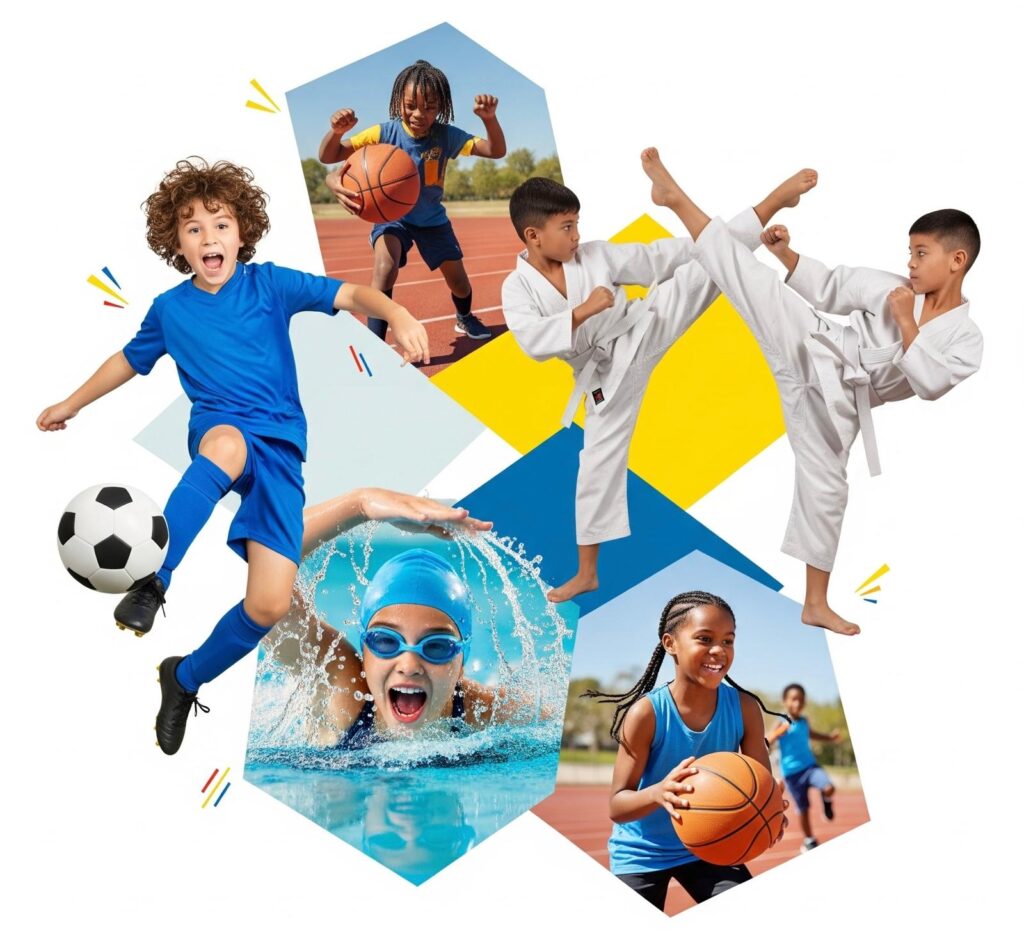
a) Team sports (e.g., soccer, basketball, netball, hockey)
Team sports consistently show the strongest protective effects for mental health.
- Children in team sports have lower depression and anxiety rates compared to those in individual sports only (Sabiston et al., 2016).
- Team settings build social skills, empathy, and communication, supporting resilience.
- A longitudinal study found children in organised team sports had higher self-esteem and life satisfaction into adolescence (Vella et al., 2017).
Best for: Children who benefit from structure, social interaction, and belonging.
b) Martial arts (e.g., judo, karate, taekwondo)
Martial arts combine physical exercise with discipline, mindfulness, and self-control.
- Meta-analyses show martial arts participation improves self-regulation, respect, and emotional control (Vertonghen & Theeboom, 2010).
- Children often report greater confidence and reduced aggression when training in structured martial arts environments.
Best for: Children who struggle with self-control, attention, or anxiety.
c) Swimming
Swimming has unique benefits as both an individual and group activity.
- Studies show aquatic exercise reduces stress and anxiety and improves mood in children (Franco et al., 2021).
- Swimming requires rhythmic breathing, which may mimic mindfulness practices, supporting relaxation.
- Group swimming lessons also enhance confidence and safety skills.
Best for: Children with anxiety, sensory sensitivities, or those who prefer non-competitive settings.
d) Dance
Dance is a creative form of exercise that blends movement, self-expression, and social interaction.
- Research shows dance improves self-esteem, emotional expression, and body image (Quiroga Murcia et al., 2010).
- Group dance fosters belonging and peer relationships, while individual dance enhances confidence.
- Dance therapy is even used clinically to support children with trauma and developmental disorders (Koch et al., 2014).
Best for: Children who enjoy creativity, music, and expressive movement.
e) Individual sports (e.g., tennis, athletics, gymnastics)
Individual sports provide discipline, goal-setting, and independence.
- They promote resilience and mastery when children learn to overcome challenges alone (Eime et al., 2013).
- However, research shows children in individual sports may have higher anxiety compared to team sports, likely due to performance pressure (Sabiston et al., 2016).
Best for: Children with strong self-motivation or those who prefer working at their own pace.
3. Choosing the right sport for your child
When choosing a sport, consider:
- Your child’s personality: Outgoing children may thrive in team sports, while introverted children may prefer dance, swimming, or martial arts.
- Mental health needs: Anxious children may benefit from rhythmic, calming activities like swimming or martial arts.
- Accessibility and inclusion: Choose programs with supportive coaches and age-appropriate training.
- Enjoyment first: The best predictor of long-term benefits is whether your child enjoys the activity (Crane & Temple, 2015).
4. How much sport is enough?
- The World Health Organization (WHO, 2020) recommends children engage in at least 60 minutes of moderate-to-vigorous activity per day.
- Structured sport 2–3 times per week, combined with informal play, provides optimal benefits for mental health.
FAQs
Q: What sport is best for children’s mental health?
Team sports like soccer and basketball provide the strongest benefits, but martial arts, swimming, and dance are also excellent options.
Q: Are individual sports bad for mental health?
Not at all. Individual sports build resilience and confidence, but research shows team sports may offer stronger protection against anxiety and depression.
Q: How many hours of sport should my child do each week?
At least 60 minutes of activity per day is recommended, with structured sport 2–3 times weekly.
Q: Can sport help children with anxiety?
Yes. Swimming, martial arts, and team sports all reduce anxiety and build coping skills.
References
- Biddle, S.J.H. et al. (2019) ‘Physical activity and mental health in children and adolescents: An updated review of reviews and an analysis of causality’, Psychology of Sport and Exercise, 42, pp. 146–155.
- Crane, J. & Temple, V. (2015) ‘A systematic review of dropout from organised sport among children and youth’, European Physical Education Review, 21(1), pp. 114–131.
- Donnelly, J.E. et al. (2016) ‘Physical activity, fitness, cognitive function, and academic achievement in children’, Medicine & Science in Sports & Exercise, 48(6), pp. 1197–1222.
- Eime, R.M., Young, J.A., Harvey, J.T., Charity, M.J. & Payne, W.R. (2013) ‘A systematic review of the psychological and social benefits of participation in sport for children and adolescents’, International Journal of Behavioral Nutrition and Physical Activity, 10(1), p. 98.
- Ekeland, E., Heian, F. & Hagen, K.B. (2005) ‘Can exercise improve self-esteem in children and young people? A systematic review of randomised controlled trials’, British Journal of Sports Medicine, 39(11), pp. 792–798.
- Franco, L.S. et al. (2021) ‘Aquatic exercise and mental health outcomes: A systematic review’, Mental Health and Physical Activity, 20, 100404.
- Hillman, C.H., Erickson, K.I. & Kramer, A.F. (2008) ‘Be smart, exercise your heart: Exercise effects on brain and cognition’, Nature Reviews Neuroscience, 9(1), pp. 58–65.
- Koch, S.C., Kunz, T., Lykou, S. & Cruz, R. (2014) ‘Effects of dance movement therapy and dance on health-related psychological outcomes: A meta-analysis’, The Arts in Psychotherapy, 41(1), pp. 46–64.
- Lubans, D.R. et al. (2016) ‘Physical activity for cognitive and mental health in youth: A systematic review of mechanisms’, Pediatrics, 138(3), e20161642.
- Quiroga Murcia, C., Kreutz, G., Clift, S. & Bongard, S. (2010) ‘Shall we dance? An exploration of the perceived benefits of dancing on well-being’, Arts & Health, 2(2), pp. 149–163.
- Sabiston, C.M., Jewett, R., Ashdown-Franks, G., Belanger, M. & Brunet, J. (2016) ‘Number of years of team and individual sport participation during adolescence and depressive symptoms in early adulthood’, Journal of Adolescent Health, 58(2), pp. 157–163.
- Stella, J.L., Croney, C.C. & Buffington, C.T. (2013) ‘Environmental factors that affect the behaviour and welfare of domestic cats living in the home’, Journal of Feline Medicine and Surgery, 15(8), pp. 737–749.
- Vella, S.A., Swann, C., Allen, M.S., Schweickle, M.J. & Magee, C.A. (2017) ‘Bidirectional associations between sport involvement and mental health in adolescence: A systematic review and meta-analysis’, Journal of Sport and Exercise Psychology, 39(6), pp. 498–509.
- Vertonghen, J. & Theeboom, M. (2010) ‘The social-psychological outcomes of martial arts practise among youth: A review’, Journal of Sports Science and Medicine, 9(4), pp. 528–537.
- World Health Organization (2020) Guidelines on Physical Activity and Sedentary Behaviour. Geneva: WHO.