1. Mental Health in Australia: Prevalence & Need
- Approximately 1 in 5 Australians (aged 16–85) experienced a mental disorder in any given year between 2020–2022; 42.9% had in their lifetime. Anxiety (17.2%) and high rates among youth (38.8% for ages 16–24) underscore widespread need (AIHW, 2025; ABS, 2023).
- Significantly more people are seeking help: 3.4 million saw a health professional and 612,000 used digital or phone-based services in the year preceding December 2021 (Department of Health, 2023).
2. Structure of Australia’s Mental Health System
Australia’s system is a complex mix of federal, state/territory, private, and not-for-profit services. It includes:
- Hospital-based services: psychiatric units for acute care.
- Community-based services: outpatient clinics, GP referrals, and support agencies.
- Crisis and digital services, including Lifeline, Headspace, and MindSpot (AIHW, 2025).
3. Key Service Pathways
A. GPs & the Better Access Scheme
Through Medicare, GPs can refer patients for subsidised sessions with psychologists and psychiatrists via the Better Access scheme, delivering over 30 million treatment services since 2006 (Baxter et al., 2021).
B. Digital and Phone-Based Services
- MindSpot Clinic: Offers free online assessments and CBT courses designed for those with anxiety, depression, OCD, PTSD, and more (Titov et al., 2015).
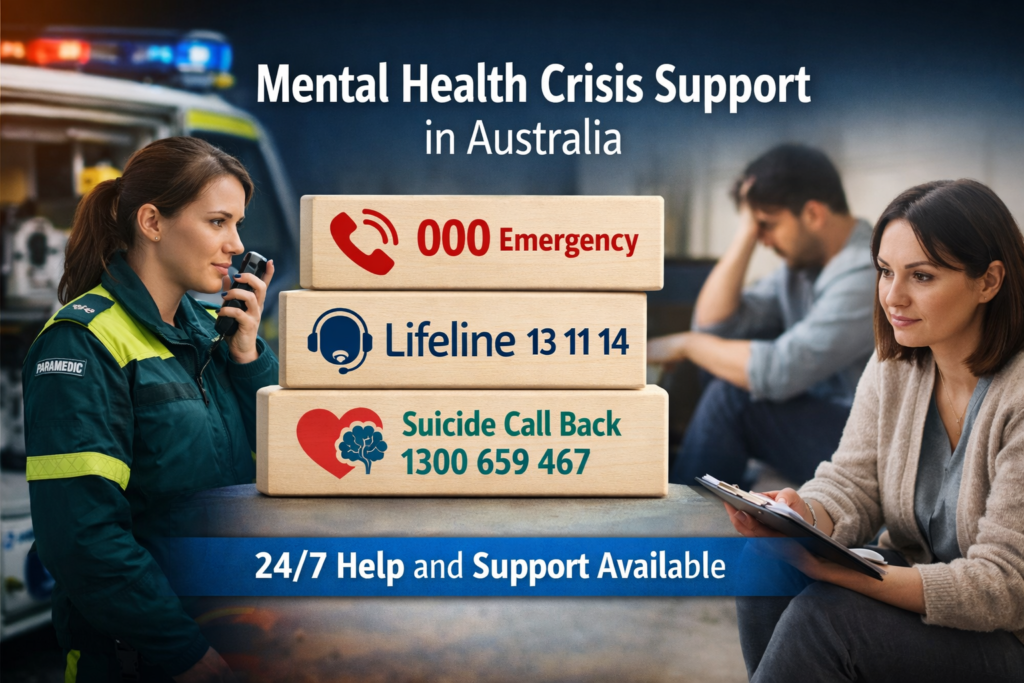
- Lifeline: A 24/7 national crisis line (13 11 14), providing emotional support and suicide prevention.
- Kids Helpline: Offers free counselling for young people (5–25 years) via phone, online, and email.
- headspace: Focused on youth (12–25), offering in-person and e‑health services for concerns like mental health, relationships, and substance use (Rickwood et al., 2015).
- Healthdirect Australia: Government-operated 24/7 health advice and service directory.
C. Medicare Mental Health Centres
Walk-in centres offering free, no‑referral support services and information for anyone, including non-citizens (Services Australia, 2023).
4. Barriers & Regional Disparities
- Rural and remote Australians face higher suicide risk and lower service uptake, partly due to distance, technology gaps, and cultural barriers (Fuller et al., 2023).
- System complexity, lower mental health literacy, and fewer culturally responsive services further impede access (Mental Health Australia, 2023).
5. National Frameworks & Standards
- The National Standards for Mental Health Services apply to all providers, ensuring safe, high-quality care (Department of Health, 2010).
- The Recovery-Oriented Framework centres on dignity, self-determination, and holistic wellbeing across services (Department of Health, 2013).
6. Funding & Reform Efforts
A. Federal Funding Initiatives
- In 2025, the Federal Government pledged $1 billion toward expanding youth mental health centres, Medicare clinics, and Headspace services (The Guardian, 2025).
- Major parties proposed increased Medicare rebates, telehealth services, and investments in rural mental health infrastructure (News.com.au, 2025).
B. Service Gaps & Advocacy
- Mental health professionals warn that rising demand, staff shortages, and cost barriers are leaving vulnerable Australians unsupported (News.com.au, 2025).
- New Step-Up Step-Down centre in Townsville is set to open by 2027 to ease pressure on emergency departments (Courier Mail, 2025).
- Community-led initiatives like “Jack’s Place” on the Sunshine Coast provide therapeutic, home-like refuges for those experiencing crisis (Courier Mail, 2025).
7. Choosing the Right Service for You
| Need | Best Starting Point |
|---|---|
| Immediate crisis or suicidal thoughts | Lifeline (13 11 14) or nearest emergency department |
| Early intervention & youth support | headspace or Medicare Mental Health Centres |
| Professional therapy access | GP referral under Better Access scheme |
| Remote or tech-supported care | MindSpot, Healthdirect, eheadspace |
| Structured recovery & hospital stepping-stone | Step-Up Step-Down centres (available regionally) |
| Alternative safe spaces | Community models like “Jack’s Place” |
8. Why This Matters for Mental Health
With nearly half of all Australians likely to experience mental ill-health at some point, access to diverse, effective services is essential. These services reduce distress, improve outcomes, and offer hope for recovery (AIHW, 2025).
FAQs
Q: How many Australians use mental health services each year?
Around 10% of the population received Medicare-supported mental health services in 2023–24 (~2.7 million people) (AIHW, 2025).
Q: What support is available for youth mental health?
headspace provides free or low-cost services both in-centre and online for those aged 12–25 (Rickwood et al., 2015).
Q: Are there mental health services available in regional Australia?
Yes, though challenges exist such as distance, limited providers, and technological barriers (Fuller et al., 2023).
Q: Can I access mental health support without seeing a GP?
Yes—via services like MindSpot, Lifeline, Kids Helpline, headspace, Medicare Mental Health Centres, and Healthdirect (Services Australia, 2023).
References
- AIHW (2025) Mental health services overview, Australian Institute of Health and Welfare.
- ABS (2023) National Study of Mental Health and Wellbeing 2020–2022, Australian Bureau of Statistics.
- Baxter, A.J., Harris, M.G. & Reavley, N.J. (2021) ‘Better Access initiative: impact and outcomes’, Australian & New Zealand Journal of Psychiatry, 55(6), pp. 522–534.
- Courier Mail (2025) New $6m mental health centre coming to Townsville by 2027.
- Department of Health (2010) National Standards for Mental Health Services 2010. Canberra: Commonwealth of Australia.
- Department of Health (2013) A National Framework for Recovery-Oriented Mental Health Services. Canberra: Commonwealth of Australia.
- Department of Health (2023) National Study confirms importance of mental health services.
- Fuller, J., Martinez, L. & Reid, K. (2023) ‘Barriers to mental health service access in rural Australia’, BMC Health Services Research, 23(1), pp. 1–12.
- Mental Health Australia (2023) Mapping mental health care access in Australia.
- News.com.au (2025) Vulnerable Aussies at breaking point.
- Rickwood, D., Telford, N., Parker, A., Tanti, C. & McGorry, P. (2015) ‘headspace – Australia’s innovation in youth mental health’, Medical Journal of Australia, 202(10), pp. 533–536.
- Services Australia (2023) Mental health care and Medicare.
- The Guardian (2025) Albanese recalls family friend’s confronting struggle as he launches $1bn funding pledge.
- Titov, N., Dear, B.F., Staples, L.G. et al. (2015) ‘MindSpot Clinic: An accessible, efficient, and effective online treatment for anxiety and depression’, Australian & New Zealand Journal of Psychiatry, 49(10), pp. 950–960.