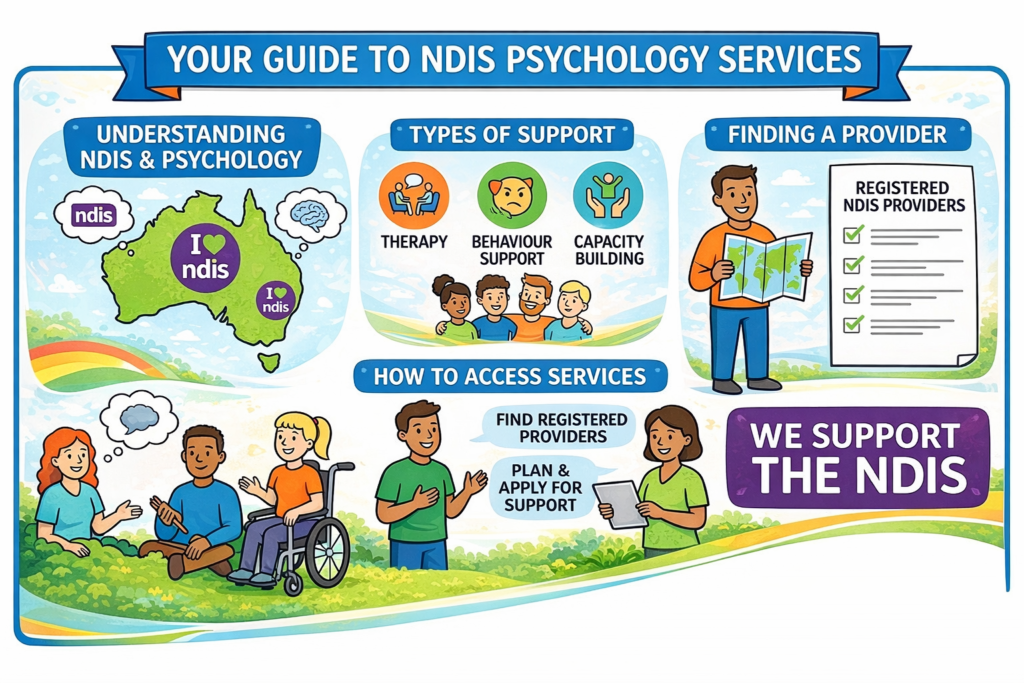

Telehealth therapy (video or phone) is as effective as in‑person for many common conditions—depression, anxiety, PTSD, insomnia and substance use—when sessions are structured and privacy is adequate (Backhaus et al., 2012; Hubley et al., 2016; Berryhill et al., 2019; Batastini et al., 2021; Lin et al., 2019; Trauer et al., 2015). A strong therapeutic alliance can be built online (Norwood et al., 2018). Consider in‑person or hybrid care if you have limited privacy, high immediate risk, or sensory/cognitive barriers that complicate video sessions. In Australia, Telehealth psychology can be accessed privately, via Medicare rebates (with a GP plan) and under the NDIS where clinically appropriate (NDIA, 2025a; NDIA, 2025c).
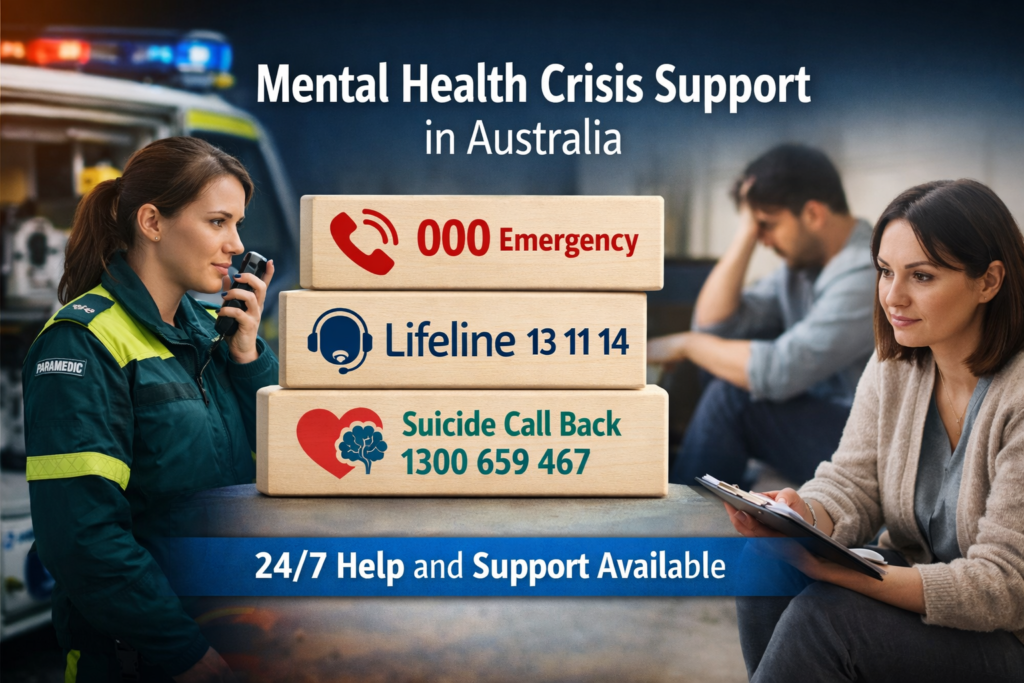
If you are in crisis or at risk, call 000. For 24/7 support, contact Lifeline 13 11 14 or 13YARN (for Aboriginal and Torres Strait Islander people).
What counts as “Telehealth therapy”?
- Synchronous video (most common) delivered via secure platforms.
- Telephone sessions where video is impractical.
- Blended care: online materials or apps plus live sessions.
Your clinician should confirm identity, location, consent, and a safety plan for emergencies.
Is it effective? What the research says
- Depression & anxiety: Large evidence base shows online CBT/ACT and videoconference psychotherapy produce outcomes comparable to in‑person care (Hofmann et al., 2012; Backhaus et al., 2012; Berryhill et al., 2019; A‑Tjak et al., 2015).
- PTSD & trauma: Strong support for PE/CPT via video; EMDR can be delivered effectively online with protocol adaptations (Cusack et al., 2016; Chen et al., 2014).
- OCD: ERP via video is effective when exposure and response prevention are carefully coached (Olatunji et al., 2013).
- Insomnia: CBT‑I works well online and by phone (Trauer et al., 2015).
- Substance use: Telemedicine‑delivered CBT/CM improves engagement and outcomes for several SUDs (Lin et al., 2019).
- Therapeutic alliance: Alliance ratings online are generally non‑inferior to in‑person (Norwood et al., 2018).
Bottom line: delivery mode matters less than fit, structure, and consistency. Your goals, preferences and environment decide the winner.
Quick self‑check: is Telehealth a good fit for you right now?
Tick what applies:
Good signs
- I can find a private, quiet space for 45–60 minutes.
- I’m comfortable with basic video/phone tech.
- My goals are skills‑focused (e.g., CBT tools, exposure plans, sleep routines).
- Travel/childcare/work make in‑person hard.
- I live regional/remote or have mobility/health barriers.
Consider hybrid/in‑person
- I cannot secure privacy (e.g., shared room, family nearby).
- I have immediate safety risks (self‑harm, domestic violence).
- I have sensory/cognitive challenges that make screens overwhelming.
- I need assessments or interventions that require in‑room equipment.
Discuss answers with your clinician; you can switch formats later.
Pros and cons (practical, not hype)
Pros
- Access & convenience: no travel time; easier for carers/shift‑workers; better clinician matching across Australia (Hubley et al., 2016).
- Continuity: fewer cancellations, useful during flare‑ups/illness.
- Cost control: NDIS plans avoid travel claims; private clients save petrol/parking (NDIA, 2025a; 2025c).
- Exposure in context: for anxiety/OCD, exposures can be done in the actual setting (home/work), not just imagined.
Cons
- Privacy limits: thin walls or interruptions reduce effectiveness.
- Tech friction: low bandwidth, audio lag can disrupt flow.
- Engagement drift: harder to notice subtle avoidance; requires active coaching.
- Suitability: some assessments (e.g., certain cognitive tests) and complex risk scenarios are better in person.
What Telehealth looks like for common concerns
- Depression: Behavioural Activation tasks are set for your week; check‑ins track activity vs mood (Ekers et al., 2014).
- Generalised anxiety & panic: psychoeducation, interoceptive and situational exposures; between‑session practice is key (Norton & Price, 2007).
- Social anxiety: graded real‑world exercises (calls, video‑on meetings), behavioural experiments (Mayo‑Wilson et al., 2014).
- PTSD: PE/CPT/EMDR with clear safety planning; optional support person nearby if helpful (Cusack et al., 2016; Chen et al., 2014).
- OCD: home‑based ERP targets real triggers; therapist observes rituals and guides prevention (Olatunji et al., 2013).
- Insomnia: CBT‑I protocols via video/phone; sleep diaries and stimulus control (Trauer et al., 2015).
- Couples: EFT/IBCT works online with structured turns and homework (Wiebe & Johnson, 2016; Shadish & Baldwin, 2003).
Preparing for your first session (10‑point checklist)
- Private space with a door; tell housemates you’ll be unavailable.
- Headphones + stable internet; test audio/video.
- Safety plan: confirm your current address, emergency contact, and local crisis options with your clinician.
- Agenda: write 1–2 goals and 1 recent example of the problem.
- Materials: notebook, medication list, recent reports.
- Camera position: eye‑level, steady; light in front.
- Notifications off; water tissues nearby.
- Back‑up plan: swap to phone if video fails.
- Boundaries: no driving/multitasking during sessions.
- Aftercare: book next session; plan one small action within 24 h.
Privacy, security and professionalism
- Use HIPAA/APPI‑aligned platforms and avoid public Wi‑Fi; your provider should explain encryption and data handling.
- In Australia, clinicians follow AHPRA standards, the Australian Privacy Principles, and (for NDIS) Commission rules on records and safety (AHPRA, 2020; OAIC, 2022; NDIS Commission, 2018).
- You may request a copy of your consent and a summary of your Telehealth plan.
Access and funding in Australia
- Private: pay‑per‑session; many clinics offer reduced‑fee or package options.
- Medicare: rebates may apply with a GP Mental Health Treatment Plan (check current MBS).
- NDIS: Telehealth is allowed when clinically appropriate; it can reduce travel charges and improve access in regional/remote areas (NDIA, 2025a; NDIA, 2025c).
- WorkCover & EAP: many employers fund Telehealth psychology; check your policy.
TherapyNearMe.com.au offers Telehealth psychology nationwide and home visits in select areas. Call 1800 NEAR ME.
When to switch (or add) in‑person sessions
- Privacy fails repeatedly despite problem‑solving.
- High acute risk or safeguarding issues arise.
- You need standardised assessments or exposure coaching that requires clinician presence.
- You simply prefer the room. Preference matters for engagement.
References
A‑Tjak, J.G.L., Davis, M.L., Morina, N., Powers, M.B., Smits, J.A.J. & Emmelkamp, P.M.G. (2015) ‘A meta‑analysis of the efficacy of Acceptance and Commitment Therapy (ACT) for anxiety and depression’, Journal of Affective Disorders, 185, pp. 13–22.
Backhaus, A., Agha, Z., Maglione, M.L., Repp, A., Ross, B., Zuest, D., Rice‑Thorp, N.M., Lohr, J. & Thorp, S.R. (2012) ‘Videoconferencing psychotherapy: A systematic review’, Psychological Services, 9(2), pp. 111–131.
Batastini, A.B., Paprzycki, P., Jones, A.C. & MacLean, N. (2021) ‘Are videoconferenced mental and behavioral health services just as good as in‑person? A meta‑analysis of a fast‑growing practice’, Clinical Psychology Review, 83, 101944.
Berryhill, M.B., Culmer, N., Williams, N., Halli‑Tierney, A., Betancourt, A., King, M., et al. (2019) ‘Videoconferencing psychotherapy and depression: a systematic review’, Telemedicine and e‑Health, 25(6), pp. 435–446.
Chen, Y.‑R., Hung, K.‑W., Tsai, J.‑C., Chu, H., Chung, M.‑H., Chen, S.‑R. & Chou, K.‑R. (2014) ‘Efficacy of eye‑movement desensitization and reprocessing for patients with post‑traumatic stress disorder: a meta‑analysis’, PLoS ONE, 9(8), e103676.
Cusack, K., Jonas, D.E., Forneris, C.A., Wines, C., Sonis, J., Middleton, J.C. et al. (2016) ‘Psychological treatments for adults with PTSD: a systematic review and meta‑analysis’, Annals of Internal Medicine, 165(12), pp. 757–767.
Ekers, D., Webster, L., Van Straten, A., Cuijpers, P., Richards, D. & Gilbody, S. (2014) ‘Behavioural activation for depression: an updated meta‑analysis of effectiveness’, PLoS ONE, 9(6), e100100.
Hofmann, S.G., Asnaani, A., Vonk, I.J.J., Sawyer, A.T. & Fang, A. (2012) ‘The efficacy of cognitive behavioral therapy: a review of meta‑analyses’, Cognitive Therapy and Research, 36(5), pp. 427–440.
Hubley, S., Lynch, S.B., Schneck, C., Thomas, M. & Shore, J. (2016) ‘Review of the effectiveness of telepsychiatry: evidence base and implications for clinical practice’, World Journal of Psychiatry, 6(2), pp. 219–230.
Lin, L.A., Casteel, D., Shigekawa, E., Weyrich, M.S., Roby, D.H. & McMenamin, S.B. (2019) ‘Telemedicine‑delivered treatment interventions for substance use disorders: A systematic review’, Journal of Substance Abuse Treatment, 101, pp. 38–49.
Norwood, C., Moghaddam, N.G., Malins, S. & Sabin‑Farrell, R. (2018) ‘Working alliance and outcome effectiveness in videoconferencing psychotherapy: A systematic review and meta‑analysis’, Clinical Psychology & Psychotherapy, 25(6), pp. 797–816.
Norton, P.J. & Price, E.C. (2007) ‘A meta‑analytic review of adult CBT outcomes across the anxiety disorders’, Journal of Nervous and Mental Disease, 195(6), pp. 521–531.
OAIC (2022) Australian Privacy Principles Guidelines. Canberra: Office of the Australian Information Commissioner. Available at: https://www.oaic.gov.au/
Olatunji, B.O., Davis, M.L., Powers, M.B. & Smits, J.A.J. (2013) ‘Cognitive behavioral therapy for obsessive–compulsive disorder: a meta‑analysis of treatment outcome and moderators’, Journal of Psychiatric Research, 47(1), pp. 33–41.
Shadish, W.R. & Baldwin, S.A. (2003) ‘Meta‑analysis of marital and family therapy: an updated review’, Journal of Marital and Family Therapy, 29(4), pp. 547–570.
Trauer, J.M., Qian, M.Y., Doyle, J.S., Rajaratnam, S.M.W. & Cunnington, D. (2015) ‘Cognitive behavioral therapy for chronic insomnia: a systematic review and meta‑analysis’, Annals of Internal Medicine, 163(3), pp. 191–204.
AHPRA (2020) Telehealth guidance for practitioners. Melbourne: Australian Health Practitioner Regulation Agency. Available at: https://www.ahpra.gov.au/
NDIA (2025a) NDIS Pricing Arrangements and Price Limits 2025–26. Canberra: National Disability Insurance Agency. Available at: https://www.ndis.gov.au/
NDIA (2025c) ‘Therapy supports’, NDIS – Supports funded by the NDIS. Canberra: National Disability Insurance Agency. Available at: https://www.ndis.gov.au/
Educational only; not a substitute for personalised advice. If you need urgent help, call 000. For Telehealth bookings with a registered psychologist, visit TherapyNearMe.com.au or call 1800 NEAR ME