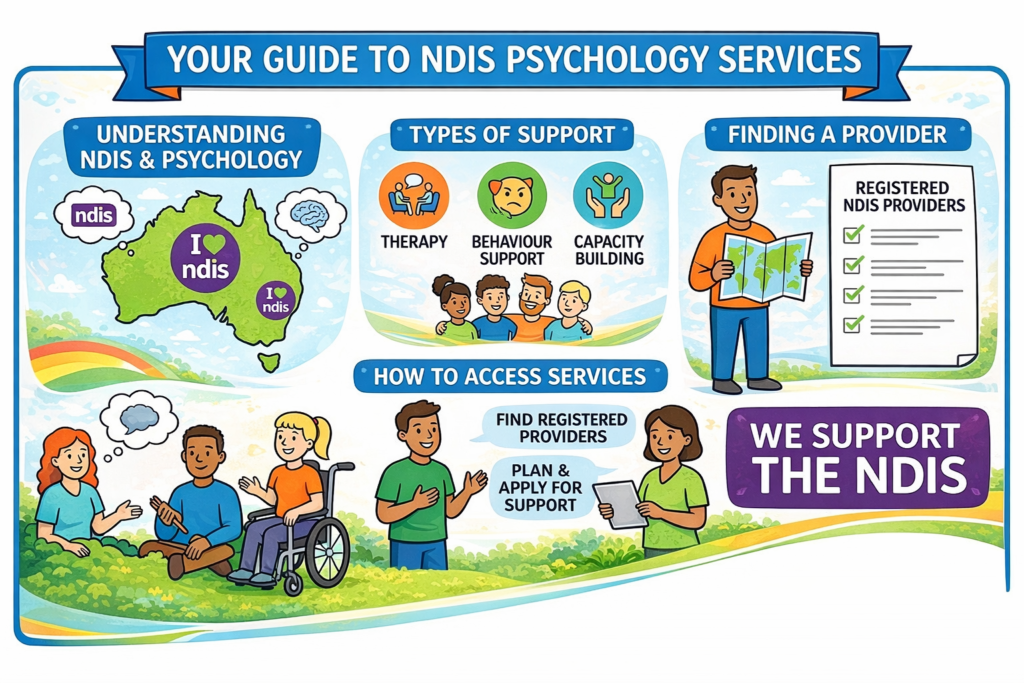
Updated for 1 July 2025 price arrangements and travel rules. This practical, plain‑English guide explains how NDIS funding works in 2025–26, what changed on 1 July 2025, and the smartest ways to use psychology, counselling, social work and behaviour support within your budget. It is written for participants, families, support coordinators and plan managers across Australia.
Note: This article is general information only; it is not financial or legal advice. Always check your plan and the current NDIS Pricing Arrangements and Price Limits (PAPL) 2025–26 and the Therapy Supportsguidance for the live rules (NDIA, 2025a; NDIA, 2025c).
1) NDIS budgets at a glance
Most plans have three funding buckets:
- Core — everyday supports to help you live your life (e.g., community access, daily activities, consumables).
- Capacity Building — skill‑building therapy supports (e.g., psychology, behaviour support, occupational therapy, speech pathology, physiotherapy).
- Capital — assistive technology (AT) and home modifications.
Therapy such as psychology, social work, behaviour support, speech and OT generally draws from Capacity Building: Improved Daily Living or Improved Relationships. Therapy must be evidence‑based and delivered by qualified professionals, even for self‑managed plans (NDIA, 2025c).
Tip: Keep therapy time, report writing, non‑face‑to‑face (NFTF) time and travel as separate line items on invoices. It helps you and your plan manager track spending and ensures claims align with the Support Catalogue (NDIA, 2025a).
How to read your plan (codes & categories)
- Category names (e.g., Improved Daily Living) describe the purpose; individual line items in the Support Catalogue determine price limits and flags such as Non‑Face‑to‑Face and Provider Travel.
- Management type (self/plan/agency) determines how invoices are paid and whether you must use registered providers. The evidence‑based requirement applies to all therapy regardless of management (NDIA, 2025c).
- Stated supports vs flexible budgets: some items (e.g., Specialist Behaviour Support) may be stated, but most therapy is flexible within its category.
2) What changed on 1 July 2025?
Price limits refreshed (2025–26)
The NDIA’s annual update adjusted national price limits across support types. Always confirm the live figure for your profession in the Support Catalogue that sits alongside the PAPL (NDIA, 2025a). Sector summaries reported standardisation across some therapy items (e.g., psychology) and small shifts for others (NDS, 2025).
New therapy‑travel rule (from 1 July 2025)
From 1 July 2025, therapy providers can claim 50% of the relevant hourly price limit for travel time, subject to the usual time caps by remoteness (NDIA, 2025b; NDIA, 2025a):
- Metro (MMM 1–3): up to 30 minutes each way
- Regional (MMM 4–5): up to 60 minutes each way
- Remote/Very remote (MMM 6–7): flexible arrangements (existing remote loadings apply)
This 50% rule applies only to therapy providers, not to disability support workers. Providers can still claim non‑labour travel costs (e.g., parking, tolls, vehicle running costs) separately by agreement (NDIA, 2025b).
Gap fees and plan‑manager responsibilities
Registered providers cannot charge gap fees or add‑ons above price limits. Plan managers must not pay invoices that exceed price limits (NDIA, 2025b). Self‑managed participants may agree higher rates but should ensure value for money and clear documentation (NDIA, 2025c).
3) Therapy supports: who can deliver what in 2025
The NDIA’s Therapy Supports guideline clarifies that therapy must be evidence‑based, current good practice, and delivered by professionals with the appropriate Ahpra registration or relevant professional accreditation (NDIA, 2025c). This applies across plan types (self‑, plan‑ and agency‑managed).
- Behaviour support is funded under Improved Relationships and—when specialised—requires a Behaviour Support Plan and compliance with the NDIS Commission’s restrictive‑practices rules (NDIS Commission, 2018; 2023a; 2023b).
- Psychology, social work and counselling typically sit under Improved Daily Living.
- Telehealth can be funded when clinically suitable; a growing evidence base finds comparable outcomes to in‑person allied health for many interventions, with high satisfaction among adults with disability (Monash, 2024; Scherer et al., 2022).
Evidence snapshot (why the NDIA insists on “evidence‑based”):
Independent and peer‑reviewed work shows that individualised funding improves choice and control, yet outcomes vary without quality providers and coordination (Fisher, 2019; Bigby et al., 2020; Young et al., 2025). That’s why provider quality and clear goals matter.
Examples of evidence‑based therapies commonly funded
- CBT/ACT for anxiety, mood and everyday functioning; motivational interviewing for behaviour change.
- Parent‑mediated programs for child behaviour (e.g., Triple P, PCIT) and Positive Behaviour Support for challenging behaviours (NICE, 2015; Sanders et al., 2014; Thomas & Zimmer‑Gembeck, 2012).
- Social‑communication interventions in autism alongside function‑based strategies (NICE, 2018; Pickles et al., 2016).
4) Travel, home and school visits in 2025
If your therapist travels to you:
- Labour (time) component: claimable at 50% of the hourly price limit within the MMM time caps above (NDIA, 2025b).
- Non‑labour costs: by agreement, e.g., vehicle running costs, parking and tolls (and, for outreach, flights/accommodation). Itemise separately to keep your therapy budget transparent (NDIA, 2025b).
Make visits efficient:
- Stack appointments at the same location (e.g., siblings, housemates or same school).
- Request back‑to‑back sessions for family members when clinically appropriate.
- Consider Telehealth when suitable to conserve funds (Monash, 2024; Scherer et al., 2022).
- Ask your provider to apportion travel fairly when they see multiple participants in one area (NDIA, 2025b).
Understanding MMM (Modified Monash Model)
MMM classifies locations from 1 (major city) to 7 (very remote). Time caps and loadings depend on the MMM rating of the service area. You can check MMM via the federal Health Workforce Locator before agreeing to travel terms (NDIA, 2024; NDIA, 2025a).
5) Plan‑managed vs self‑managed vs agency‑managed
| Feature | Plan‑managed | Self‑managed | Agency‑managed |
|---|---|---|---|
| Can use unregistered providers? | Yes (within price limits) | Yes (can pay above limits but must still meet therapy qualifications) | Registered providers only |
| Who pays invoices? | Plan manager follows PAPL rules | You pay, then claim | NDIA pays registered providers |
| Admin load on you | Low | Higher | Low |
The Therapy Supports guideline confirms self‑managed participants may pay above price limits, but supports must still be reasonable and necessary and delivered by qualified practitioners (NDIA, 2025c). For most people, plan management balances choice and compliance.
Practical set‑up steps
- Share your plan (or summaries) and goals with the provider.
- Request a service agreement that lists session fees, travel (labour at 50%), non‑labour travel costs, NFTF tasks, cancellation rules and reporting timelines.
- Ask for an 8–12‑week care plan with review dates and outcome measures.
- Keep invoices itemised: therapy, NFTF, report writing, provider travel time, non‑labour travel.
6) Making your therapy budget last (and work)
- Write specific goals (e.g., “reduce panic attacks from 4 to 1/month; return to TAFE two days/week”). Specific goals guide evidence‑based interventions and reporting.
- Ask for a session plan (frequency, duration, expected milestones) and review against outcomes every 8–12 weeks.
- Separate line items: session time, non‑face‑to‑face work (care‑team liaison, notes), report writing, travel labour, travel non‑labour.
- Use blended care: in‑person for assessments and complex reviews; Telehealth for skills coaching and CBT homework where suitable (Monash, 2024; Scherer et al., 2022).
- Coordinate supports: avoid duplication across psychology, OT and behaviour support (NDIA, 2025c).
- Prepare for reassessment: keep a progress folder with assessments, outcome measures, attendance and goal tracking; it makes plan changes smoother (NDIA, 2024).
- Schedule blocks: cluster sessions early for skill acquisition, then taper to maintenance once goals are met.
- Measure change: track simple metrics (sleep hours, school days attended, incident frequency) to demonstrate value for money.
Worked examples (illustrative only)
A) Psychologist home visit in MMM 1 (metropolitan)
- Session: 60‑minute therapy (CB:IDL).
- Travel time: 20 minutes to you + 20 minutes return (≤30‑minute cap each way) → 40 minutes billable at 50%of the psychologist price limit (NDIA, 2025a; 2025b).
- Non‑labour costs: kilometres (as agreed, e.g., vehicle running cost) + parking.
- Invoice shows: (1) therapy time; (2) provider travel time (50% rate); (3) provider travel — non‑labour costs.
B) Behaviour support in MMM 4 (regional)
- Session: 90‑minute home‑based observation + coaching (Improved Relationships).
- Travel time: 50 minutes to you + 50 minutes return (≤60‑minute cap each way) → 100 minutes billable at 50%of the behaviour‑support price limit (NDIA, 2025a; 2025b).
- Non‑labour costs: kilometres + tolls (as agreed).
- Notes: specialist behaviour support also includes plan development and implementation support as NFTF where appropriate.
7) Behaviour support in 2025: what good looks like
- Positive Behaviour Support (PBS) focuses on quality of life and functional assessment, not just risk management.
- Plans using any regulated restrictive practice must meet Commission rules: last resort, least restrictive, authorised, time‑limited and reviewed at least annually (NDIS Commission, 2018; 2023a; 2023b).
- Ask for clear proactive strategies, environmental adjustments, skills teaching (e.g., Functional Communication Training) and measurable outcomes.
- Expect team training and coaching across home/school/community and a reduction plan for any restrictive practice.
Why it matters: Poor‑quality plans are common, and audits have shown gaps in consultation and strategy quality. Investing in thorough assessment and team training pays off in fewer incidents and better participation (NDIS Commission, 2019; McVilly in The Guardian*, 2024).*
Behaviour Support Plan (BSP) essentials — parent‑friendly checklist
- Functional Behaviour Assessment (ABC data, interviews, observations)
- Clear function hypothesis (escape, attention, access, sensory)
- Prevention strategies and environmental adjustments
- Replacement skills (e.g., FCT for break/help/more)
- Reinforcement and data‑tracking plan
- Crisis/safety steps and roles
- Restrictive practice only if absolutely necessary and authorised, with reduction goals (NDIS Commission, 2018).
8) Foundational supports: what’s coming
The Independent NDIS Review (2023) recommended building foundational supports (outside the NDIS) so earlier, lighter‑touch help is available via mainstream services. Governments have agreed in principle and are rolling out elements through 2025–26 (NDIS Review Panel, 2023). Expect clearer pathways for children, psychosocial supports and school‑based services over time.
What this means for you in 2025–26
- You may be able to access some help without an NDIS plan through mainstream or community programs.
- Focus NDIS therapy on function‑linked goals where the NDIS is the most appropriate funder.
9) Service agreement & invoice templates (copy‑ready)
A) Service‑agreement clause (example)
Therapy location: home / school / community / Telehealth.
Session fee: as per current NDIS price limit (or agreed self‑managed rate).
Provider travel (therapy): up to __ minutes each way per MMM rules; billed at 50% of the hourly price limit from 1 July 2025 (NDIA, 2025b).
Provider travel (non‑labour): kilometres at agreed vehicle running cost, plus tolls/parking where applicable.
Non‑face‑to‑face tasks: care‑team liaison, notes, Behaviour Support Plan updates — as needed and agreed.
Cancellations: short‑notice rules as per the PAPL.
Reporting: progress summary every 8–12 weeks; end‑of‑plan report as required.
B) Invoice anatomy (example headings)
- Therapy: date, duration, location (home/clinic/Telehealth)
- Non‑Face‑to‑Face: task description, duration
- Provider Travel — Labour (50%): minutes each way, total minutes
- Provider Travel — Non‑labour: kilometres, parking/tolls
- Notes: outcome measures or key milestones (optional)
10) Frequently asked questions (2025)
Q: Can my psychologist charge me for travel?
A: Yes. If they travel to you, they can claim 50% of the hourly price limit for travel time within MMM caps, plus agreed non‑labour costs like parking or vehicle costs. The travel and treatment time must be billed as separate items(NDIA, 2025b).
Q: I’m self‑managed. Can I pay above the price limit?
A: You can, but therapy must still be evidence‑based and delivered by a qualified practitioner. Make sure the value is clear and that the provider itemises work to avoid overspending (NDIA, 2025c).
Q: Do I have to be diagnosed with autism to access therapy under the NDIS?
A: No. Funding decisions look at functional impact and what is reasonable and necessary. Foundational supports are being expanded to reduce pressure for diagnosis‑driven access (NDIS Review Panel, 2023).
Q: Will Telehealth “count” the same as in‑person therapy?
A: Yes — when clinically suitable. Research shows allied‑health Telehealth often delivers outcomes comparable to face‑to‑face, with strong satisfaction among adults with disability (Monash, 2024; Scherer et al., 2022).
Q: Are gap fees allowed?
A: No. Registered providers cannot add gap fees or surcharges above the price limit. Plan managers cannot pay above the limit (NDIA, 2025b).
Q: What evidence should I keep for plan reassessment?
A: Keep attendance records, outcome measures (e.g., sleep, school, incident frequency), copies of reports and a brief goal‑progress table. These help demonstrate value for money and inform next‑plan goals (NDIA, 2024).
Q: Can providers bill for travel between two participants?
A: Yes. Travel time and non‑labour costs can be apportioned when a provider sees multiple participants on the same trip, by prior agreement (NDIA, 2025b).
11) Participant and coordinator checklists
Participant
- Goals are specific, measurable and time‑bound.
- Provider qualifications and registrations confirmed.
- Service agreement includes separate line items for therapy, report writing, NFTF, travel labour and non‑labour costs.
- Considered Telehealth for certain sessions to reduce travel costs.
- Progress folder maintained (assessments, outcomes, session logs).
Support coordinator / plan manager
- Confirm provider’s MMM assumptions and travel arrangements.
- Cross‑check invoices for itemisation and correct flags (NFTF, travel).
- Schedule outcome reviews every 8–12 weeks; align with participant goals.
- Watch for duplication across allied‑health disciplines; encourage joint sessions where efficient.
12) Glossary (plain English)
- PAPL: NDIS Pricing Arrangements and Price Limits — the rulebook for prices and claiming.
- MMM: Modified Monash Model — classifies locations by remoteness; affects travel caps and loadings.
- NFTF: Non‑Face‑to‑Face therapy work (e.g., reports, liaison) when allowed by the item.
- PBS: Positive Behaviour Support — a framework focusing on quality of life, skills and environments, with reduction of restrictive practices.
- Stated support: a support that must be used as specified in your plan. Most therapy is not stated.
AHPRA & quality disclaimer
We do not provide testimonials, and we do not make claims of guaranteed outcomes. All care is delivered by qualified practitioners working within scope and current evidence‑based guidelines.
In‑text referencing style
We use Harvard in‑text citations, e.g., (NDIA, 2025a; NDIA, 2025b; Monash, 2024).
References
NDIA & Government
- NDIA (2025a) NDIS Pricing Arrangements and Price Limits 2025–26 (Version 1.0, effective 1 July 2025).National Disability Insurance Agency. Available at: https://www.ndis.gov.au/ (Accessed 12 November 2025).
- NDIA (2025b) ‘Travel claiming rules, gap fees and other costs’, NDIS News, 23 July 2025. Available at: https://www.ndis.gov.au/ (Accessed 12 November 2025).
- NDIA (2025c) ‘Therapy supports’, NDIS — Supports funded by the NDIS. Available at: https://www.ndis.gov.au/(Accessed 12 November 2025).
- NDIS Quality and Safeguards Commission (2018) NDIS (Restrictive Practices and Behaviour Support) Rules 2018. Canberra: Australian Government.
- NDIS Quality and Safeguards Commission (2019) Compendium of resources for Positive Behaviour Support.Penrith: NDIS Commission. Available at: https://www.ndiscommission.gov.au/ (Accessed 12 November 2025).
- NDIS Quality and Safeguards Commission (2023a) Policy guidance: Developing behaviour support plans.Penrith: NDIS Commission. Available at: https://www.ndiscommission.gov.au/ (Accessed 12 November 2025).
- NDIS Quality and Safeguards Commission (2023b) ‘Behaviour support and restrictive practices — rules and guidance.’ Available at: https://www.ndiscommission.gov.au/ (Accessed 12 November 2025).
- NDIA (2024) ‘Participant, families and carer outcomes reports’, NDIS Data and Research. Available at: https://dataresearch.ndis.gov.au/ (Accessed 12 November 2025).
- NDIS Review Panel (2023) Working together to deliver the NDIS: Final Report. Canberra: Commonwealth of Australia. Available at: https://www.ndisreview.gov.au/ (Accessed 12 November 2025).
Peer‑reviewed and sector evidence
- Bigby, C., Douglas, J., Carney, T., Then, S.N., Wiesel, I. and Smith, E. (2020) ‘Factors that influence the quality of paid support for adults with acquired neurological disability: a scoping review and thematic synthesis’, Disability and Rehabilitation, 42(20), pp. 2967–2983.
- Fisher, K.R. (2019) ‘Choice, control and individual funding: the Australian National Disability Insurance Scheme’, in Positive Psychology and Disability (Springer), pp. 145–164.
- Monash University (2024) ‘Delivery of allied health interventions using Telehealth modalities: A rapid systematic review.’ Healthcare, 12(12), 1217.
- National Disability Services (NDS) (2025) ‘NDIS 2025–26 prices released’, NDS News, 11 June 2025. Available at: https://www.nds.org.au/ (Accessed 12 November 2025).
- Pickles, A., Le Couteur, A., Leadbitter, K., Salomone, E., Cole‑Fletcher, R., Tobin, H. et al. (2016) ‘Parent‑mediated social communication therapy for pre‑school autism: long‑term follow‑up’, The Lancet, 388(10059), pp. 2501–2509.
- Sanders, M.R., Kirby, J.N., Tellegen, C.L. & Day, J.J. (2014) ‘The Triple P‑Positive Parenting Program: A systematic review and meta‑analysis of a multi‑level system of parenting support’, PLOS ONE, 9(8), e104789.
- Scherer, M.J., et al. (2022) ‘Perceptions about the efficacy and acceptability of allied‑health Telehealth among adults with disability in Australia.’ American Journal of Physical Medicine & Rehabilitation, 101(6), pp. 1–8.
- Thomas, R. & Zimmer‑Gembeck, M.J. (2012) ‘Parent–Child Interaction Therapy: An evidence‑based treatment for child maltreatment’, Child Maltreatment, 17(3), pp. 253–266.
- NICE (2015) Challenging behaviour and learning disabilities: prevention and interventions (NG11). London: National Institute for Health and Care Excellence.
- NICE (2018) Autism spectrum disorder in under 19s: support and management (CG170 updated). London: NICE.
- Young, S., et al. (2025) ‘Individualised funding schemes for people with mild‑to‑moderate intellectual disability: a systematic review (1990–2024)’, Journal of Intellectual & Developmental Disability, 50(2), pp. xxx–xxx.
About TherapyNearMe.com.au
Australia’s fastest‑growing mental‑health service. Immediate appointments via Telehealth and home visits (selected areas). Psychology, counselling, social work and behaviour support for NDIS participants. Call 1800 NEAR ME.