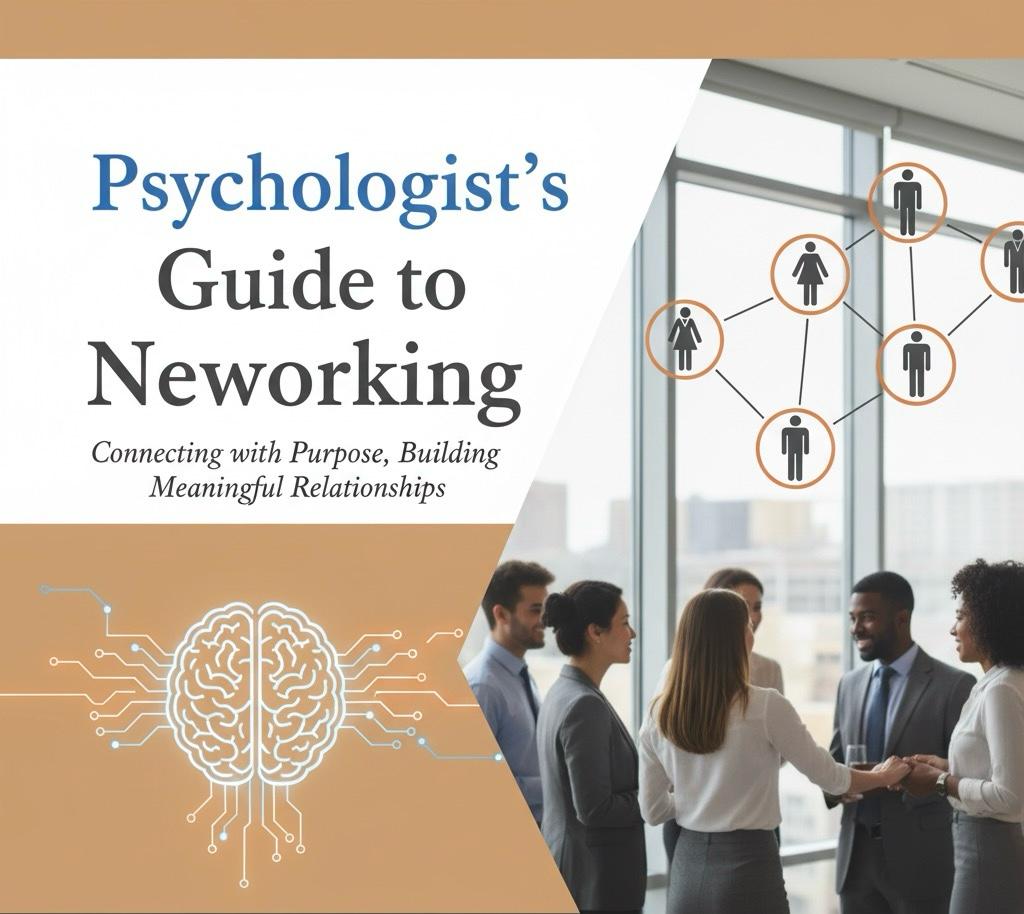
Great networkers are not the loudest people in the room—they are the most useful, curious, and reliable. Skills that matter most are: showing warmth + competence (first impressions), asking more questions, active listening, thoughtful follow‑ups, and cultivating a diverse mix of strong and weak ties (Ambady & Rosenthal, 1993; Huang et al., 2017; Itzchakov, Kluger & Castro, 2017; Granovetter, 1973; Burt, 2004). If networking feels “icky,” reframing it as helping others and learning removes the moral discomfort and increases effectiveness (Gino, Ayal & Ariely, 2014). Treat it like health: small, consistent habits beat rare heroic bursts (Lally, van Jaarsveld, Potts & Wardle, 2010).
Why networking works (and why it sometimes feels awful)
Networks drive opportunity. Weak ties and “brokers” who bridge groups hear about new ideas and roles sooner (Granovetter, 1973; Burt, 2004). Diverse teams and networks also improve problem‑solving (Hong & Page, 2004).
Your body reads rooms as threat. Social evaluation can trigger anxiety and safety behaviours (avoidance, over‑talking). Reappraising arousal as fuel improves performance (Jamieson, Mendes, Blackstock & Schmader, 2010) and self‑affirmation reduces threat responses (Cohen & Sherman, 2014).
“Instrumental networking” can feel dirty. Studies show people feel morally impure when networking for self‑gain, which reduces effort; reframing it as contributing to others or learning dissolves the effect (Gino, Ayal & Ariely, 2014).
Relationships protect wellbeing. Strong social ties buffer stress and predict longevity (Cohen & Wills, 1985; Holt‑Lunstad, Smith & Layton, 2010). That applies to professional ties too.
The first five minutes: make a trustworthy impression
- Warmth before competence. People infer intentions before ability; brief “thin‑slice” judgements shape later interactions (Ambady & Rosenthal, 1993). Smile, orient your torso, keep eye contact intervals natural.
- Openers that reduce anxiety. Use context‑anchored openers: “Hi, I’m [Name]. What brought you here today?” or “What have you learned so far?” (Cialdini, Reno & Kallgren, 1990, on norm cues).
- Signal prosocial intent. Offer small help first (“Want me to introduce you to X?”). Gratitude norms increase reciprocity (Grant & Gino, 2010).
Ask better questions; listen like a pro
- Ask more follow‑ups. In field and lab, question‑askers—especially those who ask follow‑ups—are liked more (Huang et al., 2017). Try: “That’s interesting—what made you choose that approach?”
- Use layered self‑disclosure. Reciprocal, gradual self‑disclosure builds liking and trust (Collins & Miller, 1994). Share a specific, low‑risk challenge you’re exploring; invite theirs.
- Practice high‑quality listening. Reflect back key points, ask for examples, and pause. Speakers feel more understood and less anxious when listened to well (Itzchakov, Kluger & Castro, 2017).
Build the right mix of ties
- Strong + weak ties. Strong ties support and sponsor you; weak ties expose you to novel information(Granovetter, 1973).
- Bridge “structural holes.” Being the connector between separate groups predicts creativity and access to “good ideas” (Burt, 2004).
- Avoid over‑embeddedness. Too many strong ties within one clique can limit novelty (Uzzi & Spiro, 2005).
- Reactivate dormant ties. Reaching out to past colleagues yields high‑value information rapidly (Levin, Walter & Murnighan, 2011).
Before / during / after: a psychologist’s playbook
Before
- Intentions, not scripts. Set approach goals (“learn three things; help one person”), not avoidance goals (“don’t be awkward”) (Elliot & Church, 1997).
- Self‑affirmation (2 mins). Write a few lines about a core value you live by; this reduces threat reactivity (Cohen & Sherman, 2014).
- Implementation intentions. If‑then plans double follow‑through (Gollwitzer, 1999): “If I finish a chat, then I’ll jot a note on their card/phone.”
During
- Two‑thirds rule. Aim for them speaking ~⅔ of the time. Use follow‑ups and summaries (Huang et al., 2017; Itzchakov et al., 2017).
- Name one concrete next step. “I’ll send you the paper I mentioned.” Specific commitments beat vague promises (Locke & Latham, 2002).
- Manage arousal. Slow exhale to 6 breaths/min for 60–90 seconds between conversations; improves regulation (Lehrer et al., 2020).
After
- Follow‑up within 24–48 hours. Reference something specific; offer value (a resource, intro, brief summary). Spaced follow‑ups keep ties warm (Cepeda et al., 2006).
- Log and tag. Track new contacts with 2–3 tags (topic, city, next action).
- Pay it forward. Make one intro a week; gratitude increases prosocial chains (Grant & Gino, 2010).
Anxiety‑friendly tactics (if networking terrifies you)
- Micro‑exposures. Build a graded ladder: comment on a post → DM → 1:1 coffee → small meetup → larger event (NICE, 2013).
- Reappraise nerves as readiness. “My heart’s racing because my body is preparing me to connect” (Jamieson et al., 2010).
- Self‑compassion script. Treat yourself like a good friend after awkward moments; reduces rumination (Neff, 2003).
Digital networking that doesn’t feel spammy
- Write for humans. Keep first messages 5–8 lines; show you’ve read their work; ask one clear question.
- Post useful summaries. Short, evidence‑based explainers make you a signal in noisy feeds.
- DM etiquette. Ask permission before sending pitches or calendars.
- Diversity beats echo. Follow beyond your field; diversity improves collective problem‑solving (Hong & Page, 2004).
A simple weekly cadence (compounds over time)
- Mon: Reactivate one dormant tie (Levin et al., 2011).
- Wed: Help one person (resource/intro).
- Fri: Meet one new person (coffee/video).
- Ongoing: Keep notes; send one gratitude email (Grant & Gino, 2010).
After ~8–10 weeks, habits feel more automatic (Lally et al., 2010).
FAQ
Isn’t networking just for extroverts?
No. Listening, thoughtful questions and reliable follow‑up are introvert‑friendly strengths (Huang et al., 2017; Itzchakov et al., 2017).
How big should my network be?
Breadth matters less than diversity and trust. Aim for a portfolio of strong and weak ties (Granovetter, 1973; Burt, 2004).
What if I hate small talk?
Use “high‑altitude” questions (what they’re curious about, what they’re building next). Then ask one follow‑up (Huang et al., 2017).
Australian pathways to support
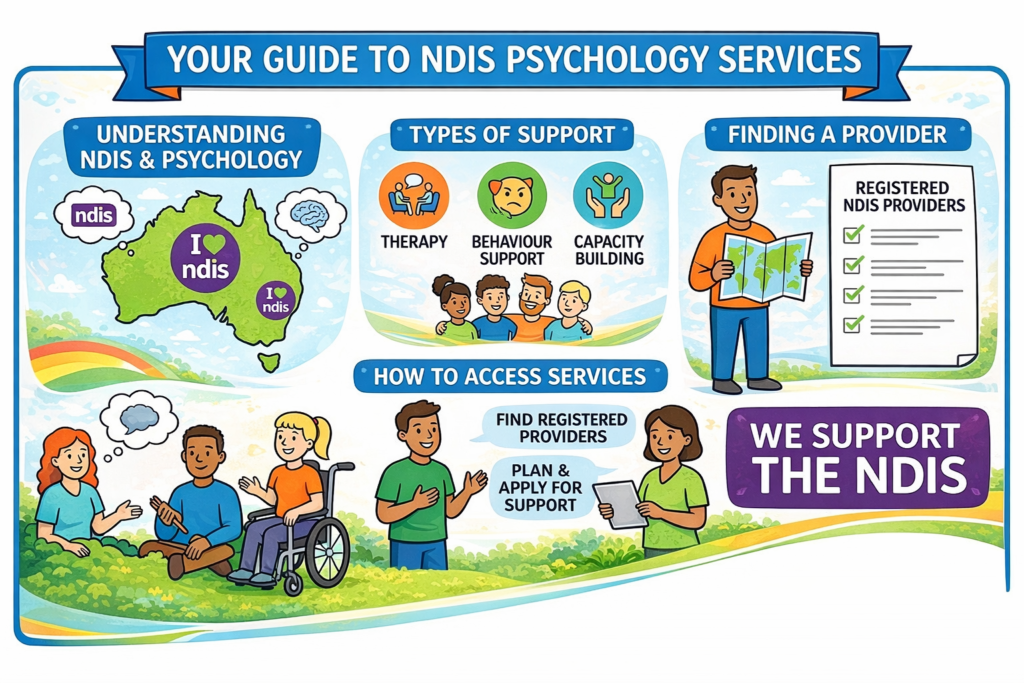
If networking anxiety or perfectionism is blocking your career, evidence‑based CBT and skills coaching can help. TherapyNearMe.com.au offers Telehealth psychology nationwide (Medicare/NDIS/private). In a crisis call 000 or Lifeline 13 11 14.
References
Ambady, N. & Rosenthal, R. (1993) ‘Half a minute: Predicting teacher evaluations from thin slices of nonverbal behavior and physical attractiveness’, Journal of Personality and Social Psychology, 64(3), pp. 431–441.
Burt, R.S. (2004) ‘Structural holes and good ideas’, American Journal of Sociology, 110(2), pp. 349–399.
Cepeda, N.J., Pashler, H., Vul, E., Wixted, J.T. & Rohrer, D. (2006) ‘Distributed practice in verbal recall tasks: A review and quantitative synthesis’, Psychological Bulletin, 132(3), pp. 354–380.
Cialdini, R.B., Reno, R.R. & Kallgren, C.A. (1990) ‘A focus theory of normative conduct’, Journal of Personality and Social Psychology, 58(6), pp. 1015–1026.
Cohen, G.L. & Sherman, D.K. (2014) ‘The psychology of change: Self‑affirmation and social psychological intervention’, Annual Review of Psychology, 65, pp. 333–371.
Cohen, S. & Wills, T.A. (1985) ‘Stress, social support, and the buffering hypothesis’, Psychological Bulletin, 98(2), pp. 310–357.
Collins, N.L. & Miller, L.C. (1994) ‘Self‑disclosure and liking: A meta‑analytic review’, Psychological Bulletin, 116(3), pp. 457–475.
Elliot, A.J. & Church, M.A. (1997) ‘A hierarchical model of approach and avoidance achievement motivation’, Journal of Personality and Social Psychology, 72(1), pp. 218–232.
Gino, F., Ayal, S. & Ariely, D. (2014) ‘Self‑serving altruism: The lure of unethical actions that benefit others’, Journal of Economic Behavior & Organization, 93, pp. 285–292. [Includes discussion of moral discomfort in instrumental networking.]
Gollwitzer, P.M. (1999) ‘Implementation intentions: Strong effects of simple plans’, American Psychologist, 54(7), pp. 493–503.
Granovetter, M.S. (1973) ‘The strength of weak ties’, American Journal of Sociology, 78(6), pp. 1360–1380.
Grant, A.M. & Gino, F. (2010) ‘A little thanks goes a long way: Explaining why gratitude expressions motivate prosocial behavior’, Journal of Personality and Social Psychology, 98(6), pp. 946–955.
Hong, L. & Page, S.E. (2004) ‘Groups of diverse problem solvers can outperform groups of high‑ability problem solvers’, Proceedings of the National Academy of Sciences, 101(46), pp. 16385–16389.
Huang, K., Yeomans, M., Brooks, A.W., Minson, J. & Gino, F. (2017) ‘It doesn’t hurt to ask: Question‑asking increases liking’, Journal of Personality and Social Psychology, 113(3), pp. 430–452.
Itzchakov, G., Kluger, A.N. & Castro, D.R. (2017) ‘I am aware of my feelings but can’t express them: The effects of high quality listening on speakers’ clarity and job attitudes’, European Journal of Work and Organizational Psychology, 26(6), pp. 1–13.
Jamieson, J.P., Mendes, W.B., Blackstock, E. & Schmader, T. (2010) ‘Turning the knots in your stomach into bows: Reappraising arousal improves performance’, Journal of Experimental Social Psychology, 46(1), pp. 208–212.
Lally, P., van Jaarsveld, C.H.M., Potts, H.W.W. & Wardle, J. (2010) ‘How are habits formed: Modelling habit formation in the real world’, European Journal of Social Psychology, 40(6), pp. 998–1009.
Lehrer, P., Kaur, K., Sharma, A., Shah, K., Huseby, R., Bhavsar, J. & Zhang, Y. (2020) ‘Heart‑rate‑variability biofeedback improves emotional and physical health: A systematic review and meta‑analysis’, Applied Psychophysiology and Biofeedback, 45, pp. 109–129.
Levin, D.Z., Walter, J. & Murnighan, J.K. (2011) ‘Dormant ties: The value of reconnecting’, Organization Science, 22(4), pp. 923–939.
Locke, E.A. & Latham, G.P. (2002) ‘Building a practically useful theory of goal setting and task motivation’, American Psychologist, 57(9), pp. 705–717.
Neff, K.D. (2003) ‘Self‑compassion: An alternative conceptualization of a healthy attitude toward oneself’, Self and Identity, 2(2), pp. 85–101.
NICE (2013) Social anxiety disorder: recognition, assessment and treatment (CG159). London: National Institute for Health and Care Excellence.
Uzzi, B. & Spiro, J. (2005) ‘Collaboration and creativity: The small world problem’, American Journal of Sociology, 111(2), pp. 447–504.
Holt‑Lunstad, J., Smith, T.B. & Layton, J.B. (2010) ‘Social relationships and mortality risk: A meta‑analytic review’, PLoS Medicine, 7(7), e1000316.
General information only. If networking anxiety is holding you back, consider a Telehealth session with a registered psychologist via TherapyNearMe.com.au (Medicare/NDIS/private). If you need urgent help, call 000 or Lifeline 13 11 14.