Psychology vs behaviour support: which one do I need?
Written by: Therapy Near Me Editorial Team
Clinically reviewed by: qualified members of the Therapy Near Me clinical team
Last updated: 18/12/2025
This article is intended as general information only and does not replace personalised medical or mental health advice. Learn more about our Editorial Policy.
An evidence‑based guide for Australian readers. This article explains the roles, methods, and evidence behind psychology and positive behaviour support (PBS), when to choose one or the other, and when a combined approach is best. General information only; not a substitute for individual clinical advice.
The short answer
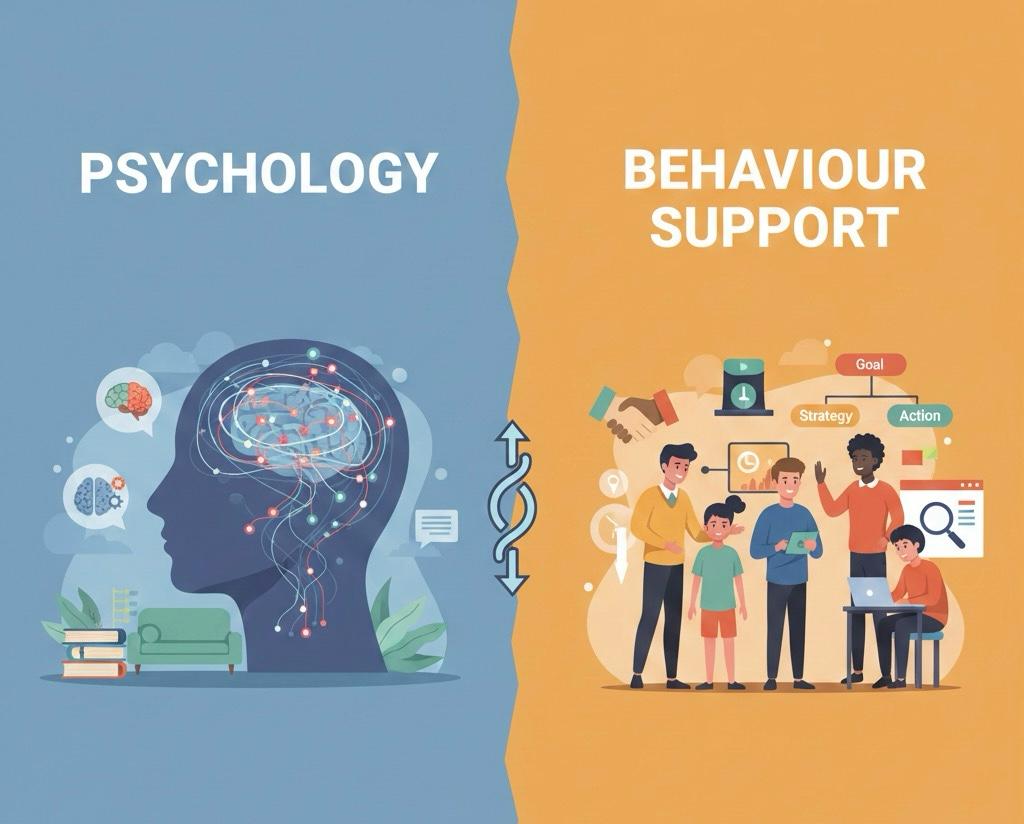
Choose psychology when the primary problem is a mental‑health condition (for example, anxiety, depression, trauma, obsessive–compulsive symptoms), when you need diagnostic assessment, or when you want structured psychological therapy. Choose behaviour support when the main concern is challenging behaviour linked to disability or environmental triggers—such as aggression, self‑injury, absconding, severe tantrums, property damage, or behaviours of concern in autism or intellectual disability—and you need a Functional Behaviour Assessment (FBA) and a Positive Behaviour Support Plan (BSP) that modifies environments, builds skills, and sets safe responses (Carr et al., 1999; Gore et al., 2013; NDIS Commission, 2019). In many real‑world situations, both are required and work best together (Heyvaert, Saenen and Maes, 2014; NICE, 2015; Emerson and Einfeld, 2011).
Definitions and scope
Psychology (clinical, counselling, educational and developmental, etc.)
- Registration & training: Psychologists are AHPRA‑registered health professionals trained in assessment, formulation, and evidence‑based therapies (e.g., CBT, ACT, exposure, behavioural activation) (AHPRA, 2024; APS, 2018).
- What they do: Diagnostic interviewing; psychometrics (e.g., cognitive, adaptive, mood, attention); therapy for mental disorders; consultation to schools and teams; risk assessment and safety planning.
- Settings & funding: Private practice, public services, hospitals, schools, telehealth. Funded via Medicare (for eligible referrals), private pay, insurers, and for NDIS participants under relevant capacity‑building categories (DoHAC, 2024; NDIA, 2025).
Behaviour support (Positive Behaviour Support under the NDIS)
- Registration & capability: Behaviour support practitioners (BSPs) are practitioners engaged by NDIS providers to deliver PBS consistent with the Positive Behaviour Support Capability Framework and NDIS (Restrictive Practices and Behaviour Support) Rules (NDIS Commission, 2019; NDIS Commission, 2021). Backgrounds may include psychology, occupational therapy, social work, special education.
- What they do: Conduct FBA (records, interviews, direct observation; ABC charts; sometimes functional analysis), develop interim and comprehensive BSPs, coach carers/staff in proactive strategies, teach replacement skills, and monitor data. Where restrictive practices are present (e.g., chemical, physical, mechanical, seclusion, or environmental), BSPs document reduction strategies and reporting/authorisation requirements (NDIS Commission, 2019; 2021).
- Settings & funding: Homes, schools, day programs, community settings; funded in the NDIS under Improved Relationships (Capacity Building) and related categories (NDIA, 2025).
How the methods differ
| Feature | Psychology | Behaviour Support (PBS) |
|---|---|---|
| Primary targets | Diagnosable mental disorders; emotional and cognitive processes; coping and quality of life | Challenging behaviours and the function they serve (escape, attention, access to items, sensory) |
| Core assessment | Clinical interview; psychometric tests (e.g., mood scales, cognitive/adaptive tests); DSM‑5‑TR formulation | Functional Behaviour Assessment (records review, interviews, ABC data, direct observation; hypothesis testing) |
| Interventions | CBT, exposure, behavioural activation, trauma‑focused therapies, PMT/PMTO, coping‑skills training | Environmental redesign, antecedent strategies, skills teaching(communication, tolerance, choice, self‑management), reinforcement systems, safeguards; carer/staff coaching |
| Measurement | Symptom scales (e.g., PHQ‑9, GAD‑7), goals, functional outcomes | Behaviour frequency, duration, severity; data sheets; goal attainment scaling |
| Safeguards | Risk assessment; safety plans; duty of care; therapy boundaries | Authorisation and reporting of restrictive practices; reduction plans; incident review (NDIS Commission rules) |
(Sources: AHPRA, 2024; APS, 2018; Carr et al., 1999; Iwata et al., 1994; Gore et al., 2013; NDIS Commission, 2019; 2021.)
Evidence base in brief
- Psychological therapies such as CBT and exposure show robust effects for common disorders across age groups (Cuijpers et al., 2017; NICE, 2011; 2018).
- Positive Behaviour Support grounded in applied behaviour analysis reduces challenging behaviour and improves quality of life in disability contexts (Carr et al., 1999; Gore et al., 2013; Heyvaert, Saenen and Maes, 2014). Parent‑ and carer‑mediated behaviour therapies (e.g., Parent Management Training) have strong evidence for child externalising problems (Kazdin, 2005; NICE, 2013).
- Combined approaches outperform single‑mode care when challenging behaviour co‑occurs with anxiety, trauma, or mood problems (NICE, 2015; Emerson and Einfeld, 2011).
Who is the best first contact? A practical decision guide
Use the primary concern and context to choose a starting point. When in doubt, start where risk and impact are highest and coordinate from there.
Start with behaviour support when:
- There are frequent, severe behaviours of concern (e.g., aggression, self‑injury, absconding, dangerous property damage).
- Behaviours appear linked to tasks or environments (e.g., transitions at school, personal‑care routines).
- You need a BSP to guide teams across home/school/day program.
- Restrictive practices are in place (or being considered)—a BSP with reduction strategies and reporting/authorisation is required (NDIS Commission, 2019; 2021).
- Example profiles: autistic child with meltdowns at transitions; adult with intellectual disability and self‑injury in response to demand; person with dementia‑like behaviours in a disability context.
Start with psychology when:
- Main symptoms are anxiety, low mood, panic, OCD, trauma, grief, insomnia, or adjustment.
- You need diagnostic clarification (e.g., ADHD or autism assessment; learning profile for school or work adjustments).
- You want a structured therapy plan (e.g., CBT for anxiety, exposure for OCD, behavioural activation for depression).
- Example profiles: teenager with social anxiety and avoidance; adult with trauma‑related hyperarousal; worker with burnout and insomnia.
Start with both when:
- Challenging behaviour co‑exists with significant mental‑health symptoms (e.g., self‑injury maintained by escape plus PTSD triggers).
- The person experiences communication barriers that drive behaviour, and anxiety that requires therapy.
- Teams need co‑design to keep strategies aligned across settings (Heyvaert, Saenen and Maes, 2014; NICE, 2015).
What the processes look like
Behaviour support workflow (PBS)
- Referral and consent (including consent for data sharing).
- FBA: gather ABC data, conduct observations; identify function of behaviour (Iwata et al., 1994).
- Interim BSP if risks are present; train carers to implement immediate proactive and response strategies.
- Comprehensive BSP: proactive environment changes; skills teaching (communication requests, toleration of delay, functional alternatives); reinforcement plans; crisis/response plans; data‑collection tools.
- Implementation coaching and review (monitor data; plan fading of any restrictive elements) (Gore et al., 2013; NDIS Commission, 2019).
Psychological therapy workflow
- Assessment and formulation (history, goals, measures).
- Shared plan with specific targets, session frequency, between‑session practice.
- Interventions matched to formulation (e.g., exposure hierarchy; behavioural activation schedule; sleep consolidation).
- Measurement‑based care (brief scales each session; adjust if no progress by sessions 4–6) (Fortney et al., 2017; Cuijpers et al., 2017).
- Relapse prevention and step‑down or step‑up as needed.
Safeguarding and legal considerations (NDIS)
- Restrictive practices (seclusion; chemical, mechanical, physical, environmental restraint) require authorisationunder state/territory arrangements and reporting to the NDIS Commission. A BSP must include strategies to reduce and eliminate restrictive practices over time (NDIS Commission, 2019; 2021).
- Providers must meet Practice Standards and ensure BSPs are implemented as written, with training and review (NDIS Commission, 2021).
- Data privacy and consent are essential when multiple services coordinate care.
Funding pathways (high‑level)
- NDIS: Behaviour support is typically funded from Capacity Building – Improved Relationships; psychology may be funded from Improved Daily Living or other relevant categories depending on goals and plan design (NDIA, 2025).
- Medicare: Psychological therapy for eligible mental‑health conditions may attract a Medicare rebate with a GP or psychiatrist referral under current national arrangements (DoHAC, 2024).
- Other: Private health insurance, workers’ compensation, and school programs may also fund parts of care. Check current rules in your state/territory.
Working together: getting the best of both
- One formulation, two toolkits: Agree on the problem statement and functional drivers, then assign tasks (e.g., BSP teaches request skills and toleration; psychology treats trauma triggers and anxiety).
- Shared measures: Use the same target behaviours and brief symptom scales across providers to track progress.
- Team coaching: BSPs coach carers/educators; psychologists coach emotion‑regulation and exposure plans—both should observe sessions when possible to align strategies.
- Review milestones: If data are flat by 6–8 weeks, adjust the plan (Fortney et al., 2017).
Examples (de‑identified composites)
- “Eli, 9, autistic, school refusal and meltdowns.” Behaviour support conducts FBA: refusal maintained by escape from noisy transitions. BSP adds visual schedules, quiet exit card, and tolerance training; psychologist treats sound sensitivity and anxiety via graded exposure and coping skills. Attendance improves; meltdowns drop 70% over 10 weeks.
- “Mara, 25, intellectual disability, self‑injury.” BSP identifies automatic/sensory function; plan adds competing sensory input and communication of discomfort. Psychologist treats co‑occurring depression with behavioural activation adapted for ID. Incidents and low‑mood days decrease together.
- “Noah, 34, OCD rituals and aggression when interrupted.” Psychologist leads ERP for OCD; BSP redesigns routines to reduce triggers and teaches “help me pause” request. Aggression falls as rituals shrink.
Pitfalls to avoid
- Treating behaviour without skills. Suppression without teaching alternatives backfires (Carr et al., 1999).
- Therapy without environmental change. Exposure/skills will stall if triggers remain unmodified.
- No measurement. Without data, teams miss non‑response risk (Fortney et al., 2017).
- Unsafe or unauthorised restriction. Always follow authorisation and reduction requirements (NDIS Commission, 2019; 2021).
Frequently asked questions
Can a psychologist also do behaviour support?
Yes—if they meet the PBS capability expectations and provider registration requirements. Many BSPs are psychologists; others are OTs, special educators, or social workers (NDIS Commission, 2019).
Does behaviour support treat trauma or anxiety directly?
PBS can reduce exposure to triggers and teach coping skills, but therapy for trauma/anxiety is typically led by a psychologist or other trained clinician (NICE, 2011; 2015).
What if medication (e.g., antipsychotic for behaviour) is used?
That is a restrictive practice (chemical restraint) in many jurisdictions and must be addressed in the BSP with a reduction plan and appropriate clinical oversight (NDIS Commission, 2019; 2021).
How quickly should we see change?
For well‑targeted plans, early indicators (reduced severity or duration; improved recovery) should appear in 4–6 weeks. If not, revisit the FBA or therapy formulation (Fortney et al., 2017; Gore et al., 2013).
References
AHPRA (Australian Health Practitioner Regulation Agency) (2024) ‘Registration standards: Psychology’. Available at: https://www.ahpra.gov.au (Accessed 9 December 2025).
APS (Australian Psychological Society) (2018) Evidence‑based psychological interventions in the treatment of mental disorders: A practical treatment guide. Melbourne: APS.
Carr, E.G., Horner, R.H., Turnbull, A.P., Marquis, J., Magito‑McLaughlin, D., McAtee, M., Smith, C.E., Ryan, K.A., Ruef, M. and Doolabh, A. (1999) *Positive Behavior Support: Evolution of an
field in applied behavior analysis to support individuals with challenging behavior and their families*. Baltimore, MD: Paul H. Brookes.
Cuijpers, P., Karyotaki, E., Reijnders, M., Purgato, M. and Barth, J. (2017) ‘Psychotherapies for depression: A meta‑analysis’, CNS Spectrums, 22(4), pp. 324–332.
DoHAC (Department of Health and Aged Care) (2024) ‘Medicare and mental health supports—consumer information’. Canberra: Australian Government. Available at: https://www.health.gov.au (Accessed 9 December 2025).
Emerson, E. and Einfeld, S. (2011) Challenging behaviour. 3rd edn. Cambridge: Cambridge University Press.
Fortney, J.C., Unützer, J., Wrenn, G., Pyne, J.M., Smith, G.R., Schoenbaum, M. and Harbin, H.T. (2017) ‘A tipping point for measurement‑based care’, Psychiatric Services, 68(2), pp. 179–188.
Gore, N.J., McGill, P., Toogood, S., Allen, D., Hughes, J.C., Baker, P., Hastings, R.P., Noone, S.J. and Denne, L.D. (2013) ‘Definition and scope for positive behavioural support’, International Journal of Positive Behavioural Support, 3(2), pp. 14–23.
Heyvaert, M., Saenen, L. and Maes, B. (2014) ‘Systematic review of behavioural interventions for reducing challenging behaviour in adults with intellectual disabilities’, Research in Developmental Disabilities, 35(9), pp. 2464–2476.
Iwata, B.A., Dorsey, M.F., Slifer, K.J., Bauman, K.E. and Richman, G.S. (1994) ‘Towards a functional analysis of self‑injury’, Journal of Applied Behavior Analysis, 27(2), pp. 197–209.
Kazdin, A.E. (2005) Parent Management Training: Treatment for oppositional, aggressive, and antisocial behavior in children and adolescents. New York: Oxford University Press.
NDIA (National Disability Insurance Agency) (2025) ‘Participant pathways and support categories—overview for participants and providers’. Canberra: NDIA. Available at: https://www.ndis.gov.au (Accessed 9 December 2025).
NDIS Commission (2019) Positive Behaviour Support Capability Framework. Canberra: NDIS Quality and Safeguards Commission.
NDIS Commission (2021) NDIS (Restrictive Practices and Behaviour Support) Rules 2018—Guidance and Practice Advice (updated). Canberra: NDIS Quality and Safeguards Commission.
NICE (National Institute for Health and Care Excellence) (2011) Generalised anxiety disorder and panic disorder in adults: management (CG113). London: NICE.
NICE (2013) Antisocial behaviour and conduct disorders in children and young people (CG158). London: NICE.
NICE (2015) Challenging behaviour and learning disabilities: prevention and interventions for people with learning disabilities whose behaviour challenges (NG11). London: NICE.
NICE (2018) Depression in adults: treatment and management (NG222). London: NICE.
How to cite this article
Therapy Near Me (2025) ‘Psychology vs behaviour support: which one do I need?’. Available at: https://TherapyNearMe.com.au (Accessed 9 December 2025).