
In Australia, most people access a psychologist via a GP referral and Mental Health Treatment Plan (MHTP) under Better Access. The GP assesses needs, creates a plan and refers you for an initial course of sessions, with a mid‑course GP review before further sessions. You pay the fee and claim a Medicare rebate (a portion of the fee); some clinics bulk‑bill or offer reduced fees. Alternatives include private/self‑referral, NDIS, WorkCover, DVA, EAP, and Victims of Crime pathways. Telehealth is widely available when clinically appropriate. Your progress should be tracked with brief outcome measures and a clear plan.
Step‑by‑step: how a psychology referral usually works
1) Recognise a need and book your GP
Typical signs include persistent low mood, anxiety, sleep problems, or functioning changes at work/study/relationships. Bring notes about symptoms, duration, impacts, medications, and any risk (e.g., thoughts of self‑harm).
2) The GP assessment and Mental Health Treatment Plan (MHTP)
Your GP takes a history, rules out medical contributors (e.g., thyroid, sleep apnoea, medication side‑effects), discusses goals, and may use brief tools such as K10, PHQ‑9, or GAD‑7. With your consent, they create a care plan outlining presenting problems, goals, initial session allocation, and referral to a registered or clinical psychologist.
What to check on the referral letter
- Your full name/DOB and address
- GP details and provider number
- Named psychologist/service (or open referral)
- Diagnosis or problem description, goals, and number of sessions in the first block
- Date and signature
Bring a copy to your first session; clinics also accept secure e‑referrals.
3) Booking your first appointment
Choose in‑person or Telehealth (video/phone), ensuring privacy. Ask about fees, gap, concession rates, and whether the clinic can process your Medicare claim on the day. If the psychologist is not a fit, you can change providers—you don’t need a new plan; ask the GP to re‑address the referral.
4) First three sessions: goals, plan and skills
A good start includes:
- Collaborative goals linked to day‑to‑day functioning
- A treatment approach matched to your needs (e.g., CBT, ACT, exposure, CBT‑I, IPT, DBT skills)
- Measurement‑based care (brief questionnaires each 1–2 sessions) to track change
- Home practice between sessions
Early improvement by sessions 3–6 is a positive prognostic sign.
5) Mid‑course GP review
When you complete the first session block, your psychologist sends a brief progress report (goals, measures, response, risks, recommendations). The GP reviews and, if appropriate, continues the plan for the next block.
6) Aftercare and relapse‑prevention
As symptoms improve, sessions taper. You consolidate skills, set relapse‑prevention plans, and agree on signs it’s time for a booster session.
Paying for care: Medicare, private health, and other funders
Medicare (Better Access)
- Available with an eligible GP, psychiatrist or paediatrician referral and a valid MHTP.
- Rebates differ for general vs clinical psychologists and may adjust over time.
- You may owe a gap if the clinic’s fee exceeds the rebate; ask for fee transparency, concession rates, or bulk‑billing policies.
- Telehealth video/phone is generally eligible when clinically appropriate and when Medicare criteria are met.
- Keep all invoices for tax and private insurance claims.
Private/self‑referral
You can see a psychologist without a referral and self‑fund. This suits those wanting greater privacy from GP records or seeking modalities/frequency outside Medicare parameters.
NDIS
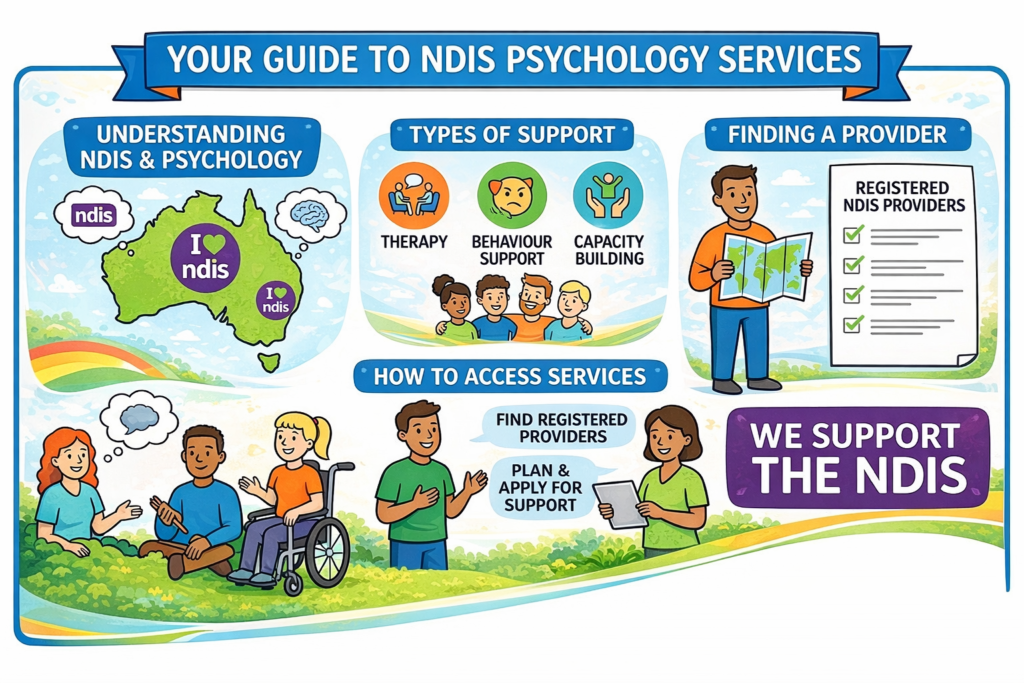
If you (or your child) are an NDIS participant, therapy can be funded where goals and functional needs support it (e.g., psychology, behaviour support, social skills). Speak with your planner/support coordinator about capacity building budgets and whether you need a report from your psychologist.
Workers’ compensation / WorkCover and DVA
If your difficulties relate to work injury or service, referrals often come from your GP, insurer, employer, or DVA. Your psychologist will usually complete a treatment plan aligned with scheme requirements.
EAP and Victims of Crime
Employer Assistance Programs (EAP) offer short‑term counselling, usually pre‑authorised by your employer. Victims of Crime schemes (state‑based) may fund therapy following eligible incidents.
Choosing the right psychologist (and getting a good fit)
- Registration & scope: All psychologists are AHPRA‑registered; clinical psychologists have additional endorsed training. Choose experience matching your presenting problems.
- Approach & methods: Ask how they treat your condition and how progress is measured.
- Accessibility: Telehealth or home visits (where available), language needs, disability access.
- Cultural safety: Preference for culturally informed, LGBTQIA+‑affirming, or neuro‑affirming practice.
- Allied care: Will they liaise (with your consent) with your GP/psychiatrist/school/NDIS team?
What good therapy looks like (the science in brief)
- Evidence‑based methods (e.g., CBT/BA for depression, exposure for anxiety, CBT‑I for insomnia, IPT for interpersonal issues) are supported by multiple meta‑analyses.
- Working alliance—agreement on goals and tasks with a positive bond—predicts outcome across therapies.
- Measurement‑based care (routine outcome monitoring) improves outcomes and reduces drop‑out by prompting timely course‑corrections.
Common measures: PHQ‑9 (depression), GAD‑7 (anxiety), K10 (general distress), CORE‑10 (broad symptoms). Bring graphs to your GP review—this speeds decisions about extending your plan.
Telehealth and privacy
Telehealth can be as effective as in‑person when sessions are structured and private. Use headphones, a quiet space, and stable internet. Your psychologist will explain informed consent, limits to confidentiality, secure record‑keeping, and what to do if technology fails mid‑session.
Costs, rebates and the ‘gap’—how to plan
- Ask for a written quote: fee, expected rebate, out‑of‑pocket amount, cancellation policy, report fees, and letters/forms.
- If finances are tight, ask about bulk‑billing, concessions, payment plans, or fewer, longer sessions with between‑session check‑ins.
- Keep an expenses log for tax and safety‑net thresholds.
Quick checklist before your first session
- GP referral letter + MHTP (or self‑referral notes)
- Medication list and relevant reports
- Two goals linked to daily life (e.g.,
return to full work days; sleep ≥7 hours 4 nights/week) - Outcome baseline: PHQ‑9, GAD‑7, K10 or CORE‑10
- Logistics: Telehealth vs in‑person, fee, rebate, transport/parking
- Questions for your psychologist (see below)
Questions to ask
- “How will we measure whether therapy is working?”
- “What does a typical session look like after the first one?”
- “How many sessions do people like me usually need?”
- “What will I practise between sessions?”
Frequently asked questions
Do I always need a GP referral?
No. You can self‑refer privately. A GP referral and plan are needed to claim Medicare rebates under Better Access.
What if I don’t click with the psychologist?
It’s fine to switch. Ask your GP to re‑address the referral; you don’t need a new plan unless it has expired.
How many sessions will I need?
Many people notice change by sessions 3–6; simple problems may resolve within 8–12. Complex or chronic concerns can take longer.
Can I use Telehealth?
In most cases yes, subject to clinical suitability and meeting Medicare criteria when claiming rebates.
Can a psychologist write to my school or employer?
Only with your consent (or as required by law for safety). Many clients benefit when clinicians liaise with schools/NDIS/GPs.
How Therapy Near Me can help
- Telehealth psychology Australia‑wide and home visits in select locations.
- Support with anxiety, depression, trauma, insomnia, ADHD, ASD, pain, and adjustment.
- We practise measurement‑based care and provide concise GP progress letters to support plan reviews.
- We can coordinate with NDIS, WorkCover, DVA, and EAP pathways where appropriate.
Book online or call 1800 NEAR ME.
References
American Psychiatric Association (2013) Diagnostic and Statistical Manual of Mental Disorders (5th ed.). Arlington, VA: APA. [For diagnostic terminology]
Australian Institute of Health and Welfare (AIHW) (2023) Mental health services in Australia. Canberra: AIHW.
Backhaus, A., Agha, Z., Maglione, M.L., Repp, A., Ross, B., Zuest, D., Rice‑Thorp, N.M., Lohr, J. & Thorp, S.R. (2012) ‘Videoconferencing psychotherapy: A systematic review’, Psychological Services, 9(2), pp. 111–131.
Barkham, M., Bewick, B.M., Mullin, T., Gilbody, S., Connell, J., Cahill, J., Mellor‑Clark, J., Richards, D. & Evans, C. (2013) ‘The CORE‑10: A short measure of psychological distress for routine use’, Psychological Assessment, 25(4), pp. 1243–1254.
Batastini, A.B., Paprzycki, P., Jones, A.C. & MacLean, N. (2021) ‘Are videoconferenced mental and behavioral health services just as good as in‑person? A meta‑analysis of a fast‑growing practice’, Clinical Psychology Review, 83, 101944.
de Jong, K., Conijn, J.M., Gallagher‑Thompson, D., Mackin, R.S. & Aartjan Beekman, A.T.F. (2014) ‘The effectiveness of routine outcome monitoring: A meta‑analysis of individual participant data’, Psychotherapy, 51(4), pp. 501–515.
Ekers, D., Webster, L., Van Straten, A., Cuijpers, P., Richards, D. & Gilbody, S. (2014) ‘Behavioural activation for depression: an updated meta‑analysis of effectiveness’, PLoS ONE, 9(6), e100100.
Flückiger, C., Del Re, A.C., Wampold, B.E. & Horvath, A.O. (2018) ‘The alliance in adult psychotherapy: A meta‑analytic synthesis’, Psychotherapy, 55(4), pp. 316–340.
Horvath, A.O. & Greenberg, L.S. (1989) ‘Development and validation of the Working Alliance Inventory’, Journal of Counseling Psychology, 36(2), pp. 223–233.
Kessler, R.C., Andrews, G., Colpe, L.J., Hiripi, E., Mroczek, D.K., Normand, S.L. et al. (2002) ‘Short screening scales to monitor population prevalences and trends in non‑specific psychological distress’, Psychological Medicine, 32(6), pp. 959–976.
Kroenke, K., Spitzer, R.L. & Williams, J.B.W. (2001) ‘The PHQ‑9: validity of a brief depression severity measure’, Journal of General Internal Medicine, 16(9), pp. 606–613.
Norwood, C., Moghaddam, N.G., Malins, S. & Sabin‑Farrell, R. (2018) ‘Working alliance and outcome effectiveness in videoconferencing psychotherapy: A systematic review and meta‑analysis’, Clinical Psychology & Psychotherapy, 25(6), pp. 797–816.
Shadish, W.R. & Baldwin, S.A. (2003) ‘Meta‑analysis of marital and family therapy: an updated review’, Journal of Marital and Family Therapy, 29(4), pp. 547–570.
Spitzer, R.L., Kroenke, K., Williams, J.B.W. & Löwe, B. (2006) ‘A brief measure for assessing generalized anxiety disorder: the GAD‑7’, Archives of Internal Medicine, 166(10), pp. 1092–1097.
Swift, J.K. & Greenberg, R.P. (2012) ‘Premature discontinuation in adult psychotherapy: A meta‑analysis’, Journal of Consulting and Clinical Psychology, 80(4), pp. 547–559.
World Health Organization (2021) Guidance on mental health services. Geneva: WHO. [Telehealth and stepped care principles]
Australian Government Department of Health and Aged Care (various years) Better Access initiatives and MBS guidance. Canberra: DoHAC.
For Telehealth bookings with a registered psychologist, visit TherapyNearMe.com.au or call 1800 NEAR ME. We can help you navigate GP referrals, MHTPs, NDIS, WorkCover and private pathways.