
Written by: Therapy Near Me Editorial Team
Clinically reviewed by: qualified members of the Therapy Near Me clinical team
Last updated: 18/11/2025
This article is intended as general information only and does not replace personalised medical or mental health advice. Learn more about our Editorial Policy.
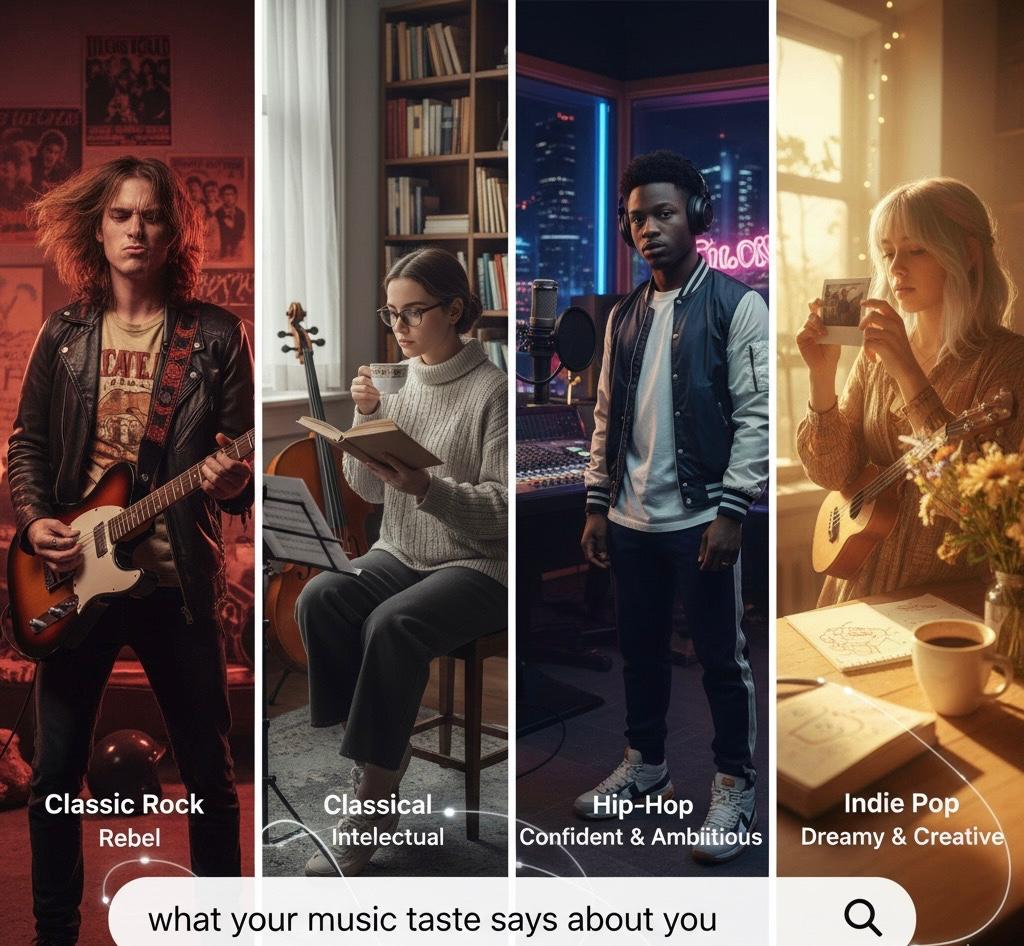
Music preferences do relate to personality, values and current mood—but effects are small‑to‑moderate, and context matters. Classic studies show repeatable links between the Big Five and broad preference clusters (e.g., openness with jazz/classical/“sophisticated”; extraversion with upbeat/dance/pop) (Rentfrow & Gosling, 2003; Rentfrow et al., 2011). Other work connects preferences with empathy/systemising styles and emotional traits (Greenberg et al., 2015; 2016). Music is also a powerful mood‑regulation tool—supportive when used intentionally, but unhelpful when it locks in rumination or late‑night arousal (Saarikallio & Erkkilä, 2007; Garrido & Schubert, 2013). Your playlists are best read as signals, not labels—and you can use them to support sleep, focus, social connection and recovery.
How researchers study music taste
Scientists map preferences using two steps:
- Dimension‑finding: Reduce thousands of songs/genres into a few stable dimensions. Early work found four (Reflective & Complex; Intense & Rebellious; Upbeat & Conventional; Energetic & Rhythmic) (Rentfrow & Gosling, 2003). Later work proposed the MUSIC model—Mellow, Unpretentious, Sophisticated, Intense, Contemporary (Rentfrow et al., 2011).
- Link to traits & outcomes: Correlate those dimensions with Big Five traits, values, cognitive styles and behaviours (e.g., openness, empathy, risk‑taking) (Chamorro‑Premuzic & Furnham, 2007; Greenberg et al., 2015; Nave et al., 2018).
Important: Associations explain a small slice of who you are; they are not diagnoses. Many people like across categories.
What your preferences can reflect (on average)
Big Five personality patterns (small‑to‑moderate effects)
- Openness to Experience → “Sophisticated/Mellow” (classical, jazz, blues, world; complex/reflective): linked with aesthetic sensitivity and abstract thinking (Rentfrow & Gosling, 2003; Rentfrow et al., 2011).
- Extraversion → “Contemporary/Upbeat” (pop, dance, hip‑hop; rhythmic/energetic): linked with sociabilityand positive affect (Rentfrow & Gosling, 2003).
- Agreeableness → “Mellow/Unpretentious” (soft rock, singer‑songwriter, country): linked with warmth and communal values (Rentfrow et al., 2011).
- Conscientiousness → “Upbeat/Conventional” (chart pop, light rock): linked with orderliness and rule‑following (Rentfrow & Gosling, 2003).
- Neuroticism: mixed patterns; some preference for intense or melancholic styles, often mediated by mood regulation motives (Chamorro‑Premuzic & Furnham, 2007; Garrido & Schubert, 2013).
Cognitive‑emotional styles
- Empathisers vs systemisers. People higher in empathy tend to prefer mellow, low‑arousal, emotional music; systemisers lean toward intense, complex music (Greenberg et al., 2015).
- Sensitivity to reward. Some listeners show high dopamine‑linked chills/pleasure to peak moments; others experience specific musical anhedonia (Mas‑Herrero et al., 2014; Salimpoor et al., 2011).
Age, culture and identity
- Adolescence: Music becomes a badge of identity, a tool for belonging and autonomy (North & Hargreaves, 1999).
- Lifespan: Preferences shift with age and life roles (Bonneville‑Roussy et al., 2013).
- Culture: There are universal emotional cues in music and strong cultural learning (Mehr et al., 2019; Cowen et al., 2020).
What your playlists don’t prove
They don’t fix your personality in place. Effects are probabilistic and contextual. Heavy metal fans, for example, are often stereotyped as “angry”, yet controlled studies show extreme‑music listening can help process anger without heightening hostility (Sharman & Dingle, 2015). Liking melancholic music does not mean you’re depressed; it can be used to process sadness or induce pleasant melancholy (Taruffi & Koelsch, 2014).
Music as a mental‑health tool: what works
1) Regulate mood strategically
Adolescents report nine common strategies (e.g., diversion, discharge, mental work, solace). Using music flexiblypredicts better mood; using it to ruminate predicts worse mood (Saarikallio & Erkkilä, 2007; Garrido & Schubert, 2013).
2) Protect sleep
Late‑night high‑arousal music and headphones can delay sleep. Switch to low‑arousal, slow‑tempo tracks 60–90 minutes before bed; keep devices out of the bedroom (Scott & Woods, 2019).
3) Use playlists by function
Create task‑based lists: focus (low‑lyric, moderate tempo), stress downshift (slow, predictable), activation (upbeat, rhythmic). HRV‑friendly breathing to music around 6 breaths/min can aid calm (Lehrer et al., 2020).
4) Leverage social connection
Choir/group singing and shared music‑making boost belonging and positive affect (Fancourt & Perkins, 2018). Even shared listening can bond teams and families.
5) Mind the algorithm
Recommendation feeds can narrow exposure. Periodically seed novelty—different eras/regions—to broaden inputs and avoid “echo playlists”. Diversity supports creativity (Hong & Page, 2004).
FAQs
Can a psychologist read my personality from my Spotify Wrapped?
They can make loose guesses about traits like openness or extraversion, but there’s large error and context noise (Nave et al., 2018). Treat music data as a conversation starter, not a verdict.
Is sad music bad for me?
Not necessarily. For many, sad music is pleasant and meaning‑making; problems arise when it drives brooding or isolates you (Taruffi & Koelsch, 2014; Garrido & Schubert, 2013).
Do genres matter or acoustic features?
Both. Newer studies link acoustic features (tempo, timbre, mode) and perceived emotions to traits across genres (Greenberg et al., 2016; Cowen et al., 2020).
Australian pathways to help
If music use is tied to sleep problems, anxiety, low mood, or identity stress, a registered psychologist can help you build healthy regulation habits. TherapyNearMe.com.au offers Telehealth psychology and NDIS behaviour support across Australia. In an emergency call 000. For 24/7 support, call Lifeline 13 11 14.
References
Bonneville‑Roussy, A., Rentfrow, P.J., Xu, M.K. & Potter, J. (2013) ‘Music through the ages: Trends in musical engagement and preferences from adolescence through middle adulthood’, Journal of Personality and Social Psychology, 105(4), pp. 703–717.
Chamorro‑Premuzic, T. & Furnham, A. (2007) ‘Personality and music: Can traits explain how people use music in everyday life?’, British Journal of Psychology, 98(2), pp. 175–185.
Cowen, A.S., Fang, X., Sauter, D., & Keltner, D. (2020) ‘What music makes us feel: At least 13 dimensions organize subjective experiences associated with music across different cultures’, Proceedings of the National Academy of Sciences, 117(4), pp. 1924–1934.
Fancourt, D. & Perkins, R. (2018) ‘The effects of singing on health and well‑being: A systematic review’, Perspectives in Public Health, 138(1), pp. 62–69.
Garrido, S. & Schubert, E. (2013) ‘Benefits of listening to sad music: Self‑report evidence of everyday benefits’, Psychology of Music, 41(4), pp. 449–465.
Greenberg, D.M., Baron‑Cohen, S., Stillwell, D.J., Kosinski, M., & Rentfrow, P.J. (2015) ‘Musical preferences are linked to cognitive styles’, PLoS ONE, 10(3), e0131151.
Greenberg, D.M., Kosinski, M., Stillwell, D., Monteiro, B.L., Levitin, D.J. & Rentfrow, P.J. (2016) ‘The song is you: Preferences for musical attributes reflect personality’, Social Psychological and Personality Science, 7(6), pp. 597–605.
Hong, L. & Page, S.E. (2004) ‘Groups of diverse problem solvers can outperform groups of high‑ability problem solvers’, Proceedings of the National Academy of Sciences, 101(46), pp. 16385–16389.
Lehrer, P., Kaur, K., Sharma, A., Shah, K., Huseby, R., Bhavsar, J. & Zhang, Y. (2020) ‘Heart‑rate‑variability biofeedback improves emotional and physical health: A systematic review and meta‑analysis’, Applied Psychophysiology and Biofeedback, 45, pp. 109–129.
Mas‑Herrero, E., Zatorre, R.J., Rodríguez‑Fornells, A. & Marco‑Pallarés, J. (2014) ‘Dissociation between musical and monetary reward responses in specific musical anhedonia’, Proceedings of the National Academy of Sciences, 111(28), pp. E4802–E4811.
Mehr, S.A., Singh, M., Knox, D., Ketter, D.M., Pickens‑Jones, D., Atwood, S. et al. (2019) ‘Universality and diversity in human song’, Science, 366(6468), eaax0868.
Nave, G., Minxha, J., Greenberg, D.M., Kosinski, M., Stillwell, D. & Rentfrow, P.J. (2018) ‘Musical preferences predict personality: Evidence from active listening and Facebook Likes’, Psychological Science, 29(7), pp. 1145–1158.
North, A.C. & Hargreaves, D.J. (1999) ‘Music and adolescent identity’, Social Development, 8(3), pp. 272–289.
Rentfrow, P.J. & Gosling, S.D. (2003) ‘The do re mi’s of everyday life: The structure and personality correlates of music preferences’, Journal of Personality and Social Psychology, 84(6), pp. 1236–1256.
Rentfrow, P.J., Goldberg, L.R., & Levitin, D.J. (2011) ‘The structure of musical preferences: A five‑factor model’, Journal of Personality and Social Psychology, 100(6), pp. 1139–1157.
Saarikallio, S. & Erkkilä, J. (2007) ‘The role of music in adolescents’ mood regulation’, Psychology of Music, 35(1), pp. 88–109.
Salimpoor, V.N., Benovoy, M., Larcher, K., Dagher, A. & Zatorre, R.J. (2011) ‘Anatomically distinct dopamine release during anticipation and experience of peak emotion to music’, Nature Neuroscience, 14, pp. 257–262.
Scott, H. & Woods, H.C. (2019) ‘Understanding links between social media use, sleep and mental health’, Current Sleep Medicine Reports, 5, pp. 141–149. [Sleep‑timing hygiene applied to music use.]
Sharman, L. & Dingle, G.A. (2015) ‘Extreme metal music and anger processing’, Frontiers in Human Neuroscience, 9, 272.
Taruffi, L. & Koelsch, S. (2014) ‘The paradox of music‑evoked sadness: An online survey’, PLoS ONE, 9(10), e110490.
General information only. For personalised advice, consider a Telehealth session with a registered psychologist via TherapyNearMe.com.au. If you need urgent help, call 000 or Lifeline 13 11 14.