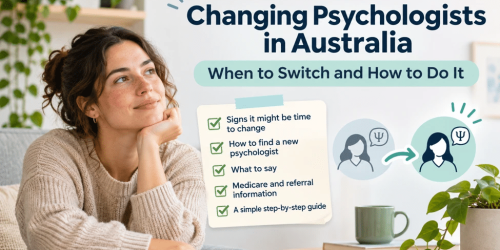

Changing Psychologists in Australia: When to Switch and How to Do It
Finding a psychologist who understands you can make a real difference to your mental health. But what happens when your psychologist does not feel like the right fit?
Maybe you do not feel understood. Perhaps you have attended several sessions but are not making the progress you hoped for. Or your needs have changed and you want someone with different experience.
Whatever the reason, you can change psychologists in Australia. You do not need to keep seeing the same person if the relationship is not working for you.
You can also usually change psychologists while using a Mental Health Treatment Plan, without having to start a new plan. There are still referral rules to check, which we explain below.
Is It OK to Change Psychologists?
Yes. Changing psychologists is a normal part of getting mental health care. Psychologists have different communication styles, experience and treatment approaches. The right fit for one person may not be right for another.
You might prefer someone who listens in a different way, offers more practical strategies, has experience with your concerns or provides appointments that better fit your life.
Changing psychologists does not mean your previous treatment was wasted. You may have learned useful skills or worked out what you need from therapy. That knowledge can help you make a better choice next time.
7 Signs It Might Be Time to Change Psychologists
1. You Do Not Feel Heard or Understood
Your psychologist should listen carefully and take your concerns seriously. You do not need to agree on everything, but you should feel respected and able to speak openly.
You may want to reconsider the relationship if you often feel dismissed, judged, interrupted or unable to ask questions. Sometimes a direct conversation can help. If the problem continues, changing psychologists may be reasonable.
2. You Are Not Making Progress
Therapy takes time, and progress is not always steady. However, you should usually understand what you are working towards and how you and your psychologist will review progress.
Ask yourself:
- Do I understand my treatment goals?
- Do we talk about what is helping and what is not?
- Am I learning useful ways to handle problems outside sessions?
- Have we reviewed my progress and the next steps?
A conversation about your goals may help. You can also read how to tell if therapy is working for practical signs of progress.
3. Your Psychologist Does Not Have the Experience You Need
Your reasons for seeking help may change. You might have started therapy for everyday stress and now need support with trauma, ADHD, autism, grief, parenting or another concern.
Not every psychologist has the same experience or scope of practice. If your current psychologist cannot provide the right care, they may be able to refer you to someone with suitable skills.
4. You Do Not Feel Comfortable Being Yourself
Therapy can involve uncomfortable conversations. That does not always mean something is wrong. But there is a difference between discussing hard feelings and regularly feeling unsafe, judged or disrespected.
You should be able to ask questions, discuss concerns and say when something does not feel right. If that is not possible, you may prefer a different psychologist.
5. You Want a Different Therapy Approach
Psychologists may use different evidence-based treatments, such as Cognitive Behavioural Therapy (CBT), Acceptance and Commitment Therapy (ACT) or other approaches suited to your needs.
You might want more practical exercises, clearer goals, a different pace or a treatment that better matches your concerns. Ask your psychologist whether the approach can be adjusted. If not, another practitioner may suit you better.
6. Appointments No Longer Fit Your Life
Sometimes the reason is practical. You may have changed jobs, moved, developed family responsibilities or found travel difficult.
You might prefer evening appointments, shorter travel time or online sessions. Telehealth psychology appointments can make treatment more convenient when online care is suitable for your situation.
7. Concerns About Your Care Are Not Addressed
You should be able to ask why a treatment is being recommended and discuss concerns about professional behaviour, confidentiality or safety.
If you have serious or unresolved concerns, you do not have to stay simply because you have already started. You can ask the practice for help, seek another opinion or contact the relevant health complaints body. Ahpra provides information about concerns involving registered practitioners.
Should You Tell Your Psychologist You Want to Leave?
You can choose whether to discuss your decision. In many cases, a conversation is useful because the problem may be fixable.
You could say:
“I do not feel I am making the progress I expected. Could we review my goals and talk about another approach?”
Or:
“I think I need someone with different experience. Can we talk about my options?”
You do not have to give a long explanation if you do not feel comfortable. You can contact the practice to cancel future appointments. Check the cancellation policy first so you know whether a fee applies.
How to Change Psychologists in Australia: 5 Steps
Step 1: Work Out What You Need
Think about what helped with your previous psychologist and what did not. Would you prefer a different communication style, more practical strategies, specific experience or different appointment times?
You do not need perfect answers. Even a few preferences can make it easier to find a good fit.
Step 2: Find a New Psychologist
Look at the psychologist’s registration, experience, approach, fees, availability and appointment options. You can also ask your GP for a recommendation.
If you are not sure where to start, Therapy Near Me’s intake team can discuss your needs and help you explore suitable practitioner options.
Step 3: Check Your Medicare Referral
If you use Medicare rebates, ask the new practice to check your current referral before booking.
A Mental Health Treatment Plan does not expire. You can generally use any unused sessions on a valid referral with another eligible psychologist, even if the referral names your previous psychologist.
However, a referral is for a set course of treatment. If those sessions have been used, you will need a new referral for another course. Changing psychologists also does not reset your yearly Medicare session limit.
Step 4: Ask About Transferring Records
Your new psychologist may find a short treatment summary, previous assessment results or a list of strategies you have already tried helpful.
Under Australian privacy law, you generally have a right to request access to your health information, with some exceptions. You can also ask for relevant information to be sent securely to your new provider. A reasonable access fee may apply.
Your new psychologist can help you decide which information is useful. You do not necessarily need every session note transferred.
Step 5: Book Your First Appointment
Your new psychologist will usually ask why you are seeking support, what you have tried before and what you hope to achieve.
You can explain why you changed psychologists without criticising your previous practitioner. A simple description of what you are looking for is enough.
For more information about what happens in the first session, read Your first psychology appointment in Australia.
Can You Change Psychologists Under a Mental Health Care Plan?
Yes. A Mental Health Treatment Plan (often called a Mental Health Care Plan) does not tie you to one psychologist.
Under Medicare’s Better Access initiative, eligible people may claim rebates for up to 10 individual mental health treatment services per calendar year across eligible providers, subject to referral and other claiming rules.
Your referral sets the number of sessions for the current course of treatment. The initial course may cover up to six individual sessions. Further sessions need another referral, up to the yearly limit.
Example
If you have used four eligible sessions this year, you may have up to six left under the annual limit. But you can only claim the sessions allowed by a valid referral. The new practice can help check what remains.
Unused sessions on a valid referral may carry into the next calendar year, but they count towards that new year’s limit. Changing psychologists does not restart your allowance.
For a fuller explanation, see our Mental Health Care Plan in Australia guide.
Can You Change Psychologists Without a Referral?
Yes. You do not need a GP referral to book a private psychology appointment in Australia. You can contact a practice directly and pay privately.
If you want Medicare rebates, you must meet the relevant eligibility and referral rules. Ask about fees and rebates before booking.
Can NDIS Participants Change Psychologists?
Yes. NDIS participants can generally change providers, subject to their funding arrangements, provider requirements and any existing service agreement.
Before switching, check any cancellation or notice terms and confirm that the new supports are funded under your plan. Not every psychology service is automatically covered by the NDIS.
Therapy Near Me offers NDIS psychology services for eligible plan-managed and self-managed participants. Availability and support type depend on the participant’s needs and funding.
How Long Should You Give a New Psychologist?
There is no fixed number of sessions you must attend before deciding whether someone is a good fit. Some people feel comfortable quickly; others need several appointments to build trust.
Instead of judging only your first impression, consider whether your psychologist listens, respects your views, explains the treatment plan and checks progress with you.
Therapy can feel difficult even when it is helping. The important question is whether you can work through those difficulties in a safe and respectful relationship.
Frequently Asked Questions
Can I change psychologists after one session?
Yes. You can choose not to continue after the first appointment. Remember that the first session often focuses on understanding your history and goals, so it may be too early to judge treatment progress.
Do I have to tell my psychologist why I am leaving?
No. You can explain your reasons if you wish, but you do not have to give a detailed personal account. You should still cancel appointments in line with the practice’s policy.
Can I change psychologists at the same practice?
Yes, if another suitable psychologist is available. The administration team may be able to help you explore the options.
Can I see two different psychologists?
Sometimes, but it is best to discuss this with the professionals involved. Seeing two practitioners for the same problem can make treatment planning more complicated. Medicare claiming rules also still apply.
Can I switch from in-person therapy to telehealth?
Yes, when telehealth is suitable for your needs. Eligible telehealth psychology appointments may attract Medicare rebates under current rules.
What if my new psychologist is not the right fit either?
You can review what has helped and try again. If you have complex needs, ask your GP whether another type of service or a psychologist with more specialised experience might be appropriate.
Looking for a New Psychologist? Therapy Near Me Can Help
Changing psychologists can feel like a big decision, especially after you have spent time getting to know someone. But you do not have to stay in treatment that does not meet your needs.
Therapy Near Me provides psychology and counselling across Australia, including telehealth and selected in-person or at-home services.
Our friendly intake team can discuss your concerns, preferences and appointment needs to help identify a suitable practitioner. You can tell us what has and has not worked for you before.
We can also explain fees, appointment options and referral requirements before you book.
Ready to explore a better fit? Book therapy with Therapy Near Me or call 1800 632 763. Appointment availability depends on your needs, location and practitioner capacity.
Sources and Further Reading
- Services Australia: Better Access referrals and calendar-year limits
- Services Australia: Mental Health Treatment Plan requirements
- OAIC: Access your health information
- Ahpra: Notifications and concerns about registered practitioners
- Flückiger et al. (2018): The alliance in adult psychotherapy — meta-analysis
This article provides general information, not personal medical or psychological advice. Medicare rules and funding arrangements can change. If you are in immediate danger, call 000. For crisis support in Australia, call Lifeline on 13 11 14.