Therapy Near Me

Author name: Therapy Near Me Editorial Team

Psychology of managing grief

Grief vs Prolonged Grief Disorder: What’s Normal, When to Get Help, and What Evidence-Based Support Looks Like (Australia, 2026)

Grief vs Prolonged Grief Disorder: What’s Normal, When to Get Help, and What Evidence-Based Support Looks Like (Australia, 2026) Written by: Therapy Near Me Editorial Team Clinically reviewed by: qualified members of the Therapy Near Me clinical team Last updated: 01/04/2026 This article is intended as general information only and does not replace personalised medical or mental health advice. Learn more about our Editorial Policy. Content type: Health education (Australia) Grief can be intense, messy, and unpredictable. Some people cry daily for weeks. Others feel numb. Some function at work but fall apart at night. None of that automatically means something is “wrong”. But for a minority of people, grief doesn’t gradually soften or integrate with time. Instead it stays stuck—dominating daily life, relationships, sleep, and the ability to plan a future. That pattern is often described clinically as prolonged grief disorder (PGD) (Eisma 2023; Prigerson et al. 2022). This article explains the difference between common grief reactions and prolonged grief, what to look for, and how Australians can access safe, evidence-based support. Safety: This is general information, not medical advice. If you’re in immediate danger call 000. For 24/7 crisis support, contact Lifeline 13 11 14 (Healthdirect Australia 2026). 1) What “normal” grief can look like Grief isn’t linear. People often move back and forth between: This “oscillation” is commonly referenced in modern grief models and is echoed in professional commentary for clinicians supporting grief (Australian Psychological Society 2024).  You can have strong grief and still be within a normal range, especially after: 2) When grief may be becoming “prolonged” or clinically significant Prolonged grief disorder (PGD) is now recognised in major diagnostic systems (ICD-11 and DSM-5-TR). A common benchmark is that the death occurred at least 12 months ago for adults (and at least 6 months ago for children/adolescents), alongside persistent, impairing symptoms (Eisma 2023; American Psychiatric Association 2022).  Signs that justify a clinical conversation If many of these are present most days and are disrupting life, it’s worth getting assessed: Griefline summarises PGD as grief that does not ease with time and interferes with day-to-day functioning and wellbeing (Griefline 2025).  3) Grief can look like anxiety or depression (and sometimes it is) Grief commonly includes: Those can overlap with depression and anxiety, but PGD is not simply “depression in disguise.” That’s why quality assessment matters—so treatment targets the correct problem (Eisma 2023).  4) What evidence-based grief therapy looks like There isn’t a single “grief script,” but there are evidence-based approaches for complicated/prolonged grief presentations. The Australian Psychological Society notes that complicated grief treatment focuses on reducing loss-related symptoms while helping people rebuild relationships and personal life goals (Australian Psychological Society 2026).  In practice, evidence-based treatment often includes: What it should not look like: being pushed to “move on”, being told your grief is “too much”, or being rushed into intense memory work without stabilisation and consent. 5) When to get help sooner (even before 12 months) Even if it’s early, seek support sooner if you notice: Healthdirect’s grief resources encourage getting professional support when distress is severe or functioning is significantly affected (Healthdirect Australia 2026).  6) Practical next steps in Australia Step 1: Choose the right kind of support Step 2: Use targeted grief services if you want low-barrier support Griefline offers grief counselling resources and support services (Australian Government listing; Griefline). If you prefer groups, Griefline also runs peer-supported bereavement support groups (Griefline).  Step 3: Bring a short “symptom and function” note to your appointment Write down: 7) FAQ “Is it normal to still grieve years later?” Yes. Many people carry grief long-term. The question isn’t “Do you still miss them?” but “Is grief still dominating your life and blocking functioning most days?” (Australian Psychological Society 2026; Griefline 2025).  “What if people are telling me I should be over it?” That’s a common secondary wound. A good clinician focuses on your reality and functioning, not timelines or social expectations (Australian Psychological Society 2024).  References American Psychiatric Association 2022, Prolonged grief disorder, American Psychiatric Association, viewed 5 March 2026, https://www.psychiatry.org/patients-families/prolonged-grief-disorder.  Australian Government Department of Health and Aged Care 2024, Griefline (service listing), viewed 5 March 2026, https://www.health.gov.au/contacts/griefline?language=en.  Australian Psychological Society 2026, Grief, APS, viewed 5 March 2026, https://psychology.org.au/for-the-public/psychology-topics/grief.  Australian Psychological Society 2024, Helping clients ride the waves of grief, APS Insights, viewed 5 March 2026, https://psychology.org.au/insights/helping-clients-ride-the-waves-of-grief.  Eisma, MC 2023, ‘Prolonged grief disorder in ICD-11 and DSM-5-TR’, Current Opinion in Psychology (via PubMed Central), viewed 5 March 2026, https://pmc.ncbi.nlm.nih.gov/articles/PMC10291380/.  Griefline 2025, Understanding prolonged grief: when grief doesn’t ease with time, Griefline, viewed 5 March 2026, https://griefline.org.au/resources/understanding-prolonged-grief-when-grief-doesnt-ease-with-time/.  Griefline n.d., Grief support – You’re not alone, Griefline, viewed 5 March 2026, https://griefline.org.au/.  Griefline n.d., Bereavement support groups, Griefline, viewed 5 March 2026, https://griefline.org.au/get-help/bereavement-support-groups/.  Healthdirect Australia 2026, Grief and loss, Healthdirect, viewed 5 March 2026, https://www.healthdirect.gov.au/grief-loss.  Healthdirect Australia 2026, Understanding anticipatory grief, Healthdirect, viewed 5 March 2026, https://www.healthdirect.gov.au/understanding-anticipatory-grief.  Prigerson, HG et al. 2022, ‘Prolonged grief disorder diagnostic criteria—helping clinicians identify bereaved persons with maladaptive grief responses’, JAMA Psychiatry, viewed 5 March 2026, https://jamanetwork.com/journals/jamapsychiatry/fullarticle/2788766. 


Grief vs Prolonged Grief Disorder: What’s Normal, When to Get Help, and What Evidence-Based Support Looks Like (Australia, 2026) Read More »

Dialectical Behaviour Therapy (DBT)

Dialectical Behaviour Therapy (DBT) in Australia: What It Is, Who It Helps, and What Good Treatment Looks Like (2026)

Dialectical Behaviour Therapy (DBT) in Australia: What It Is, Who It Helps, and What Good Treatment Looks Like (2026) Written by: Therapy Near Me Editorial Team Clinically reviewed by: qualified members of the Therapy Near Me clinical team Last updated: 29/03/2026 This article is intended as general information only and does not replace personalised medical or mental health advice. Learn more about our Editorial Policy. Content type: Mental health education (Australia) Search interest in DBT keeps growing because more Australians are trying to understand whether it is the right therapy for intense emotions, self-harm urges, relationship instability, impulsive behaviour, or borderline personality disorder (BPD). That makes this a strong topic for health-content trust: people want clear, evidence-based guidance, not vague wellness language. This article explains what DBT is, who it is commonly used for, what a quality DBT-informed treatment plan looks like, and how to avoid common misunderstandings. Important: This article is general information, not personal medical advice. If there is immediate danger or a serious risk of self-harm or suicide, call 000. For urgent crisis support in Australia, contact Lifeline 13 11 14.  What is DBT? Dialectical behaviour therapy (DBT) is a structured talking therapy that developed from cognitive behavioural therapy and is especially associated with helping people who have significant difficulty regulating intense emotions. Healthdirect describes DBT as useful for people with borderline personality disorder or for people who have trouble controlling their emotions.  In practical terms, DBT is not just “talking about feelings.” It is usually skills-based and focuses on helping people: Who is DBT commonly used for? DBT is most strongly associated with borderline personality disorder (BPD), but DBT skills can also be used more broadly where emotional dysregulation is a major issue. Healthdirect notes that DBT is useful for people with BPD, while the NHMRC clinical practice guideline for BPD supports structured, evidence-based psychological treatment as the core of care.  A person might be a good candidate for DBT-style work if they struggle with things like: That does not mean DBT is only for people with a formal BPD diagnosis. Many clinicians use DBT-informed skills when emotional regulation is the central problem, even if the diagnosis is different. That is a clinical judgement call, and the best fit depends on assessment, risk, goals, and complexity. This is an inference based on the way Healthdirect and the NHMRC describe DBT’s role in emotion regulation and BPD care.  What problems does DBT try to solve? DBT is designed around a simple reality: when distress becomes too intense, people often do something fast to escape it. That “something” might be: DBT aims to interrupt that cycle by teaching alternatives that are more effective in the long run. Healthdirect describes DBT as helping people who have trouble controlling strong emotions, and the NHMRC BPD guideline is built around structured management, risk reduction, and longer-term functional improvement rather than blame or stigma.  The 4 core DBT skill areas A helpful way to understand DBT is through its four core skill domains. 1) Mindfulness This is about noticing what is happening internally and externally without immediately reacting. It helps create a pause between feeling and action. Healthdirect identifies DBT as a structured therapy approach derived from CBT, and mindfulness is one of its recognised skill pillars.  2) Distress tolerance These are crisis-survival skills for getting through acute emotional pain without making the situation worse. This area matters particularly when someone feels an urge to act immediately just to end distress. The NHMRC guideline places heavy emphasis on crisis planning, risk management, and safer responses during periods of acute instability.  3) Emotion regulation This focuses on understanding emotions, reducing vulnerability to emotional blow-ups, and responding in more deliberate ways. Healthdirect specifically links DBT with difficulty regulating strong emotions.  4) Interpersonal effectiveness These skills help people ask for what they need, set boundaries, and manage conflict without escalating or collapsing. Because BPD and related emotion-regulation difficulties often affect close relationships, this domain is clinically important.  What does good DBT treatment actually look like? One of the biggest misconceptions is that DBT is just a weekly chat with a therapist who “uses some DBT skills.” That can still be helpful, but full DBT is usually more structured than that. A high-quality DBT program often includes: The NHMRC guideline for BPD places strong weight on coordinated, structured care, especially where there is self-harm, suicidality, or repeated crisis presentation.  In plain English, good DBT should feel like treatment with a map. You should understand: DBT is not just for crisis Many people first hear about DBT after self-harm, suicidal ideation, or repeated emotional crises. But DBT is also about longer-term life functioning. The goal is not only fewer crises; it is also better relationships, more stability, stronger boundaries, and a greater sense of control over behaviour. This is consistent with Healthdirect’s description of DBT and the NHMRC’s broader treatment goals for BPD management.  That matters for E-E-A-T because it positions therapy as a legitimate, evidence-based clinical intervention rather than a vague self-help trend. Common myths about DBT Myth 1: DBT is only for people with BPD Not true. DBT is strongly linked with BPD, but DBT skills are also used where emotional dysregulation, impulsivity, or crisis-prone behaviour is central.  Myth 2: DBT is only for “severe” patients Not necessarily. People do not have to be in constant crisis to benefit from learning distress tolerance, emotional regulation, and interpersonal skills. This is an inference from DBT’s skills-based framework and its focus on emotion regulation.  Myth 3: Medication is the main treatment for BPD Healthdirect states that medicine can sometimes help with some symptoms, but it is not the main treatment for BPD; psychological therapy is central.  Myth 4: People with BPD cannot get better That is a harmful myth. The NHMRC guideline and SANE both frame BPD as treatable and support psychological therapies as the most effective treatment pathway.  How to tell whether a DBT provider is credible If you are choosing a clinician or service, ask practical questions: These questions are sensible because authoritative Australian sources consistently frame BPD and


Dialectical Behaviour Therapy (DBT) in Australia: What It Is, Who It Helps, and What Good Treatment Looks Like (2026) Read More »

Ai and mental health guide

Using AI Chatbots for Mental Health Support: Benefits, Risks, Privacy, and Safer Use in Australia (2026)

Using AI Chatbots for Mental Health Support: Benefits, Risks, Privacy, and Safer Use in Australia (2026) Written by: Therapy Near Me Editorial Team Clinically reviewed by: qualified members of the Therapy Near Me clinical team Last updated: 15/03/2026 This article is intended as general information only and does not replace personalised medical or mental health advice. Learn more about our Editorial Policy. Content type: Educational guide (Australia) AI chatbots are now part of everyday mental health “self-help”: people use them to journal, reframe anxious thoughts, practise coping scripts, or get a sense of what to say in a hard conversation. For some, they’re a low-friction first step toward getting real support. But AI tools are not clinicians, they can make confident mistakes, and they may handle sensitive personal information in ways users don’t expect. In Australia, professional bodies and regulators are increasingly explicit that AI must be used with strong safeguards—especially when mental health is involved (APS 2026; WHO 2025; OAIC 2025).  This guide explains what AI can realistically help with, what it can’t, and how to use it more safely—particularly if you’re dealing with anxiety, depression, burnout, trauma symptoms, or emotional distress. If you’re in immediate danger or at risk of harm: call 000. If you’re in crisis, contact Lifeline 13 11 14 (Healthdirect Australia 2025). (AI tools should not be used for crisis care.) 1) What AI chatbots can help with (when used appropriately) Used carefully, chatbots can support “between-session” skills and low-risk tasks, such as: The Black Dog Institute notes that chatbots may be helpful for general wellbeing tips and self-management ideas, provided people understand limitations and use them safely (Black Dog Institute 2026).  2) What AI chatbots should not be used for If the stakes are high, a chatbot is the wrong tool. Avoid using AI for: The WHO’s guidance on generative AI in health highlights core risks like errors (“hallucinations”), bias, privacy, and accountability gaps—risks that matter more when people are vulnerable (WHO 2025).  3) The “therapy illusion”: why AI can feel helpful even when it isn’t safe A key risk is that chatbots can simulate empathy and certainty. The APS has publicly discussed Australians using AI chatbots as a “personal therapist” and the potential harms when people treat these tools as clinical care (APS 2025).  What this can look like: If you notice you’re using a chatbot compulsively (“I can’t stop messaging it”), treat that as a signal to get human support. (The APS has commented on this “always-on” dynamic in AI mental health chatbot discussions.)  4) Privacy: the part most people underestimate Mental health data is sensitive. Even if you never type your name, you can easily share identifying details (workplace, suburb, family specifics). In Australia, the OAIC’s health privacy guidance explains obligations around health information and best practice privacy handling for health service contexts (OAIC 2025).  Safer privacy habits (practical, not paranoid) For parents and younger users, eSafety’s online safety guidance emphasises protecting personal information and using trusted guides for apps/services (eSafety Commissioner 2026).  5) A simple “safe use” framework: LOW-RISK, TIME-LIMITED, VERIFIED Here’s a framework that works well for most people: LOW-RISK Use AI for skills practice and planning, not for diagnosis, crisis, or trauma processing. TIME-LIMITED Set a time box (e.g., 10 minutes). If you’re still distressed after the time box, switch to: VERIFIED If AI gives factual claims (Medicare rules, NDIS supports, medication, legal issues), verify against authoritative sources. The WHO warns that LMM outputs can be plausible but wrong, and that governance is essential in health contexts (WHO 2025).  6) What “good” AI mental health support looks like (and what’s a red flag) Green flags Red flags Australia’s online safety framework (BOSE) reflects stronger expectations that online services take reasonable steps to keep Australians safe (eSafety Commissioner 2026).  7) How clinicians may use AI (and what you can ask) AI is also entering clinical workflows (e.g., note assistance, admin, measurement tools). The APS has released professional practice guidelines for psychologists using AI and emerging technologies, aimed at helping clinicians navigate risks and responsibilities (APS 2026).  If you’re seeing a psychologist and AI is used in the practice, you can ask: Good services should be comfortable answering these questions clearly, without defensiveness. 8) If you’re using AI because therapy feels hard to access This is common: waitlists, cost, time, stigma, or not knowing where to start. If AI is your “bridge,” use it to take concrete steps toward support: AI can help you draft the email and define your goals—but it shouldn’t be the only support you rely on. References Australian Psychological Society (APS) 2025, ‘APS discusses Australians using AI chatbots as personal therapists’, APS Insights, viewed 5 March 2026.  Australian Psychological Society (APS) 2026, ‘Use AI in practice: New APS practice guidelines’, APS Insights, viewed 5 March 2026.  Black Dog Institute 2026, ‘Thinking of using AI for mental health support? Here’s what to consider’, Black Dog Institute, viewed 5 March 2026.  eSafety Commissioner 2025, Basic Online Safety Expectations Regulatory Guidance (Updated December 2025), Australian Government, viewed 5 March 2026.  eSafety Commissioner 2026, ‘Basic Online Safety Expectations’, Australian Government, viewed 5 March 2026.  eSafety Commissioner 2026, ‘Online safety basics’, Australian Government, viewed 5 March 2026.  Office of the Australian Information Commissioner (OAIC) 2025, ‘Guide to health privacy’, OAIC, viewed 5 March 2026.  World Health Organization (WHO) 2024, ‘WHO releases AI ethics and governance guidance for large multi-modal models’, WHO News, viewed 5 March 2026.  World Health Organization (WHO) 2025, Ethics and governance of artificial intelligence for health: Guidance on large multi-modal models, WHO, viewed 5 March 2026. 

Using AI Chatbots for Mental Health Support: Benefits, Risks, Privacy, and Safer Use in Australia (2026) Read More »

NDIS Referrals Process

NDIS Referrals That Start Faster: A Practical Guide for Support Coordinators, Families and Plan Managers

Written by: Therapy Near Me Editorial Team Clinically reviewed by: qualified members of the Therapy Near Me clinical team Last updated: 23/03/2026 This article is intended as general information only and does not replace personalised medical or mental health advice. Learn more about our Editorial Policy. When an NDIS participant is ready to start psychology, speech therapy, counselling or Positive Behaviour Support, the biggest delay is often not funding. It is referral quality. In practice, referrals slow down when the provider has to chase basic details: who to contact, what the participant’s goals are, whether the support is plan-managed or self-managed, what risks need to be considered, and whether there are existing reports that should shape triage from day one. The NDIS describes support coordination as a capacity-building support that helps participants understand and use their plan, connect with providers, and build confidence using their supports. It also explains that plan management, funding approach, and provider rules affect how services are set up and paid.  That is why a strong referral matters. It is not just admin. It is one of the clearest ways to reduce wait-related friction, improve clinician matching, and get a participant into goal-aligned support faster. Why referral quality matters under the NDIS NDIS services are expected to connect to a participant’s goals, functioning and support budgets, not just a diagnosis label. The NDIA explains that support budgets fund different categories of support, and that Support Coordination helps participants make the best use of those supports. The agency also notes that provider pricing and payment rules differ depending on whether a participant is self-managed, plan-managed or NDIA-managed.  That has a practical consequence for referrals: a provider cannot safely or efficiently commence services if the referral does not explain the participant’s goals, barriers, delivery preferences and funding setup. A referral that simply says “needs psychology” or “needs behaviour support” is usually too thin to move quickly. A referral that explains the participant’s functional impact, participation barriers, current risks and preferred delivery method is far more likely to lead to a clean, timely commencement. This is an inference drawn from the NDIA’s explanation of how support coordination, support budgets and pricing rules work together in practice.  What Therapy Near Me provides for NDIS participants Therapy Near Me supports NDIS participants with therapeutic supports, speech therapy and Positive Behaviour Support, delivered via telehealth Australia-wide and mobile or in-community sessions where available. The service positioning on Therapy Near Me’s public NDIS pages emphasises evidence-based care, telehealth flexibility, NDIS-funded support pathways and fast access.  Based on the current referral pack, the main service streams are: NDIS Psychology and therapeutic supports These supports are framed around goal-aligned therapy, including functional impact, emotional regulation, coping skills, relationships and participation. That is consistent with the NDIS concept that therapeutic supports should connect to day-to-day functioning and plan goals, rather than existing as generic treatment disconnected from plan outcomes.  NDIS Behaviour Support This includes Functional Behaviour Assessment, Positive Behaviour Support Plans, carer coaching, implementation support and coordinated stakeholder engagement where appropriate. The NDIA’s behaviour support guideline explains that behaviour support practitioners use behaviour assessment findings, including functional assessment, to develop behaviour support plans tailored to the participant’s circumstances.  NDIS Speech Therapy Speech pathology referrals are framed around functional communication, social communication and participation outcomes, with assessment, reporting, carer coaching and communication with the participant’s wider team where needed. That aligns well with an NDIS service model focused on capacity building and participation.  Counselling within NDIS therapeutic supports Counselling support can be relevant where a participant needs structured coping strategies, practical therapeutic support and culturally responsive engagement tied to daily functioning and participation goals. This is a service-model inference based on the referral pack and the NDIS emphasis on capacity-building supports.  What Support Coordinators should include to help services start fast The fastest NDIS referrals are usually the clearest ones. Based on the Therapy Near Me referral process, the following details are the most useful upfront: This checklist mirrors real operational needs created by NDIS funding rules and service setup requirements. For example, NDIA guidance states that plan-managed and NDIA-managed supports must follow pricing arrangements and price limits, while self-managed participants have greater flexibility in provider choice and pricing.  That means funding type is not a minor detail. It affects how quickly a provider can issue service agreements, confirm fees, and commence support. The best referrals are goal-led, not diagnosis-led A diagnosis can be important, but under the NDIS it is rarely enough by itself. For triage and matching purposes, a provider usually needs to know what is actually happening in the participant’s life. Are they withdrawing from community participation? Struggling with communication breakdowns? Escalating after routine changes? Showing behaviours of concern in certain settings? Needing carer coaching to support implementation? The NDIA’s description of support coordination and support budgets makes clear that the system is designed around helping participants pursue goals and use supports effectively, not simply assign services by label.  So a strong referral does not just say, “Participant has autism and needs therapy.” It says something closer to, “Participant has difficulty with emotional regulation after transitions, reduced community engagement, and family is seeking practical strategies to improve coping and participation.” That kind of referral makes clinician matching faster and more accurate. This is an inference supported by the structure of NDIS goal-based planning and support coordination.  Why existing reports should be sent with the first referral If there is already a PBS plan, incident summary, speech report, OT assessment or previous allied health documentation, sending it at the referral stage can save time and reduce duplication. This is especially important in behaviour support. The NDIA’s behaviour support guidance highlights the role of behaviour assessment in developing a comprehensive behaviour support plan. Where prior assessments exist, they can materially improve triage and reduce the need to rebuild context from scratch.  For speech and psychology referrals, prior reports can also help clarify baseline functioning, previous interventions and current barriers. That is not stated as a

NDIS Referrals That Start Faster: A Practical Guide for Support Coordinators, Families and Plan Managers Read More »

Adult Autism Assessment Guide

Adult Autism Assessment in Australia: Signs, Screening Tools, Diagnostic Pathway, and NDIS Evidence (2026)

Adult Autism Assessment in Australia: Signs, Screening Tools, Diagnostic Pathway, and NDIS Evidence (2026) Written by: Therapy Near Me Editorial Team Clinically reviewed by: qualified members of the Therapy Near Me clinical team Last updated: 17/03/2026 This article is intended as general information only and does not replace personalised medical or mental health advice. Learn more about our Editorial Policy. Content type: Educational health guide (Australia) Searching “adult autism signs” often starts the same way: you’ve managed life by masking, copying social scripts, and pushing through sensory overload—until burnout hits, relationships strain, or work becomes harder to sustain. Many adults then wonder whether autism could explain long-standing patterns that never quite fit anxiety or depression alone. This guide covers what autistic traits can look like in adults, what a high-quality assessment involves in Australia, what to watch out for (to reduce misdiagnosis), and what evidence is typically useful if you’re considering an NDIS access request. Safety note (YMYL): This is general information, not a diagnosis or medical advice. If you’re in immediate danger call 000. For crisis support call Lifeline 13 11 14 (Healthdirect Australia, 2025). 1) What autism can look like in adults Autism is a neurodevelopmental difference. In adults it can present subtly—especially in people who’ve spent years masking. Some common themes include: Important: these traits can overlap with anxiety, trauma responses, ADHD, sleep issues, or mood disorders. That’s why quality assessment matters. 2) Screening tools: useful, but not diagnostic A common first step in primary care is a screening questionnaire. The RACGP notes the Autism Spectrum Quotient (AQ) is a screening tool that can indicate likelihood of autistic traits, but it is not a diagnostic test (Bradshaw & others, 2021).  Use screeners for what they’re good at: But don’t treat an online score as a diagnosis. 3) What a high-quality adult autism assessment should include Australia has a National Guideline for autism assessment and diagnosis, published by Autism CRC and approved by the NHMRC (Autism CRC, 2018; Autism CRC, n.d.).  Autism CRC also provides an adult-focused summary of what people should expect during assessment (Autism CRC, n.d.).  In practical terms, credible adult assessment usually includes: Developmental history (not optional) Because autism is neurodevelopmental, assessors will look for patterns across childhood and adulthood (Autism CRC, n.d.).  Functional impact The focus isn’t “Do you have traits?” but “How do these traits affect daily functioning, relationships, study/work, and wellbeing?” (Autism CRC, n.d.).  Differential diagnosis and comorbidities High-quality assessment considers overlapping conditions such as ADHD, anxiety, depression, PTSD, and sensory processing issues (Autism CRC, n.d.).  Evidence-based approach and clear reporting A formal report should explain: Autism CRC’s adult information resources are specifically designed to set expectations around this process (Autism CRC, n.d.).  4) Who can assess and diagnose adults in Australia? Pathways differ depending on clinician type and local availability. Autism CRC’s guideline focuses on practitioner roles and the process, and is intended to drive consistency (Autism CRC, n.d.).  In real-world terms, many adult assessments are conducted by clinicians with experience in adult autism assessment (often psychologists and/or psychiatrists), and sometimes a multidisciplinary approach is used depending on complexity (Autism CRC, n.d.).  A simple way to vet a provider before booking: 5) Red flags: when to slow down Be cautious if an assessment service: You’re paying for clinical judgment—not just a label. 6) If you’re considering the NDIS: what evidence is usually useful For NDIS access, diagnosis can help, but the NDIA commonly focuses on evidence about functional impact—how the condition affects your everyday life and the supports you need. The NDIA’s disability evidence guidance highlights the value of a statement from a treating health professional describing duration, treatments explored, and how the condition impacts daily life (NDIS, n.d.).  A strong evidence pack often includes: Practical tip: When you speak with clinicians, ask them to include a clear “functional impact” section in reports—because that’s what decision makers can actually use. 7) What to do next: a clean, low-stress pathway Authorship, review, and editorial standards Author: Therapy Near Me Editorial TeamEditorial standards: This article is written and maintained under our sourcing, review, and update process. Read our Editorial Policy: https://therapynearme.com.au/editorial-policy/ References Autism CRC n.d., National Guideline for the assessment and diagnosis of autism in Australia, Autism CRC, viewed 5 March 2026, https://www.autismcrc.com.au/best-practice/assessment-and-diagnosis.  Autism CRC n.d., Information for adults seeking an assessment, Autism CRC, viewed 5 March 2026, https://www.autismcrc.com.au/best-practice/assessment-and-diagnosis/for-adults.  Autism CRC n.d., Introduction – Assessment and Diagnosis Guideline (NHMRC approved), Autism CRC, viewed 5 March 2026, https://www.autismcrc.com.au/best-practice/assessment-and-diagnosis/guideline/introduction.  Bradshaw, P et al. 2021, ‘Recognising, supporting and understanding Autistic adults’, Australian Journal of General Practice, RACGP, viewed 5 March 2026, https://www1.racgp.org.au/ajgp/2021/march/recognising-supporting-and-understanding-autistic.  National Disability Insurance Scheme (NDIS) n.d., Types of disability evidence, NDIA, viewed 5 March 2026, https://www.ndis.gov.au/applying-access-ndis/how-apply/information-support-your-request/types-disability-evidence. 

Adult Autism Assessment in Australia: Signs, Screening Tools, Diagnostic Pathway, and NDIS Evidence (2026) Read More »

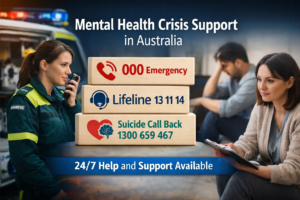
Mental health crisis support in Australia showing emergency services, counselling support and crisis helpline numbers.

Mental Health Crisis Support in Australia: What to Do, Who to Call, and How to Get Immediate Help

Written by: Therapy Near Me Editorial Team Clinically reviewed by: qualified members of the Therapy Near Me clinical team Last updated: 11 March 2026 This article is intended as general information only and does not replace personalised medical or mental health advice. Learn more about our Editorial Policy.Content type: Crisis support guide (Australia) Mental health crises can develop quickly and may involve intense emotional distress, suicidal thoughts, panic, or feeling unable to stay safe. Knowing what to do in those moments — and which services are available — can make a critical difference. This guide explains how to recognise a crisis, when to call emergency services, and how to access Australia’s major crisis support services. The information is based on authoritative Australian health resources and is intended to support people seeking help for themselves or someone else. Emergency warning: If you or someone else is in immediate danger, has attempted suicide, taken an overdose, or cannot be kept safe, call Triple Zero (000) immediately. (Healthdirect Australia) What Is a Mental Health Crisis? A mental health crisis is any situation where a person’s emotional or psychological distress becomes severe enough that they may be at risk of harm or unable to cope safely. According to Healthdirect, crises may include suicidal thoughts, self-harm, extreme anxiety or panic, severe emotional distress, or sudden deterioration in mental wellbeing requiring urgent support. (Healthdirect Australia) Common warning signs may include: Suicide Call Back Service notes that warning signs can appear in behaviour, mood or communication, and they should always be taken seriously. (Suicide Call Back Service) When to Call Emergency Services (000) In Australia, Triple Zero (000) should be called if a situation is immediately life-threatening or someone is at imminent risk. Examples include: Healthdirect and Beyond Blue both emphasise that emergency services should be contacted when someone is in immediate danger. (Healthdirect Australia) (Beyond Blue) If you are unsure whether the situation is serious enough, it is safer to seek emergency help than delay. National Mental Health Crisis Support Services If a situation is urgent but not an immediate emergency, several free Australian crisis support services are available 24 hours a day. Lifeline – 13 11 14 Lifeline provides 24-hour crisis counselling by trained volunteers and professionals. Support is available via: Lifeline supports people experiencing distress, suicidal thoughts, or emotional crisis. (Healthdirect Australia) Suicide Call Back Service – 1300 659 467 Suicide Call Back Service provides free nationwide counselling to: The service operates 24/7 and offers phone and online counselling. (Suicide Call Back Service) Beyond Blue Support Service – 1300 22 4636 Beyond Blue provides support for people experiencing anxiety, depression, or emotional distress. Services include: Beyond Blue advises contacting 000 for emergencies and using their support line when urgent emotional support is needed. (Beyond Blue) What to Do If You Are in Crisis If you are experiencing severe distress or suicidal thoughts, the following steps can help increase immediate safety. 1. Assess Immediate Safety If you feel unable to stay safe or believe you may act on suicidal thoughts, call 000 or go to the nearest emergency department. (Healthdirect Australia) 2. Contact a Crisis Support Service If it is not an immediate emergency, call a crisis service such as Lifeline or Suicide Call Back Service to speak with a trained counsellor. These services are confidential and available 24 hours a day. (Healthdirect Australia) 3. Reduce Isolation If possible, tell a trusted person that you are struggling and ask them to stay with you or remain on the phone. Connection can reduce the intensity of crisis thinking and provide support until professional help is accessed. 4. Increase Immediate Safety If suicidal thoughts are present, practical safety steps may include: Safety-planning approaches promoted by Beyond Blue emphasise identifying warning signs, coping strategies, and emergency contacts in advance. (Beyond Blue) What to Do If You Are Worried About Someone Else If you believe someone may be experiencing a mental health crisis: Suicide Call Back Service specifically supports people who are concerned about a friend, family member, or colleague. (Suicide Call Back Service) Crisis Support vs Ongoing Mental Health Care Crisis helplines provide immediate emotional support and safety assistance, but they are not a replacement for ongoing mental health care. Healthdirect explains that Australia’s mental health system includes GPs, psychologists, psychiatrists, community mental health services and hospital-based care. (Healthdirect Australia) After a crisis, follow-up support may include: Early follow-up support can reduce the risk of future crises. When to Seek Help Even If It Is Not an Emergency You do not need to wait until a crisis becomes life-threatening before asking for help. Healthdirect recommends seeking support if mental health difficulties are significantly affecting daily life, work, relationships, sleep, or ability to cope. (Healthdirect Australia) Examples include: Early intervention often leads to better outcomes than waiting until symptoms escalate. Preparing a Crisis Safety Plan A safety plan is a short, practical guide created during a calm period that outlines what to do during future crises. According to Beyond Blue, effective safety plans often include: Digital tools such as the Beyond Now safety planning app are designed to help people create and access these plans quickly during distress. (Beyond Blue) If You Need Help Right Now If you are experiencing a crisis or feel unsafe: Emergency:Call 000 Crisis counselling:Lifeline — 13 11 14 Suicide support:Suicide Call Back Service — 1300 659 467 Mental health support:Beyond Blue — 1300 22 4636 These services are available across Australia and operate 24 hours a day. Authorship and Editorial Standards Author: TherapyNearMe.com.au Editorial Team This article has been written using authoritative Australian health sources and is intended for educational purposes only. It does not replace professional medical advice, diagnosis or treatment. If you are in immediate danger, contact emergency services. For information on our health content review process, see our Editorial Policy:https://therapynearme.com.au/editorial-policy/ References Beyond Blue 2026, Urgent help, Beyond Blue, viewed 11 March 2026,https://www.beyondblue.org.au/get-support/urgent-help Beyond Blue 2026, Suicide safety planning, Beyond Blue, viewed 11 March 2026,https://www.beyondblue.org.au/mental-health/suicide-prevention/suicide-safety-planning Healthdirect Australia 2026, Mental health crisis support, Healthdirect, viewed 11 March 2026,https://www.healthdirect.gov.au/mental-health-crisis-support Healthdirect Australia 2026, Mental health helplines, Healthdirect, viewed 11 March 2026,https://www.healthdirect.gov.au/mental-health-helplines Healthdirect Australia 2026, Mental health: where

Mental Health Crisis Support in Australia: What to Do, Who to Call, and How to Get Immediate Help Read More »

NDIS Psychology Services Guide

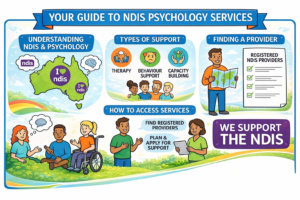
NDIS Psychology in Australia: What It Covers, Which Budget It Comes From, and How to Avoid Payment Problems (2026)

Written by: Therapy Near Me Editorial Team Clinically reviewed by: qualified members of the Therapy Near Me clinical team Last updated: 10/03/2026 This article is intended as general information only and does not replace personalised medical or mental health advice. Learn more about our Editorial Policy. Content type: Educational guide (Australia, NDIS) NDIS funding can make psychology more accessible—but it can also become confusing fast: Which budget pays? Do you need a registered provider? What does a plan manager need on an invoice? What’s the difference between “therapy” and “behaviour support”? This guide is written to answer the questions participants and families actually run into, using primary sources (NDIS and NDIS Commission guidance) and practical steps to reduce avoidable delays. Important (YMYL): This is general information, not medical or legal advice. If you’re in immediate danger call 000. For crisis support call Lifeline 13 11 14 (Healthdirect Australia 2025).  1) What is “NDIS psychology” and what can it be used for? NDIS-funded psychology is typically used where it is reasonable and necessary to build capacity, improve functioning, and work toward NDIS goals (rather than treating a condition in a general health sense). In practice this can include: Most commonly, psychology sits under capacity building supports—particularly Improved Daily Living (see next section). This alignment is widely reflected in provider and participant guidance, but the key is always your plan goals and funded categories (NDIS 2026).  2) Which NDIS budget usually pays for psychology? Many plans fund psychology from Capacity Building – Improved Daily Living, because it is designed for skill development and allied health capacity building (NDIS 2026).  That said, the NDIS is not “one-size-fits-all.” Funding categories can vary based on your plan structure and goals. The safe way to confirm is: Why this matters: the NDIS has pricing rules and price limits that apply to NDIA-managed and plan-managed supports, and these are updated periodically (NDIS 2026).  3) Do you need a registered NDIS provider for psychology? It depends on how your plan is managed: NDIA-managed (Agency-managed) You generally need to use registered providers for supports funded through NDIA-managed budgets, because those payments are made under the NDIA system rules and pricing arrangements (NDIS 2026).  Plan-managed Plan-managed participants can usually access a broader range of providers, but invoices still need to comply with NDIS invoice requirements and pricing rules where relevant (NDIS 2026).  Self-managed Self-management provides the most flexibility in choosing providers, but participants still have responsibilities (record keeping, spending aligned with plan goals). The NDIA has also tightened evidence expectations (e.g., keeping invoices/receipts) and clarified claim evidence requirements (NDIS 2024; NDIS 2026).  4) Service agreements: why they matter (and what should be in them) A service agreement is essentially your contract with a provider. The NDIS explains that when you use your NDIS budget for supports, you’re entering into a contract and a service agreement helps clarify what both sides have agreed to (NDIS 2026).  A strong service agreement reduces disputes and payment friction. It should clearly cover: 5) Invoicing: the fastest way to avoid plan-manager “bounce backs” The NDIA publishes explicit invoicing and record-keeping requirements. Key points include: If you’ve ever had an invoice rejected, it’s usually because one of these basics is missing, or the invoice doesn’t clearly tie to the correct support category / pricing rule. Practical checklist before you send an invoice to a plan manager 6) Psychology vs Behaviour Support: don’t mix them up “Behaviour support” under the NDIS is a specific regulated area—particularly when it involves restrictive practices. The NDIS Quality and Safeguards Commission sets expectations and rules for behaviour support and restrictive practices and emphasises rights-based, evidence-informed positive behaviour support (NDIS Commission 2026).  If you need formal behaviour support plans, ensure the provider and practitioner are operating within the appropriate framework and obligations (NDIS Commission 2026).  This distinction matters for: 7) How to choose a psychology provider that is genuinely safe and credible Participants should look for concrete quality signals, not marketing promises. Green flags Red flags 8) Quick action plan: get started cleanly in 48 hours Authorship, review, and editorial standards Author: TherapyNearMe.com.au Editorial TeamEditorial standards: This article is created and maintained under our quality, sourcing, and clinical governance process. Read our Editorial Policy: https://therapynearme.com.au/editorial-policy/ References Healthdirect Australia 2025, Mental health helplines, Healthdirect, viewed 5 March 2026.  National Disability Insurance Scheme (NDIS) 2024, Information about self-management evidence requirements, NDIS, viewed 5 March 2026.  National Disability Insurance Scheme (NDIS) 2026, Invoicing and record keeping, NDIS, viewed 5 March 2026.  National Disability Insurance Scheme (NDIS) 2026, Making a service agreement, NDIS, viewed 5 March 2026.  National Disability Insurance Scheme (NDIS) 2026, Plan management, NDIS, viewed 5 March 2026.  National Disability Insurance Scheme (NDIS) 2026, Pricing arrangements, NDIS, viewed 5 March 2026.  National Disability Insurance Scheme (NDIS) 2026, Self-management, NDIS, viewed 5 March 2026.  NDIS Quality and Safeguards Commission 2026, Behaviour support and restrictive practices, NDIS Commission, viewed 5 March 2026.  NDIS Quality and Safeguards Commission 2026, Rules for behaviour support and restrictive practices, NDIS Commission, viewed 5 March 2026. 

NDIS Psychology in Australia: What It Covers, Which Budget It Comes From, and How to Avoid Payment Problems (2026) Read More »

Mental Health Care Plan Guide

Mental Health Care Plan in Australia: How Medicare Psychology Rebates Work (2026 Guide)

Written by: Therapy Near Me Editorial Team Clinically reviewed by: qualified members of the Therapy Near Me clinical team Last updated: 2 March 2026 This article is intended as general information only and does not replace personalised medical or mental health advice. Learn more about our Editorial Policy. Content type: Educational resource (Australia) If you’ve been told to “get a Mental Health Care Plan” (now commonly referred to as a Mental Health Treatment Plan) and you’re not sure what it actually covers, you’re not alone. This guide explains, in plain English, how Medicare-subsidised psychology works in Australia in 2026, what you can realistically expect to pay, and the key 2025–2026 rules that can trip people up. Safety note: This article is general information, not medical advice. If you’re in immediate danger or at risk of harm, call 000. For urgent support you can call Lifeline 13 11 14 (Healthdirect, 2025) or Beyond Blue 1300 22 4636 (Beyond Blue, 2026). If you’re feeling suicidal, you can also contact Suicide Call Back Service 1300 659 467 (Suicide Call Back Service, 2026). What is a Mental Health Treatment Plan? A Mental Health Treatment Plan (MHTP) is a plan your GP (or another eligible doctor) prepares after a mental health assessment. It records your goals and outlines recommended supports, including referrals to eligible mental health professionals such as psychologists (Services Australia, 2025).  People often use the older phrase “Mental Health Care Plan”, but the practical point is the same: it’s the gateway to Medicare rebates for certain mental health sessions under the Better Access initiative (Department of Health, Disability and Ageing, 2026).  How many Medicare-subsidised psychology sessions can you get per year? Under Better Access, eligible patients can claim Medicare benefits for up to: Your doctor will usually refer you for up to 6 sessions at a time, then review progress before issuing further sessions (Services Australia, 2025; Australian Psychological Society, 2025).  The 2025–2026 change most people miss: MyMedicare / “usual medical practitioner” From 1 November 2025, the government introduced changes linking Mental Health Treatment Plan preparation, referrals and review to either: In plain terms: if you bounce between random clinics, you may get caught in admin friction. The cleanest pathway is to: Step-by-step: how to get a Mental Health Treatment Plan 1) Book a longer GP appointment Tell reception you want a mental health assessment and may need a treatment plan. Many clinics book a longer consult because the GP needs time to assess and document properly (Services Australia, 2025).  2) Do the assessment and agree on goals Your GP may ask personal questions (mood, sleep, anxiety, functioning, stressors, risk). The plan includes goals, treatment options, and referral arrangements (Services Australia, 2025).  3) Get a referral To claim rebates, you need a valid referral to an eligible practitioner (e.g., psychologist), typically for up to 6 sessions initially (Services Australia, 2025; Australian Psychological Society, 2025).  4) Book your psychology sessions and confirm fees Psychologists set their own fees; Medicare covers a rebate amount, not necessarily the full fee (Services Australia, 2025). Always ask: 5) Review after your initial sessions If you need more sessions, your GP decides whether to refer you for additional sessions within the yearly cap (Services Australia, 2025).  What does Medicare actually pay? Medicare rebates depend on the type of clinician and the relevant Medicare item numbers. The authoritative source is the Medicare Benefits Schedule (MBS) item descriptions (e.g., Better Access-related items) (MBS Online, 2025).  Because rebates and item numbers can change, the safest approach is: Bulk billing vs gap fees: what to expect If your GP or psychologist bulk bills, Medicare covers the full schedule fee and you pay nothing for that appointment. If they don’t bulk bill, you pay either the full fee or the gap between the fee and what Medicare reimburses (Services Australia, 2025).  In practice, many people will have an out-of-pocket gap for psychology. That doesn’t mean you should avoid care—it means you should go in with eyes open and ask for transparent pricing upfront. Telehealth: can your Mental Health Treatment Plan and sessions be done online? Telehealth mental health services remain available, and permanent telehealth settings exist for Better Access in appropriate circumstances (Department of Health, Disability and Ageing, 2026).  However, the MyMedicare/usual medical practitioner requirements also apply to certain GP/PMP telehealth items from 1 Nov 2025 (MBS Online, 2025). That means: if you’re doing your plan by telehealth, it’s even more important that your GP relationship satisfies the eligibility rules. Who is eligible for Better Access? Eligibility is determined by a clinician and generally requires: Common mistakes that delay Medicare rebates Mistake 1: No valid referral (or the referral is outdated) If the referral isn’t valid, rebates can be delayed or refused. Keep a copy and confirm the referral date and session count (Services Australia, 2025).  Mistake 2: Expecting all 10 sessions on one referral Referrals are commonly written for up to 6 sessions, then reviewed (Services Australia, 2025; Australian Psychological Society, 2025).  Mistake 3: Assuming Medicare covers the whole fee Medicare covers a rebate; fees can exceed the schedule amount (Services Australia, 2025).  Mistake 4: Changing GPs constantly From late 2025, plan/referral continuity is more explicitly linked to your MyMedicare practice or usual medical practitioner (MBS Online, 2025).  FAQ Can I use Medicare rebates and private health insurance for the same psychology session? Often you can’t “double dip” for the same service, but rules vary by insurer/product and service type. If you have private health, ask the insurer what is claimable for your specific extras cover (Services Australia, 2025).  Do I need a diagnosis to get a plan? Your GP assesses you and determines whether you meet eligibility criteria for Better Access, which includes being assessed with a clinically diagnosed mental disorder (Department of Health, Disability and Ageing, 2026).  What if I’m rural or remote? Medicare includes telehealth options and there are pathways intended to improve access, including for people who can’t easily attend face-to-face care (Services Australia, 2025).  Practical next step: make the first appointment easier When you book your first psychology appointment, have these ready: If you want support via telehealth, it’s worth stating that upfront so the clinic can match you to

Mental Health Care Plan in Australia: How Medicare Psychology Rebates Work (2026 Guide) Read More »

NDIS Referral Pack

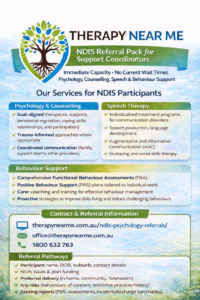
Therapy Near Me – NDIS Referral Pack for Support Coordinators

Therapy Near Me – NDIS Referral Pack for Support Coordinators Immediate capacity | No current wait times | NDIS Psychology, Speech Pathology, Counselling & Positive Behaviour Support Therapy Near Me supports NDIS participants with therapeutic supports, Positive Behaviour Support and Speech Therapy, delivered via telehealth Australia-wide and mobile/in-community sessions where available. We work closely with Support Coordinators, Plan Managers, families and providers to commence services quickly and provide NDIS-aligned documentation and reporting.  How to refer Online referral form (preferred): https://therapynearme.com.au/ndis-psychology-referrals/ Email: office@therapynearme.com.au Reception: 1800 632 763 What we provide for NDIS participants NDIS Psychology & Therapeutic Supports NDIS Behaviour Support (Positive Behaviour Support) NDIS Speech Therapy (Speech Pathology) Current Practitioners with Immediate Availability Psychologists (NDIS therapeutic supports) Dr Ross Leembruggen – Psychologist | Newcastle & Telehealth Alyson Dunn – Psychologist | Gold Coast & Telehealth Nadia Sologuren Guevara – Psychologist | Perth & Telehealth Speech Pathology Shine Yin Teoh – Speech Pathologist | Western Sydney & Telehealth Counselling (NDIS therapeutic supports) Jimmy Nweke – Counsellor & Social Worker | Western Sydney & Telehealth Behaviour Support Practitioners (NDIS Positive Behaviour Support) Mohamed Abdelsalam – Behaviour Analyst | Western Sydney (Parramatta) & Telehealth Victoria Nguyen – Behaviour Support Practitioner | Melbourne & Telehealth Lidija Ivicevich – Behaviour Support Practitioner | NSW South Coast & Telehealth What to include so we can start fast Kind regards, TNM Team

Therapy Near Me – NDIS Referral Pack for Support Coordinators Read More »

How do you measure success in therapy An evidence‑based guide

How do you measure success in therapy? An evidence‑based guide

Written by: Therapy Near Me Editorial Team Clinically reviewed by: qualified members of the Therapy Near Me clinical team Last updated: 31/12/2025 This article is intended as general information only and does not replace personalised medical or mental health advice. Learn more about our Editorial Policy. By TherapyNearMe.com.au. General information only; not a substitute for individual medical or psychological advice. If you are in crisis, call 000. For 24/7 support: Lifeline 13 11 14; Beyond Blue 1300 22 4636. Why this question matters “Feeling better” is important, but therapy succeeds when symptoms fall, function improves, life quality rises, and goals meaningful to the client are reached—with benefits that last and avoid harm. Modern services use measurement‑based care (MBC) and routine outcome monitoring (ROM) to track these dimensions session‑by‑session and to adapt treatment when progress stalls (Fortney et al., 2017; Lambert, 2010; Kazdin, 2007). The five outcome domains Best practice includes one brief instrument for symptoms, one for functioning/well‑being, one alliance/process tool, and a goal measure, reviewed every 2–4 weeks (Fortney et al., 2017; Priebe et al., 2011). Commonly used validated tools (examples) Symptoms Functioning and well‑being Goal attainment Process/alliance Risk/safety (examples) Interpreting change: more than a raw score Combine RCI + CSC for high‑confidence classification: recovered, improved, unchanged, or deteriorated(Jacobson and Truax, 1991; Lambert, 2010). Process matters: the alliance and early response The therapeutic alliance (agreement on goals/tasks and the bond) is consistently linked to outcomes across modalities (Horvath and Symonds, 1991; Flückiger, Del Re, Wampold and Horvath, 2018). Early change over sessions 1–4 predicts end‑of‑treatment results; monitoring enables timely adjustments (Howard, Kopta, Krause and Orlinsky, 1986; Hansen, Lambert and Forman, 2002). Feedback‑informed approaches that use ORS/SRS or OQ‑Analyst to flag “not‑on‑track” cases reduce deterioration and improve outcomes (Lambert, 2010; Anker, Duncan and Sparks, 2009). A practical measurement blueprint for individuals and services What “success” looks like in real life (mini‑case) Client: Adult with low mood, anhedonia and sleep problems affecting work attendance.Measures: PHQ‑9 (symptoms), WHODAS‑12 (function), WEMWBS (well‑being), SRS (alliance), two GAS goals (sleep routine; two social contacts/week).Course: By session 4, PHQ‑9 down 4 points (early response); sleep routine at 4/7 nights; alliance strong. At session 8, RCI met on PHQ‑9; CSC achieved on WEMWBS; GAS goals rated +1 and +2 (better than expected). Work attendance back to baseline; relapse‑prevention plan drafted.Interpretation: Symptom reduction + functional gains + goal attainment + strong alliance + maintenance plan = success under multiple lenses. How many sessions does success take? There is no one‑size number. Dose–response curves show most change early, then a taper; many clients improve by 8–12 sessions, while others need longer courses or stepped care (Howard et al., 1986; Hansen, Lambert and Forman, 2002). Complexity (comorbidity, trauma, social determinants) stretches timelines; measurement guides pacing rather than forcing discharge. Choosing measures wisely (clinically and culturally) Risks and ethical guardrails Quick checklist you can print References Anker, M.G., Duncan, B.L. and Sparks, J.A. (2009) ‘Using client feedback to improve couple therapy outcomes: A randomized clinical trial in a naturalistic setting’, Journal of Consulting and Clinical Psychology, 77(4), pp. 693–704. Bordin, E.S. (1979) ‘The generalizability of the psychoanalytic concept of the working alliance’, Psychotherapy: Theory, Research & Practice, 16(3), pp. 252–260. Evans, C., Connell, J., Barkham, M., Margison, F., McGrath, G., Mellor‑Clark, J. and Audin, K. (2002) ‘Towards a standardised brief outcome measure: psychometric properties and utility of the CORE‑OM’, British Journal of Psychiatry, 180(1), pp. 51–60. Flückiger, C., Del Re, A.C., Wampold, B.E. and Horvath, A.O. (2018) ‘The alliance in adult psychotherapy: A meta‑analytic synthesis’, Psychotherapy, 55(4), pp. 316–340. Fortney, J.C., Unützer, J., Wrenn, G., Pyne, J.M., Smith, G.R., Schoenbaum, M. and Harbin, H.T. (2017) ‘A tipping point for measurement‑based care’, Psychiatric Services, 68(2), pp. 179–188. Hansen, N.B., Lambert, M.J. and Forman, E.M. (2002) ‘The psychotherapy dose‑response effect and its implications for treatment policy’, Clinical Psychology: Science and Practice, 9(3), pp. 329–343. Horvath, A.O. and Symonds, B.D. (1991) ‘Relation between working alliance and outcome in psychotherapy: A meta‑analysis’, Journal of Counseling Psychology, 38(2), pp. 139–149. Howard, K.I., Kopta, S.M., Krause, M.S. and Orlinsky, D.E. (1986) ‘The dose‑effect relationship in psychotherapy’, American Psychologist, 41(2), pp. 159–164. Jacobson, N.S. and Truax, P. (1991) ‘Clinical significance: A statistical approach to defining meaningful change in psychotherapy research’, Journal of Consulting and Clinical Psychology, 59(1), pp. 12–19. Kazdin, A.E. (2007) ‘Evidence‑based treatment and practice: new opportunities to bridge clinical research and practice, enhance the knowledge base, and improve patient care’, American Psychologist, 62(2), pp. 85–100. Kiresuk, T.J. and Sherman, R.E. (1968) ‘Goal Attainment Scaling: A general method for evaluating comprehensive community mental health programs’, Community Mental Health Journal, 4(6), pp. 443–453. Kroenke, K., Spitzer, R.L. and Williams, J.B.W. (2001) ‘The PHQ‑9: Validity of a brief depression severity measure’, Journal of General Internal Medicine, 16(9), pp. 606–613. Lambert, M.J. (2010) Prevention of Treatment Failure: The use of outcome measures to identify and help not‑on‑track patients. Washington, DC: American Psychological Association. Lovibond, S.H. and Lovibond, P.F. (1995) Manual for the Depression Anxiety Stress Scales (DASS). 2nd edn. Sydney: Psychology Foundation. Miller, S.D., Duncan, B.L. and Johnson, L.D. (2000) ‘The Session Rating Scale 3.0: The therapeutic alliance in a brief, consumer‑based format’, Psychotherapy Bulletin, 36(1), pp. 1–4. Miller, S.D., Duncan, B.L., Brown, J., Sparks, J.A. and Claud, D. (2003) ‘The Outcome Rating Scale: A brief measure of therapeutic change in an outpatient setting’, Administration and Policy in Mental Health and Mental Health Services Research, 30(6), pp. 523–541. Priebe, S., McCabe, R., Bullenkamp, J., Hansson, L., Lauber, C., Martinez‑Leal, R., et al. (2011) ‘Patient‑reported outcome data in mental health: Advantages and limitations’, British Journal of Psychiatry, 199(4), pp. 259–261. Spitzer, R.L., Kroenke, K., Williams, J.B.W. and Löwe, B. (2006) ‘A brief measure for assessing generalized anxiety disorder: The GAD‑7’, Archives of Internal Medicine, 166(10), pp. 1092–1097. Tennant, R., Hiller, L., Fishwick, R., Platt, S., Joseph, S., Weich, S., et al. (2007) ‘The Warwick‑Edinburgh Mental Well‑being Scale (WEMWBS): Development and UK validation’, Health and Quality of Life Outcomes, 5, 63. World Health Organization (2010) Measuring Health and Disability: Manual for WHO Disability Assessment Schedule (WHODAS 2.0). Geneva: WHO Press. How to cite this article Therapy Near Me (2025) ‘How do you measure success in therapy? An evidence‑based guide’. Available at: https://therapynearme.com.au

How do you measure success in therapy? An evidence‑based guide Read More »

wpChatIcon

Book An Appointment