Therapy Near Me

Author name: Therapy Near Me Editorial Team

Getting Psychology Government Funding in the US

Written by: Therapy Near Me Editorial Team Clinically reviewed by: qualified members of the Therapy Near Me clinical team Last updated: 02/07/2025 This article is intended as general information only and does not replace personalised medical or mental health advice. Learn more about our Editorial Policy. Securing government funding to access psychological services in the United States can seem daunting. However, a range of public programs and initiatives is in place to improve affordability and accessibility for individuals seeking mental health support (Substance Abuse and Mental Health Services Administration [SAMHSA], 2021). Below, we explore key pathways—including Medicaid, Medicare, and government-sponsored insurance marketplaces—while highlighting strategies to maximise the benefits you are entitled to. Keywords: Government-funded psychology, Mental health coverage, Subsidised therapy, Medicaid mental health, Medicare mental health, Affordable Care Act (ACA), CHIP (Children’s Health Insurance Program) 1. Understanding the Importance of Government Funding The World Health Organization (WHO) estimates that mental health conditions account for a significant portion of the global burden of disease (World Health Organization, 2022). In the US, government-backed programs aim to reduce out-of-pocket costs and ensure that individuals, regardless of socioeconomic status, can access professional support from psychologists and other mental health providers (National Institute of Mental Health [NIMH], 2021). Key benefits of government funding for mental health include: Reduced Financial Barriers: Subsidised or fully covered therapy sessions can lessen the cost burden on individuals (Centers for Medicare & Medicaid Services [CMS], 2020). Greater Access to Services: People in remote or under-served areas can gain access to psychologists through Telehealth services. Focus on Preventive Care: Early intervention and ongoing treatment can be more affordable with government assistance, improving long-term mental health outcomes (SAMHSA, 2021). 2. Medicaid: Support for Low-Income Individuals Medicaid is a state and federal program designed to help low-income Americans access medical services, including mental health care (CMS, 2020). Eligibility criteria differ by state but typically factor in income, family size, and specific needs (e.g., disability status). What Medicaid Covers Diagnostic assessments, therapy sessions, and sometimes medication management. Telehealth psychology services, subject to state regulations. Certain preventive and rehabilitative mental health services, such as community-based care. How to Apply Check State-Specific Requirements: Each state manages its own Medicaid program under federal guidelines, so coverage and eligibility can vary. Application Channels: You may apply via your state’s Medicaid agency website, healthcare.gov, or by phone. Documentation: Applicants typically need to provide proof of income, identity, and residency. 3. Medicare: Coverage for Seniors and Individuals with Disabilities Medicare is a federal health insurance program, primarily serving individuals aged 65 and above, as well as younger people with specific disabilities (CMS, 2019). Mental health coverage under Medicare applies to both inpatient and outpatient services, offering partial reimbursement for treatment from psychologists, psychiatrists, and other licensed professionals. Parts of Medicare That Cover Mental Health Part A (Hospital Insurance): Covers inpatient mental health treatment in hospitals. Part B (Medical Insurance): Assists with costs for outpatient services, including therapy and consultations with mental health professionals. Medicare Advantage (Part C): Offers at least the same coverage as Parts A and B but can include additional benefits, depending on the plan. 4. Affordable Care Act (ACA) and Insurance Marketplaces The Affordable Care Act (ACA) established online marketplaces where individuals and families can shop for subsidised health plans, many of which include mental health coverage (U.S. Department of Health and Human Services [HHS], 2021). Insurance providers on these marketplaces must adhere to mental health parity laws, ensuring psychological services are covered on par with physical health treatments (Mental Health Parity and Addiction Equity Act, 2008). Accessing ACA Benefits Open Enrollment: Typically occurs towards the end of each calendar year, but special enrollment periods may apply after significant life events (e.g., marriage, loss of coverage). Subsidies and Tax Credits: Depending on income, you may qualify for lower premiums or cost-sharing reductions. Essential Health Benefits: Plans must cover key services, including mental health and substance abuse treatment. 5. CHIP: Children’s Health Insurance Program The Children’s Health Insurance Program (CHIP) provides healthcare coverage to children in families who earn too much to qualify for Medicaid but not enough to afford private insurance (CMS, 2020). Many CHIP programs cover behavioural health assessments and therapy sessions tailored to minors. Key Details Eligibility varies by state, with some states integrating CHIP into Medicaid. Coverage includes developmental screenings and mental health support for children and adolescents. Families often pay low or no premiums, depending on their income. 6. Additional Avenues for Government-Funded Mental Health Support Community Health Centres Federally funded centres that offer mental health assessments, counselling, and group therapy. Fees are often sliding-scale, based on household income (SAMHSA, 2021). Veterans Affairs (VA) Veterans enrolled in the VA healthcare system can receive mental health services, including therapy and psychiatric care (U.S. Department of Veterans Affairs, 2021). Grant-Funded Programs Non-profit organisations and universities may run grant-funded counselling programs at reduced or no cost. SAMHSA often provides grants to local communities to develop or expand mental health services. 7. Tips for Navigating the System Understand Your Eligibility: Each program has unique criteria based on factors like age, income, and health conditions. Keep Documents Updated: Proof of income, ID, and state residency are commonly required during enrolment or renewal. Compare Plans: If choosing through the ACA Marketplace, compare mental health benefits, copayments, and provider networks. Ask for Clarifications: Government program rules can be complex. Contact your state’s health department or a licensed insurance broker for guidance. 8. Challenges and Ongoing Developments Despite multiple funding streams, barriers remain: Provider Shortages: Rural or remote areas often have limited numbers of psychologists, affecting timely access. Stigma and Awareness: Some individuals may not seek support due to misconceptions surrounding mental health treatment (NIMH, 2021). Policy Changes: Funding levels and eligibility criteria may shift with legislative changes at both federal and state levels (HHS, 2021). Continuing reforms, telehealth expansion, and an increasing focus on preventative care suggest that access to government-funded psychological services will likely improve in coming years. Understanding available programs, eligibility, and application processes is crucial for

Getting Psychology Government Funding in the US Read More »

Explore the psychological themes in Anora, with expert film analysis on character behavior and mental health dynamics

Psychological Breakdown of Anora: A Film Analysis

Written by: Therapy Near Me Editorial Team Clinically reviewed by: qualified members of the Therapy Near Me clinical team Last updated: 15/07/2025 This article is intended as general information only and does not replace personalised medical or mental health advice. Learn more about our Editorial Policy. Sean Baker’s Anora (2024) is a psychological drama that explores themes of identity, power, autonomy, and self-worth through the lens of its protagonist, Ani, a Brooklyn-based stripper who impulsively marries the son of a Russian oligarch. The film offers a nuanced portrayal of class dynamics, emotional resilience, and societal perceptions of sex work. From a psychological standpoint, Anora raises compelling questions about self-perception, emotional vulnerability, fantasy versus reality, and power imbalances in relationships. This article provides an in-depth psychological analysis of the film, examining Ani’s character development and the broader socio-psychological themes reflected in her journey. Keywords: Anora film psychological analysis, Anora movie character breakdown, Identity crisis in Anora, Power dynamics in Anora film, Emotional resilience in Anora, Class struggle in Anora movie, Anora and self-perception, Fantasy vs. reality in Anora 1. Identity and Self-Perception 1.1 The Role of Stripping in Ani’s Self-Concept Ani’s work as a stripper plays a central role in shaping her self-identity and agency. Psychological research suggests that self-concept is shaped by both internalised self-perception and societal stigma (Goffman 1963). While sex work is often viewed through a victimhood lens, Ani demonstrates agency and control in her work, challenging stereotypes about exploitation. Psychological Perspective: Ani exhibits characteristics of self-determination theory (Deci & Ryan 2008), where individuals seek autonomy, competence, and relatedness. Her profession provides her with a sense of financial autonomy, even as societal judgment attempts to strip her of personal dignity. However, the external stigma surrounding sex work means that Ani’s self-perception is frequently shaped by others’ views, influencing her emotional state and life decisions. 1.2 Class and Identity Conflict Ani’s impulsive marriage to Vanya exposes her to a drastically different social class, forcing her to navigate unfamiliar elite circles where she is perceived as an outsider. Social identity theory (Tajfel & Turner 1979) suggests that people define themselves based on group affiliations, leading to ingroup-outgroup biases. Ani struggles with internalised class inferiority, evident in her moments of self-doubt and hesitation when engaging with Vanya’s family. The dissonance between her working-class background and the world of wealth creates an identity conflict, where Ani must balance self-authenticity with the pressures to assimilate into high society. 2. Power Dynamics and Control in Relationships 2.1 Power Imbalance Between Ani and Vanya Vanya’s privilege and inherited wealth create a fundamental power imbalance in the relationship. While Ani appears to enter the marriage on equal terms, there are underlying socioeconomic and gendered power structures at play. Attachment theory (Hazan & Shaver 1987) suggests that individuals with insecure attachment styles may gravitate toward relationships that offer a sense of security—even if they come with an imbalance of power. Ani’s willingness to commit so quickly suggests a desire for stability, potentially compensating for past instability in her life. However, once Vanya’s family intervenes and attempts to annul the marriage, Ani’s illusion of control shatters, reinforcing the temporary and transactional nature of their relationship. 2.2 The Commodification of Ani Ani’s relationship with Vanya mirrors broader themes of commodification, where personal relationships are influenced by economic disparities. Research on gender and economic dependence (Luthar & Ciciolla 2015) highlights how financial dependence in relationships can lead to diminished autonomy. Ani is initially presented as an equal partner, but as soon as Vanya’s family interferes, it becomes clear that she is seen as disposable—a person to be “removed” rather than respected. This shift forces Ani to confront her worth outside of economic or transactional value, a pivotal moment in her psychological development. 3. Fantasy vs. Reality: The Psychological Toll of Disillusionment 3.1 The Fairy Tale Illusion Ani’s rapid involvement with Vanya represents a modern Cinderella story—a fantasy of escape, love, and upward mobility. However, as the film progresses, this dream collapses under the weight of reality, highlighting the emotional and psychological impact of chasing illusions. Cognitive dissonance theory (Festinger 1957) explains Ani’s internal conflict: she must reconcile the idealised fantasy of her marriage with the harsh reality of its transactional nature. This breakdown leads to psychological distress, including self-doubt, regret, and a profound sense of betrayal. 3.2 The Emotional Toll of Betrayal and Abandonment As Vanya’s family moves to erase Ani from their son’s life, Ani experiences a loss of control over her own narrative, triggering feelings of abandonment and rejection. Trauma research (van der Kolk 2014) indicates that betrayal, especially in intimate relationships, can evoke deep-seated emotional wounds. Ani’s gradual disillusionment mirrors the stages of grief (Kübler-Ross 1969): denial (holding onto hope), anger (fighting back), bargaining (attempting to reclaim agency), depression (internalising loss), and, ultimately, acceptance. 4. Emotional Resilience and Psychological Growth 4.1 Ani’s Coping Mechanisms Despite her setbacks, Ani exhibits remarkable emotional resilience. Rather than succumbing to despair, she rebuilds her sense of self, drawing strength from her own agency rather than external validation. Post-traumatic growth theory (Tedeschi & Calhoun 2004) suggests that adversity can lead to positive psychological transformation, fostering increased self-awareness and emotional strength. Ani’s journey from passive participant to self-advocate marks a critical shift in her psychological development. 4.2 The Final Act: Reclaiming Self-Worth The climax of Anora serves as a cathartic moment of self-liberation, where Ani rejects the labels placed upon her and reclaims control over her future. This transformation aligns with: Maslow’s hierarchy of needs (Maslow 1943): transitioning from basic survival to self-actualisation. Self-efficacy theory (Bandura 1997): Ani develops a belief in her ability to shape her own destiny, rather than relying on external circumstances. Her final choices in the film suggest that true empowerment comes not from external validation, but from self-acceptance and independence. 5. Societal Critique and Psychological Themes 5.1 Stigma and the Double Standards of Sex Work The film critiques societal double standards regarding sex work and female agency. Ani’s treatment by Vanya’s family reflects: Social stigma theory (Goffman

Psychological Breakdown of Anora: A Film Analysis Read More »

Understanding toxic masculinity through psychology—gender norms, emotional repression, and mental health effects

Toxic Masculinity: Psychologist’s Perspective

Written by: Therapy Near Me Editorial Team Clinically reviewed by: qualified members of the Therapy Near Me clinical team Last updated: 13/12/2025 This article is intended as general information only and does not replace personalised medical or mental health advice. Learn more about our Editorial Policy. Toxic masculinity refers to cultural norms, behaviours, and attitudes that encourage men to suppress their emotions, avoid vulnerability, and maintain power or dominance over others (Connell, 1995). While masculinity itself is not inherently problematic, the term “toxic” highlights how certain restrictive or aggressive expressions of manhood can harm both men and the broader community. This article offers an overview of the concept, explores its psychological and social implications, and discusses potential strategies for challenging harmful gender stereotypes. Keywords: Toxic masculinity, Harmful gender norms, Masculine stereotypes, Male emotional suppression, Aggression and dominance, Gender inequality, Men’s mental health, Patriarchal culture 1. Defining Toxic Masculinity “Toxic masculinity” captures the idea that some aspects of traditional masculinity—such as aggression, emotional suppression, and the pursuit of dominance—can be destructive (Kimmel, 2008). It does not imply that all men or all masculine traits are negative. Instead, it points to specific, culturally reinforced patterns of thought and behaviour that lead to harmful outcomes for individuals and society. Key facets of toxic masculinity often include: Emotional Restriction: Men may be discouraged from expressing vulnerability or sadness, which can undermine mental health (Seidler et al., 2016). Aggression and Dominance: In some settings, aggression is celebrated, reinforcing the belief that men should be forceful or “in control” (Connell, 1995). Homophobia and Transphobia: Certain masculine norms define “real men” narrowly, marginalising those who do not conform (Edwards & Jones, 2009). Disregard for Women: Toxic masculinity can fuel sexism and misogyny, affecting women’s safety and opportunities. 2. Psychological and Social Implications Research shows that strict gender norms can negatively affect men’s mental health and contribute to a range of social problems (American Psychological Association, 2018). Below are some of the recognised implications: Mental Health Challenges Men who internalise beliefs that they must remain stoic or unemotional may experience difficulties expressing or regulating emotions (Seidler et al., 2016). Studies have linked avoidance of emotional vulnerability to increased depression, anxiety, and stress (Rice et al., 2020). High Rates of Risk-Taking Certain masculine ideals encourage risk-taking behaviours—such as dangerous driving, heavy alcohol consumption, or drug use—as ways to display “toughness” (Courtenay, 2000). This can lead to adverse health outcomes and, in some cases, legal or financial difficulties. Violence and Aggression Toxic masculinity often romanticises aggression, leading to higher incidences of violence, including domestic violence and sexual assault (Flood & Pease, 2009). By normalising hostility, these norms can perpetuate cycles of harm across communities. Strained Relationships Difficulty in communicating emotions can limit men’s capacity to form close connections, sometimes resulting in loneliness, social isolation, or relationship breakdown (Seidler et al., 2016). Emotional unavailability can also cause stress in romantic, familial, or workplace interactions. Impact on Others Women and children frequently bear the brunt of toxic masculine behaviours through acts of control, intimidation, or violence (Flood & Pease, 2009). These dynamics reinforce harmful stereotypes and foster environments where inequality and discrimination flourish. 3. Toxic Masculinity in the Australian Context Although toxic masculinity is a global issue, it has particular resonance in Australia. Historically, the “Aussie bloke” stereotype has celebrated toughness, emotional stoicism, and physical prowess (Pease, 2010). While these traits can sometimes be markers of resilience or pride in hard work, they can also feed into restrictive ideas about what it means to be a “real man.” Cultural Narratives: The emphasis on rugged individualism and self-reliance in Australia can contribute to a stigma around seeking help for mental health challenges. Sporting Culture: While sport can foster camaraderie and community, it may also pressure men to prioritise displays of strength and aggression, undermining healthy emotional expression (Light & Kirk, 2000). 4. Challenging Harmful Norms Recognising and challenging toxic masculinity involves both individual and collective efforts. Key strategies include: Encouraging Emotional Expression Family members, schools, and workplaces can model positive communication and emotional openness. Normalising help-seeking behaviours—for instance, speaking to a counsellor—can reduce stigma and increase psychological wellbeing (Seidler et al., 2016). Education and Awareness Public awareness campaigns and school programs can highlight the negative effects of rigid gender norms (Flood & Pease, 2009). Educational initiatives that promote empathy, mutual respect, and healthy conflict resolution can contribute to cultural shifts. Positive Role Modelling Celebrities, community leaders, and everyday people who challenge stereotypes can inspire broader acceptance of more flexible forms of masculinity. Demonstrating kindness, vulnerability, and collaboration can help redefine what “strength” looks like. Supportive Community and Mental Health Services Access to mental health resources, such as psychology services—whether in-person or via telehealth—allows men to safely explore their emotions. Group programs or support groups tailored to men can create spaces for shared experiences and mutual encouragement. Policy and Structural Change Workplace policies that promote work-life balance and prioritise employee wellbeing can reduce pressure on men to conform to hyper-masculine standards. Advocacy for survivors of violence and sexual assault, paired with clear legal ramifications for perpetrators, helps address broader cultural issues of aggression and entitlement. 5. Moving Towards Healthier Masculinities The antidote to toxic masculinity does not lie in discarding masculinity itself, but rather in embracing healthier, more inclusive expressions of manhood. By fostering emotional literacy, encouraging respect for others, and dismantling oppressive structures, we can create social environments that support positive mental health, equitable relationships, and community safety (Connell, 1995; American Psychological Association, 2018). Key themes in healthy masculinity include: Self-awareness and emotional intelligence Non-violent communication and empathy Equitable relationships that value mutual respect Rejection of prejudice, bigotry, and harassment Recognition that strength can manifest through kindness, collaboration, and integrity Conclusion Toxic masculinity is a complex cultural construct with profound implications for men’s mental health and societal wellbeing. By unpicking harmful gender stereotypes, embracing emotional openness, and advocating for respectful relationships, individuals and communities can challenge these toxic norms. The journey towards healthier forms of masculinity demands concerted effort—through education, policy change,

Toxic Masculinity: Psychologist’s Perspective Read More »

Are people high on meth psychopaths? Explore the psychological effects of meth use, cognitive impairment, and behavioral changes

Are People High on Meth Psychopaths? A Psychological Analysis

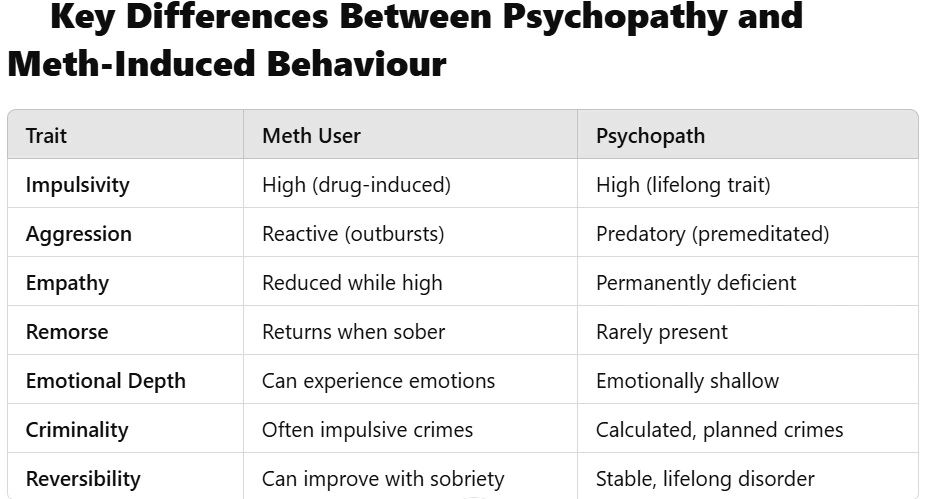
Written by: Therapy Near Me Editorial Team Clinically reviewed by: qualified members of the Therapy Near Me clinical team Last updated: 12/09/2025 This article is intended as general information only and does not replace personalised medical or mental health advice. Learn more about our Editorial Policy. Methamphetamine (meth) is a potent psychostimulant known for its intense effects on the brain, behaviour, and cognition. Users often exhibit aggression, impulsivity, and emotional detachment, which raises the question: Do people high on meth display psychopathic traits, and does meth use increase the risk of psychopathy? While methamphetamine can induce behaviours resembling psychopathy, such as lack of empathy, impulsivity, and aggression, this does not necessarily mean meth users meet the clinical criteria for psychopathy, as defined by Hare’s Psychopathy Checklist-Revised (PCL-R) (Hare 2003). Instead, meth influences the dopaminergic and serotonergic systems in ways that can mimic psychopathic traits but do not cause true, long-term psychopathy (Volkow et al. 2010). This article examines the relationship between methamphetamine use and psychopathy, drawing from psychological, neurobiological, and criminological perspectives. Keywords: Methamphetamine and psychopathy, Effects of meth on empathy, Meth-induced aggression, Psychopathy vs. addiction, Criminal behaviour in meth users 1. What is Psychopathy? 1.1 Clinical Definition Psychopathy is a personality disorder characterised by callousness, lack of empathy, impulsivity, and manipulativeness (Hare 2003). It is primarily assessed using the PCL-R, which categorises psychopathy into two broad factors: Factor 1 (Interpersonal-Affective Traits): Lack of empathy, superficial charm, manipulativeness. Factor 2 (Behavioural-Antisocial Traits): Impulsivity, irresponsibility, and aggression. Psychopathy is neurodevelopmental, meaning it emerges early in life and remains relatively stable over time (Blair et al. 2005). 1.2 Psychopathy vs. Antisocial Personality Disorder (ASPD) Although psychopathy and ASPD share similarities, ASPD is more common and focuses on chronic rule-breaking and impulsivity (APA 2022). Most criminals with ASPD are not true psychopaths, as psychopathy is rarer (~1% of the population) and involves emotional deficits beyond antisocial behaviour (Hare 2003). Key distinction: Psychopaths lack emotional depth (affective coldness). Meth users may exhibit impulsivity and aggression but still experience emotions, including remorse when sober (Volkow et al. 2010). 2. Methamphetamine’s Effects on the Brain 2.1 Dopamine and Reward Pathways Meth floods the brain with dopamine, increasing levels 1,000% higher than normal (Volkow et al. 2010). Chronic meth use damages dopamine receptors, leading to: Increased impulsivity Weakened emotional regulation Higher aggression and recklessness Psychological impact: Meth’s effect on the prefrontal cortex and limbic system impairs decision-making and impulse control, which are also impaired in psychopathy (Koob & Volkow 2016). 2.2 Emotional Blunting and Empathy Reduction Meth users often display emotional detachment, similar to psychopathic affective deficits. Chronic use reduces oxytocin levels, a hormone linked to social bonding and empathy (McGregor et al. 2008). However, these changes are drug-induced and reversible, unlike the lifelong emotional deficits seen in psychopathy (Koob & Volkow 2016). 3. Do Meth Users Exhibit Psychopathic Traits? 3.1 Impulsivity and Risk-Taking Meth users score high on impulsivity, resembling Factor 2 psychopathy (behavioural-disinhibition) (Potvin et al. 2018). However, impulsivity in meth users is substance-induced, whereas psychopaths exhibit impulsivity even when sober (Hare 2003). 3.2 Aggression and Violence Meth increases aggressive outbursts, sometimes leading to violent crimes (Glenn & Raine 2014). Psychopaths also show aggression, but their violence is premeditated and instrumental, unlike the reactive aggression seen in meth users (Blair et al. 2005). 3.3 Lack of Empathy Meth use temporarily reduces empathy and remorse, mirroring psychopathic affective deficits (Volkow et al. 2010). However, once sober, many users experience deep regret, showing they still possess moral emotions (Potvin et al. 2018). 4. Meth, Crime, and Psychopathy: Overlapping but Not Identical 4.1 Meth Use and Criminal Behaviour Meth use is linked to higher criminality, including theft, assault, and domestic violence (Glenn & Raine 2014). However, most meth-related crimes are impulsive, whereas psychopaths engage in planned, calculated crimes (Hare 2003). 4.2 Are Meth Users Overrepresented in Prison Psychopathy Assessments? Studies show that meth-using inmates score higher on PCL-R assessments than non-users (Salo et al. 2013). However, once meth is removed from their system, their psychopathic traits often decline, suggesting a drug-induced effect rather than true psychopathy. 5. Long-Term Effects: Can Methamphetamine Cause Psychopathy? 5.1 Neurotoxicity and Permanent Changes Chronic meth use shrinks the prefrontal cortex, leading to long-term impulse control issues (Volkow et al. 2010). Severe cases may resemble acquired psychopathy, where brain damage causes emotional blunting and aggression (Koob & Volkow 2016). 5.2 Recovery and Reversibility Some meth users recover cognitive and emotional function after prolonged abstinence (McGregor et al. 2008). This suggests meth-induced psychopathy-like traits are reversible, unlike true psychopathy, which is permanent (Hare 2003). Conclusion: Are Meth Users Psychopaths? No, meth users are not inherently psychopaths, but meth can induce psychopathic-like traits, including impulsivity, aggression, and emotional detachment. Key Takeaways: Methamphetamine alters brain chemistry, leading to temporary emotional blunting and increased risk-taking. Meth users exhibit behaviours that resemble psychopathy, but these effects are largely drug-induced and reversible. True psychopathy is a stable, lifelong personality disorder, whereas meth-induced changes can improve with treatment and abstinence. Not all meth users engage in violent crime, and many express remorse once sober, unlike clinical psychopaths. Understanding the neurological and psychological impact of methamphetamine use can help distinguish between addiction-driven behaviour and psychopathy, aiding effective treatment and criminal justice interventions. References American Psychiatric Association (APA) 2022, Diagnostic and Statistical Manual of Mental Disorders (DSM-5-TR), 5th edn, APA, Washington, DC. Blair, R.J., Mitchell, D.G. & Blair, K.S. 2005, The Psychopath: Emotion and the Brain, Blackwell, Oxford. Hare, R.D. 2003, Without Conscience: The Disturbing World of the Psychopaths Among Us, Guilford Press, New York. Koob, G.F. & Volkow, N.D. 2016, ‘Neurobiology of Addiction: A Neurocircuitry Analysis’, The Lancet Psychiatry, vol. 3, no. 8, pp. 760–773. Volkow, N.D., Chang, L. & Wang, G.J. 2010, ‘Loss of Dopamine Transporters in Methamphetamine Abusers’, The Journal of Neuroscience, vol. 20, no. 2, pp. 1–6 Enjoyed Our Free Daily Mental Health Articles? If you find value in our insights and resources, we’d love to hear from you! Please consider visiting our Google Business Profile nearest to

Are People High on Meth Psychopaths? A Psychological Analysis Read More »

wpChatIcon

Book An Appointment