
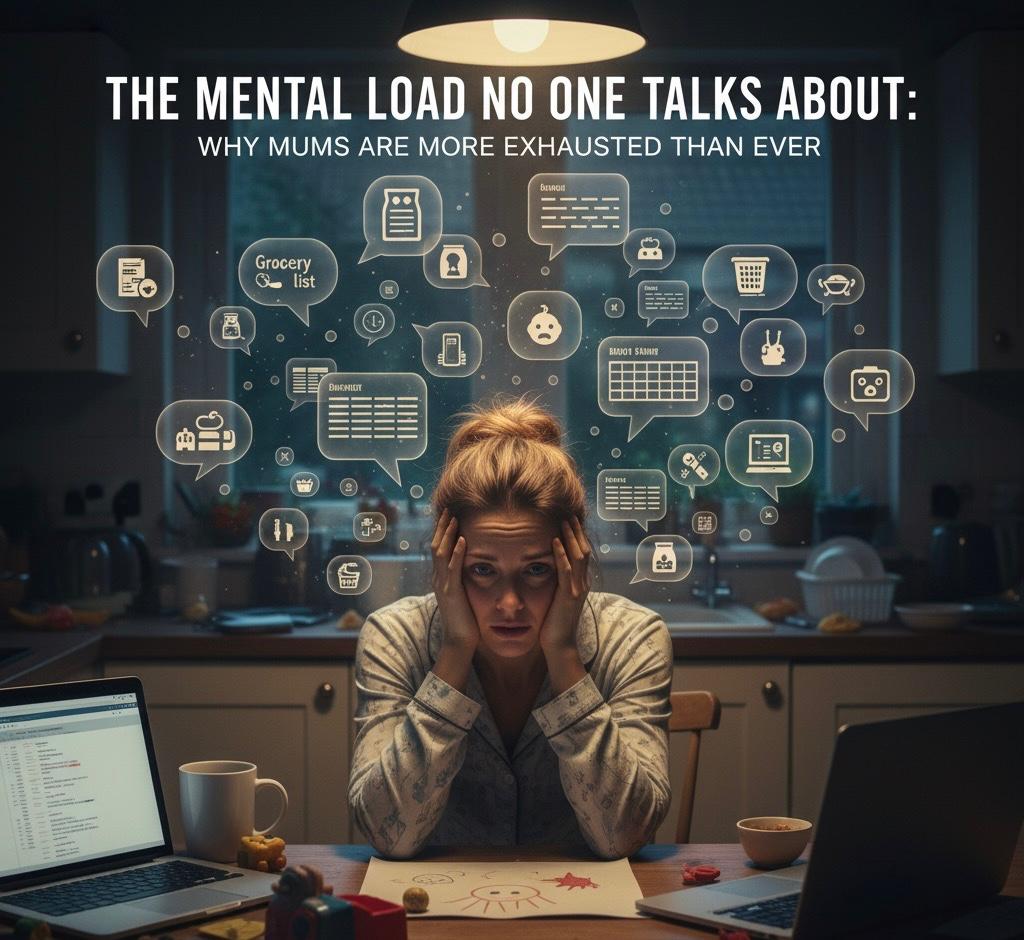
The Mental Load No One Talks About: Why Mums Are More Exhausted Than Ever
Written by: Therapy Near Me Editorial Team Clinically reviewed by: qualified members of the Therapy Near Me clinical team Last updated: 24/10/2025 This article is intended as general information only and does not replace personalised medical or mental health advice. Learn more about our Editorial Policy. Many families divide tasks fairly on paper, yet mothers often report feeling permanently “on call”—the default parent, manager, and emotional hub of the household. This invisible strain is the mental load: the ongoing, largely unseen work of remembering, anticipating, coordinating, and worrying so that life runs smoothly (Daminger, 2019). In 2025, digital life, cost‑of‑living pressures, and blurring work–home boundaries have amplified that load, leaving mums more exhausted than ever. This article examines the mental load through an evidence‑based lens, synthesising findings from time‑use research, cognitive psychology, maternal mental health, and labour economics. We offer practical strategies for partners, employers, and policymakers to redistribute invisible work, support maternal wellbeing, and build healthier, more equitable homes. 1) What is the mental load? The mental load—also called cognitive labour—includes four recurring processes (Daminger, 2019): Unlike household chores, cognitive labour is continuous, difficult to outsource, and socially expected of mothers (Craig & Brown, 2017). It consumes working memory and produces decision fatigue, both of which erode mood and performance (Baumeister et al., 2008). 2) Why the mental load disproportionately falls on mums Cultural scripts and default parenthood Sociological studies show mothers are still treated as the default parent—the first point of contact for schools, healthcare, and extended family—even when both parents work full‑time (Hochschild & Machung, 2012). Social expectations position mothers as responsible for kin‑keeping (birthdays, playdates, thank‑yous) and emotional labour(soothing, managing conflict) (Erickson, 2005). Time‑use evidence Australian and international time‑use surveys find that mothers perform more unpaid care and mental coordinationthan fathers, including at night and on weekends (Craig & Brown, 2017; Bianchi et al., 2012). Even where fathers increase hands‑on care, mothers retain project management and quality control roles (Daminger, 2019). Sleep and off‑hours responsibility New mothers lose hundreds of hours of sleep in the first year (Mindell & Lee, 2015). Night waking, infant feeding, and anticipatory anxiety contribute to fragmented sleep, predicting higher depressive symptoms and daytime fatigue (Okun, 2016). The digital amplifier School portals, WhatsApp groups, e‑forms, online medical bookings, and perpetual notifications shift administrative work from institutions to parents—usually mothers. This platform‑mediated parenting increases context switching and attentional residue (Leroy, 2009), intensifying cognitive strain. 3) Health consequences: why the load feels like burnout Cognitive and emotional costs Chronic invisible work is linked to stress, irritability, sleep problems, and depressive symptoms (Spinola et al., 2020). Continuous monitoring elevates cortisol and keeps the sympathetic nervous system on alert, undermining recovery (Brosschot et al., 2005). Maternal mental health Globally, 1 in 7 to 1 in 5 women experience perinatal depression or anxiety (Woody et al., 2017). Perceived inequity at home predicts lower relationship satisfaction and higher depressive symptoms (Ruppanner et al., 2019). The mental load also correlates with parental burnout—emotional exhaustion specific to the parenting role (Mikolajczak et al., 2019). Physical health spillovers Decision fatigue and time scarcity reduce exercise, sleep opportunity, and nutritious meal planning, while increasing stress eating and musculoskeletal pain from multitasking (Schieman et al., 2018). 4) Intersectional realities The mental load is not experienced equally. Single mothers, migrant mums, mothers of children with disabilities, and low‑income families face higher administrative complexity (service forms, funding plans, multiple appointments) with fewer buffers (childcare flexibility, paid leave) (Carney et al., 2021). Neurodivergent mothers (e.g., ADHD, autism) may experience greater executive‑function demands and sensory overload, intensifying exhaustion (Sibley et al., 2021). 5) Workplaces and the “second shift” in 2025 Hybrid work often shifts, not shares, domestic coordination to mothers who are at home more and thus “available” (Ruppanner et al., 2021). Back‑to‑back video calls combined with school logistics, deliveries, and medical admin create role spillover and context collapse—strong predictors of burnout (Edmondson & Lei, 2014). Yet organisations can mitigate this with flexible scheduling, predictable time off, and manager training to normalise caregiving (Deloitte, 2020). Access to EAP, parental coaching, and return‑to‑work planning reduce attrition among mothers in the mid‑career “leaky pipeline.” 6) Myths that keep the load stuck 7) Evidence‑based strategies to lighten the load at home A. Make the invisible visible B. Transfer ownership, not tasks C. Reduce decision fatigue D. Protect sleep E. Build community buffers 8) What employers can do 9) Policy levers that reduce the load 10) A compassionate reframing Mother‑led invisible work is not a personality trait; it is a system outcome produced by norms, institutions, and technology design. Naming the mental load allows families and employers to move from exhaustion and resentmentto design and partnership. The aim is not perfect 50/50 symmetry every day but a fair system where cognitive labour, recovery time, and decision power are shared. Conclusion Mums are more exhausted than ever because the modern household runs on cognitive labour that is continuous, undervalued, and disproportionately assigned to mothers. The costs are real: sleep loss, burnout, depressive symptoms, and stalled careers. The solutions are also real: make the invisible visible, transfer full ownership of planning, protect sleep, design employer flexibility, and use policy levers that recognise caregiving as economic infrastructure. With intentional redistribution and supportive systems, families can replace silent overload with shared leadership and sustainable wellbeing. References
The Mental Load No One Talks About: Why Mums Are More Exhausted Than Ever Read More »